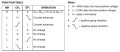
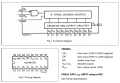
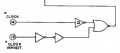
CD4017BD (datasheet for CD4017BCN) am I reading this right?

Thread Starter

Tonyr1084

Joined Sep 24, 2015
9,744
@GopherT LOVE IT! Only, it doesn't make enough noise.

Mine also winds marbles up to the top using an Archimedes screw.

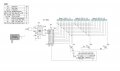
Anyway, everybody: Here's where I'm at with my design. Does anyone see any problems? Concerns? Suggestions? I have yet to commit this to solder, so there's still time.

30 Step Chase Lights.png
 

GopherT

Joined Nov 23, 2012
8,009
Switch R7 and VR1

With your current setup, you’ll get a very short duty cycle of the LEd flash. With the fixed 1k resistor between pin 7 and Vcc, you’ll get closer to a square wave for all potentiometer values.

Also, put a fixed 1k resistor in series with the fixed section of the pot to make sure the thing keeps flashing.

Also, you could add a switch that allows the user to select slow flashes vs faster flash range (switch between 22 and 2.2 uF capacitor (c1)).
 

Thread Starter

Tonyr1084

Joined Sep 24, 2015
9,744
Switch R7 and VR1
Yeah, I noticed that. I may just do that.

put a fixed 1k resistor in series with the fixed section of the po
My test bench model seems to work well enough. At current configuration I can get a very slow pulse to an imperceivable flash rate. When divided out by 30 LED's I'm sure you'll still be able to see a trace, but if turned up (down) all the way, the pulse rate will be very slow. Approaching 2 pulses per second. But hey! the breadboard model - it's easy enough to try.

The discharge rate is on the order of 4.6 milli-seconds, and at the fastest rate it's rise time is 6.4 milli-seconds.

{edited} Changed "microseconds" to "milli-seconds"
 
Last edited:

Audioguru

Joined Dec 20, 2007
11,248
Pin 13 on a 74HC4017 and on a CD4017 is the "clock enable" pin that you are feeding clock pulses. But pin 14 is the "clock" pin that is normally used. I have never tried it but I guess your way of clocking it works OK.
 

Thread Starter

Tonyr1084

Joined Sep 24, 2015
9,744
From what I gathered (correctly or incorrectly) with pin 14 held low a clock signal on pin 13, the positive going edge is counted. Whereas, if 13 is held low and the clock pulse is fed to pin 14, the count is on the negative going edge. I think.
 

Thread Starter

Tonyr1084

Joined Sep 24, 2015
9,744
A LITTLE HELP PLEASE?

I've got the darn thing built but it's not counting. It's definitely oscillating but it's not oscillating. Output #0 is not on (verified with the o-scope). Have checked all connections. Pins 14 & 15 on U1 are grounded. When on the breadboard it worked. Not working now that it's committed to solder. I HATE THAT! Been looking it over for days and still haven't seen any sign of anything wrong. Here's the final version of what's been built. Remember, this worked on the breadboard, so it's a sound circuit. Just can't figure out why it's not working.

Tried it with two power supplies: One wall wart who's voltage was 6.1 volts DC and used the modified PC Power Supply (5.1 volts). Only once did I get output #5 to light up. It was lit but wouldn't toggle. Just can't figure out why not.

I'm taking a break from all this. Maybe a clear mind will yield better thinking. Maybe lunch is in order here.
 

Bernard

Joined Aug 7, 2008
5,784
What circuit are you using ? 4017, pin 13 lo, pin 14 goes hi = count; pin 14 hi, pin 13 goes lo = count , from function table
 

Thread Starter

Tonyr1084

Joined Sep 24, 2015
9,744
What circuit are you using ?
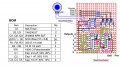
I'm using the 74HC4017 chip. And you're right, I'm holding pin 14 low. Dumb dumb dumb! Thanks for spotting that obvious error. Did I not post my latest schematic? Well, here it is:

[edit] Oh, I guess my BOM should indicate the 555 is the NE555P chip.

30 Step Chase Lights.jpg
30 LED PCB Map.jpg
 
Last edited:

Thread Starter

Tonyr1084

Joined Sep 24, 2015
9,744
CIRCUIT PERFORMANCE: Odd thing is that with the counters NOT counting, I'm still not getting an output. In theory, with no clock pulse, at power-up, output 0 should be high. It's not.
 

Thread Starter

Tonyr1084

Joined Sep 24, 2015
9,744
The Q1, Q2, Q3 should be reverse the polarity first and all c of bjt connected to Vcc.
Thank you. But no. The purpose of the Q's is to provide path to ground when energized. Each Q is on when it's associated output from U3 is on. So the Q's only provide ground to one of three segments of 10.

Notice there are three stages of LED's. LED's 1, 11 & 21 are common anode with the cathodes each controlled by the transistors. Only one transistor should be active at any time, meaning only LED 1 or LED 11 or LED 21 will light, but never all three of them. It worked on my breadboard. Still can't figure out what I did wrong, but obviously something is. As the count progresses through all 10 outputs (0 - 9), at the carry out (clock pulse) the second counter advances one position (output 0 to 1) turning off Q1 and turning on Q2. 10 more pulses and Q2 shuts off and Q3 turns on. Each time a transistor turns on it provides a ground path, so I'm not using them to power the LED's I'm using them to ground them in three segments. It's possible to have this same circuit (with some additional transistors) to have this count up to 100 LED's. Add a third counter and you could count up to 1000 LED's. Don't know why anyone would want to do that - but - - - .

[edit] oh, and ignore the second BOM, it wasn't updated.
 

dl324

Joined Mar 30, 2015
18,360
In theory, with no clock pulse, at power-up, output 0 should be high. It's not.
Are any of the other outputs HIGH?

You're assuming that the counter powers up in the reset condition. A more conservative design would include a power on reset circuit to initialize the circuit if initial state was important.
 

Thread Starter

Tonyr1084

Joined Sep 24, 2015
9,744
Are any of the other outputs HIGH?

You're assuming that the counter powers up in the reset condition. A more conservative design would include a power on reset circuit to initialize the circuit if initial state was important.
I'll have to retest. But for what I'm seeing, nothing is lighting up. My general assumption is that none are high. But to be certain (not to make an assume) I'll check them. From memory I don't think I found any of them high when I probed them with the scope.
 

dl324

Joined Mar 30, 2015
18,360
I'll have to retest. But for what I'm seeing, nothing is lighting up. My general assumption is that none are high. But to be certain (not to make an assume) I'll check them. From memory I don't think I found any of them high when I probed them with the scope.
Save yourself some time by not assuming anything. You have the circuit in front of you and know that one output from each 4017 should be HIGH. Probe the outputs of each 4017 until you find which output is HIGH. Then try to understand how the counter got in that state.

If you use only the LEDs for troubleshooting, you would see one on only if the count on U3 was 0-2. If, for some reason, that counter didn't initialize to 0-3, you wouldn't see an LED turn on until it cycled through it's full count.
 

Thread Starter

Tonyr1084

Joined Sep 24, 2015
9,744
Save yourself some time by not assuming anything. You have the circuit in front of you and know that one output from each 4017 should be HIGH. Probe the outputs of each 4017 until you find which output is HIGH. Then try to understand how the counter got in that state.
Excellent point. I will check U3. Up to now I've only been checking U2. U1 is giving me a nice square wave output of almost six volts. I'm hoping that the counters will work if the input voltage is just slightly exceeded. If I recall, the Vcc range was from 4 to 6 volts. My supply unloaded is putting out 6.1 volts. Maybe THAT is the whole problem. That and that I have pins 14 (U2 & 3) held low when they should be held high. If the counters were allowed to run they should reset themselves into the stable state I want.

I'll be back.
 

dl324

Joined Mar 30, 2015
18,360
Did I not post my latest schematic?
What is the purpose of R8?

It has been pointed out earlier that the minimum TTL output voltage levels don't satisfy the minimum CMOS input voltage level requirements. If you get typical parts, things will probably work as expected; that may not be the case with outliers.
 
Top