Power vs Temperature Mosfet datasheet

Thread Starter

andrew74

Joined Jul 25, 2022
204
I am looking at the datasheet for this power MOSFET:
https://www.vishay.com/docs/78251/sir510dp.pdf

In the table, I can see the power dissipation as a function of ambient temperature:

1771422922164.png

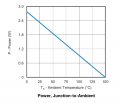
However, at the bottom of the graph, the values are different; there are no 6W values, nor are they reached on the vertical axis:
1771422827328.png
Am I doing something wrong?


This does not happen in the case of Tc!
You will see that the values in the table (104W and 66.6W) correspond to those in the "Power, Junction-to-Case" graph.

Thanks
 

ronsimpson

Joined Oct 7, 2019
4,645
There are notes in the data sheet.
Notes:
a. Package limited
b. Surface mounted on 1" x 1" FR4 board
c. t = 10 s
d. See solder profile (www.vishay.com/doc?73257). The PowerPAK SO-8 is a leadless package. The end of the lead terminal is exposed copper (not plated) as a result of the singulation process in manufacturing. A solder fillet at the exposed copper tip cannot be guaranteed and is not required to ensure adequate bottom side solder interconnection
e. Rework conditions: manual soldering with a soldering iron is not recommended for leadless components f. Maximum under steady state conditions is 54 °C/W
I think 2.3W at room temp is for a small PCB with just the footprint in copper. No heat sink, no VIAs, no large copper fill. Often there is the PCB picture for the temperature tests.
The 100Watts is probably on a massive Aluminum PCB with air flow.
I would look at different manufactures data sheet using the same package. (there are many)
Somewhere I have seen power dissipation verses different types of PCB and copper.
There is lots if information on how to get the heat out of surface mount parts. Use thick copper, large pieces of copper. Use VIAs to get the heat to the other side of the board.
---edited---
Using the old through hole transistors, there is a "watts rating" using an infinite heatsink. Think of a heatsink, bigger than a house, that is held at 25C. This is not a real-world thing.
 

Thread Starter

andrew74

Joined Jul 25, 2022
204
There are notes in the data sheet.

I think 2.3W at room temp is for a small PCB with just the footprint in copper. No heat sink, no VIAs, no large copper fill. Often there is the PCB picture for the temperature tests.
The 100Watts is probably on a massive Aluminum PCB with air flow.
I would look at different manufactures data sheet using the same package. (there are many)
Somewhere I have seen power dissipation verses different types of PCB and copper.
There is lots if information on how to get the heat out of surface mount parts. Use thick copper, large pieces of copper. Use VIAs to get the heat to the other side of the board.
---edited---
Using the old through hole transistors, there is a "watts rating" using an infinite heatsink. Think of a heatsink, bigger than a house, that is held at 25C. This is not a real-world thing.
Thank you for your reply.

If I need to compare two MOSFETs from a dissipation point of view, I usually just compare Tja, Rja and Rjc. Right?

You suggest to check different manufactures datasheet using the same package, so PowerPAK® SO-8.
Suppose I find a transistor with the same package (but with characteristics that are certainly different), what should I check?
I don't quite understand what you mean.
 

Irving

Joined Jan 30, 2016
4,996
The 6W value is based on a single 10sec pulse. My guess is that the graph is steady state conditions.

@ronsimpson is right; the 104W figure is based a case temperature of 25C and a junction temperature of 150C which represents a theoretical infinite heatsink to an ambient of 25C. Its a figure of merit following a JEDEC standard for comparing different devices, but isn't useful otherwise (like the manufacturer's mpg figure for a car). The 66.6W figure at a case temperature of 70C is not much more useful, as it requires a heatsink of better than 0.67C/W to ambient of 25C which is very hard to achieve with an SMD part.

Its very unlikely you'll find much variation between manufacturers. The thermal performance of the package is pretty consistent.

What is your application & required operating conditions?
 

ronsimpson

Joined Oct 7, 2019
4,645
I don't quite understand what you mean.
From a different source. Different part. Same package.
0.9W Device mounted on FR-4 PC board, with minimum recommended pad layout, single sided.
1.9W . Device mounted on FR-4 substrate PC board, 2oz copper, with thermal bias to bottom layer 1-inch square copper plate.
A different company will have a different way of saying the same thing. I thought that data sheet was short on information.
Back in school (dark ages) if I did not understand a chapter I went and found a different book for the same course.
 
Top