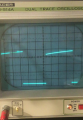
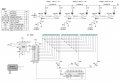
Screenshot from video:
I assume vertical is 1V/div. The slope on the top edge is curious, but it's not the problem because it's the rising/falling edge that's triggering the 4017.
If you're referring to the timing cap, that can't be the problem. The comparators toggle a flip flop.
A bad timing cap would affect timing, but wouldn't affect the output voltage levels. It might be edifying to monitor the power supply voltage when the timer is running.
No, not referring to C1. Was wondering if maybe C3, C4 or C5 could be bad. I DID have a good square wave before messing with U2 & 3 pins 14, where the caps are grounded (most convenient and closest location to those caps). After messing with it I'm getting the strange waveform.
Actually, the output on pin 3 and the main power line both look identical. I haven't set up the second trace but I doubt one is higher when the other is lower. To me what it looks like is a possible short, and the resistor is acting like a voltage divider. MAYBE. IDK. I'll be tinkering with this later on tonight. Maybe in a few hours from now, after the sun sets and it's getting cold out again. The warm weather (relatively speaking) is good for building the machine the lights are supposed to go on. If I can't get these lights working I still want to give the machine to the kids to play with.
The main supply voltage should not have a signal on it because it should be a very low impedance with a pretty big capacitance to ground.
Then what happens is the output of the 555 causes its 400mA surge which causes the supply voltage to quickly drop then slowly come back up producing the slanted squarewave waveform.
Since R8 measures 1k ohms then the 74HC4017 must be bad with its clock or clock enable pin with about 100 ohms to the supply voltage.
And it works… BUT ! ! ! It's starting at output #4. So it's looking like I need to change (at least) U3 to pin 13 held low and pin 14 getting the carry out signal. We're getting there folks. But it was nice to see my LED's do their thing. Of course I COULD just wire it up starting with output #4 (the fifth output). Nah! Why not do it right?!
Honestly I don't care where it starts. As long as it sequences back to the base and climbs up the ladder then runs along the rain gutter (so to say). I'll post some pics of the marble machine when I have it a bit more substantially done.
Digikey does not sell a ULN2981 but its datasheet shows that it has an output voltage high that is 1.8V less than its supply voltage so +3.3V with your 5.1V supply. The saturation voltage of the transistors reduces the voltage available for the LEDs and their resistors to about 3V so you will need to buy thousands of blue LEDs, test them all and hope to find some with a forward voltage less than 3V. The ULN2981 has too much output voltage loss. Some 74HC4017 ICs also have too much voltage loss to drive 3V blue LEDs with a 5V supply. Use a higher supply voltage or use 1.8V red LEDs.
I don't have the ULN2981 to do the test, and I calculated the Vout as 5V-(0.2V+0.7V+0.7V)=3.4V, it is enough to provides the voltage for LED, but the ULN2981 is more expensive and maybe not easy to buy.
LEDs do not have one forward voltage, they are all different and have a range of voltages. Some will be 2.6V, some 3.0V and some 3.4V even if they have the same part number. Maybe the last production run made mostly 3.4V ones then they will not work in your voltage starved circuit. Did you measure the forward voltages of all your blue LEDs and find any that will work from 3.3V?
The CD4017 can just barely drive a 74LS TTL input but worst case to worse case will work. The maximum allowed 74LS output current low is 8mA which makes LEDs not very bright. Your 56 ohm resistors will try to blow up the 74LS ICs with 7 times or more too much current.
@Audioguru.
Did you check the datasheet of 74LS06, how is the rating current?
Have you ever think of the led is working with pulse, and how is the drawing current?
2. Add a PNP transistor and pullup resistor after each 2N7000 (reuse the three NPN base resistors for the PNP bases), one for each group of 10 LED anodes, and *eliminate four* of the 7406's.
3. Connect the 7406's VCC and GND pins directly to the rails.
4. Have each 7406 gate drive three LEDs, one from each group.
They're averaging 2.8 Vf. The circuit is working as is as you can see from the link to the video I posted. The only change I need to make is to use pin 14 as the clock pulse and pin 13 needs to be tied to ground (if I remember correctly, I'll consult the data sheet again).
New wrinkle in this project: I may be assigned to a job out of state and may have to put this on hold. Nothing for sure yet, but so far the circuit is working as intended. The NPN transistors pull the LED's to ground. Since only one LED is powered at any given moment, the Vf isn't going to be an issue. Adding the 2n7000 seems like an unnecessary step at this point but it WAS an early consideration. And I don't want to up my parts count by another 30 or more parts. No need for it. After all, this IS a child's toy. The ONLY interaction they will have with the lights is a knob they can twist and make the lights seemingly shimmer or step slowly up and across the machine.
[edit] I might add, regarding the LED's, they all work at about the brightness I want and there's no issues.
@Audioguru.
Did you check the datasheet of 74LS06, how is the rating current?
Have you ever think of the led is working with pulse, and how is the drawing current?
I haven't seen an old TTL datasheet for about 35 years so I looked in my Cmos Cookbook that says ordinary 74LS outputs sink 8mA max.
But this 74LS06 is a high current buffer with a max recommended output of 40mA (!) but with a maximum voltage loss of 0.7V.
I have never seen a blue LED with a forward voltage of only 2.8V like the ones here (mine are all 3.2V to 3.5V) So I am glad to hear and see that his work fine.
Wait a minute. The Vcc pin on the 74LS06 ICs are not powered on the schematic so they will not work. The datasheet says that every IC should have its own supply bypass capacitor that are missing. The supply current for the 74LS06 is massive so I hope it does not overheat the little transistors.
I have never seen a blue LED with a forward voltage of only 2.8V like the ones here (mine are all 3.2V to 3.5V) So I am glad to hear and see that his work fine.
Wait a minute. The Vcc pin on the 74LS06 ICs are not powered on the schematic so they will not work. The datasheet says that every IC should have its own supply bypass capacitor that are missing. The supply current for the 74LS06 is massive so I hope it does not overheat the little transistors.

 Facebook
 Google
 GitHub
 Linkedin