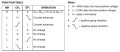
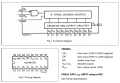
Yes, but its datasheet says that its absolute maximum allowed output current is 25mA.74HC4017, no current limiting , white LED, max. current measured was 44 mA @ Vdd =5V.

Yeah, I noticed that. I may just do that.Switch R7 and VR1
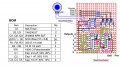
My test bench model seems to work well enough. At current configuration I can get a very slow pulse to an imperceivable flash rate. When divided out by 30 LED's I'm sure you'll still be able to see a trace, but if turned up (down) all the way, the pulse rate will be very slow. Approaching 2 pulses per second. But hey! the breadboard model - it's easy enough to try.put a fixed 1k resistor in series with the fixed section of the po
Thank you. But no. The purpose of the Q's is to provide path to ground when energized. Each Q is on when it's associated output from U3 is on. So the Q's only provide ground to one of three segments of 10.The Q1, Q2, Q3 should be reverse the polarity first and all c of bjt connected to Vcc.
Are any of the other outputs HIGH?In theory, with no clock pulse, at power-up, output 0 should be high. It's not.
I'll have to retest. But for what I'm seeing, nothing is lighting up. My general assumption is that none are high. But to be certain (not to make an assume) I'll check them. From memory I don't think I found any of them high when I probed them with the scope.Are any of the other outputs HIGH?
You're assuming that the counter powers up in the reset condition. A more conservative design would include a power on reset circuit to initialize the circuit if initial state was important.
Save yourself some time by not assuming anything. You have the circuit in front of you and know that one output from each 4017 should be HIGH. Probe the outputs of each 4017 until you find which output is HIGH. Then try to understand how the counter got in that state.I'll have to retest. But for what I'm seeing, nothing is lighting up. My general assumption is that none are high. But to be certain (not to make an assume) I'll check them. From memory I don't think I found any of them high when I probed them with the scope.
Excellent point. I will check U3. Up to now I've only been checking U2. U1 is giving me a nice square wave output of almost six volts. I'm hoping that the counters will work if the input voltage is just slightly exceeded. If I recall, the Vcc range was from 4 to 6 volts. My supply unloaded is putting out 6.1 volts. Maybe THAT is the whole problem. That and that I have pins 14 (U2 & 3) held low when they should be held high. If the counters were allowed to run they should reset themselves into the stable state I want.Save yourself some time by not assuming anything. You have the circuit in front of you and know that one output from each 4017 should be HIGH. Probe the outputs of each 4017 until you find which output is HIGH. Then try to understand how the counter got in that state.
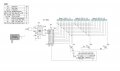
What is the purpose of R8?Did I not post my latest schematic?