CD4017BD (datasheet for CD4017BCN) am I reading this right?

crutschow

Joined Mar 14, 2008
38,539
I'll probably be going with shift registers. They're not too expensive, and after searching YouTube for videos I think I have the idea of how to program it. Is their memory volatile?
Yes, they lose memory when power is lost.
But they only draw a very small leakage current when static, so you can keep their memory alive with a coin cell for months if not years.
 

Thread Starter

Tonyr1084

Joined Sep 24, 2015
9,744
Yes, they lose memory when power is lost.
Definitely glad to hear that. I'll look into looping the last Shift Register (SR) back to the first SR. I may just use one entire chain and sweep the dot around the whole thing rather than build 3 or 4 different circuits.

Do they only come in 8's or do they come in bigger packages? I'm considering a couple strings of 20 and a couple strings of 8.

Does anybody have a recommendation?
 
Last edited:

Audioguru

Joined Dec 20, 2007
11,248
With a 5V supply, a CD4017 can typically sink 0.88mA when its output voltage is only 0.4V but an LED is not 0.4V, it is 2V for a red LED when the current will typically be 3.5mA. If the supply is 10V then the sinking output current into a 2V red LED is typically 14mA.

The maximum allowed dissipation (heating) in an output transistor so with a 10V supply and sinking 14mA into a 2V LED 112mW creates a dissipation of (10V - 2V) x 14mA= 112mW, so add a series resistor to share the heat.

All Cmos datasheets from Texas Instruments show graphs of the sinking and sourcing typical and minimum output current with 5V, 10V and 15V supplies and with various voltage drops.

A 74HC IC can typically produce 50mA to 60mA into a short but its maximum allowed output current is 25mA.
 

Thread Starter

Tonyr1084

Joined Sep 24, 2015
9,744
@crutschow I should have said: "It's good to know that the programming needs to be maintained." That's why I'm glad to hear that - or to have that clarified for me. It would have stunk to do all the programming work and then turn it over only to have it do nothing. Always good to avoid looking foolish.

@Audioguru Thanks for the clarification. I'm not real accustomed to looking (reading) data sheets. I saw those numbers and wasn't sure what I was reading. That's the whole reason behind posting this question, so I can get clarity on what I'm doing. Turns out I have some 74HC series chips pulled out of treadmills over the years. I guess I need to go through them and see if I have a decade counter. I think I have some that are "Decade / Divide by 12" counters, not sure if I have that, nor am I sure I know how to wire it. But I will figure it out. Especially with the help of these fine people on this site.
 

Thread Starter

Tonyr1084

Joined Sep 24, 2015
9,744
The only thing I have in my stock is the SN74LS92N, and that's the divide by 12 counter I mentioned. It's output is binary, not sequential like the CD4017 is. Can anyone tell me of a sequential counter in the 74 series?
 

Thread Starter

Tonyr1084

Joined Sep 24, 2015
9,744
I've found this IC: 74HC4017. Trying to figure out how to cascade from one to the next so that a single lit LED could travel 20 steps. The YouTube video's I've seen only show what the builder can do with the chips. No explanation at all. AND they only step through 10 LED's

In my scenario I want LED 1 to light. Then LED 1 goes out as LED 2 comes on. Then 3. Then 4; 5; 6; 7; 8; 9; 10; 11; 12 - - - and so on all the way up to LED 20. Then go back to LED 1 and start the process all over again. I might be able to do it with the aid of a Double D Flip Flop. But then I'm only limited to a maximum of 20 LED's in a row.
 

dl324

Joined Mar 30, 2015
18,357
Yeah, looking at the data sheet on that one right now.
It's just the 74HC version of CD4017. If you don't already have them, you should buy CD4017; they have a wider operating voltage.

If you really want TTL, there aren't any counters with decoded decimal output (that I'm aware of, and I just scanned the 74 series list of components). You'd need a BCD counter and a BCD to decimal decoder, like 74LS145.
 

Thread Starter

Tonyr1084

Joined Sep 24, 2015
9,744
Just ordered the 74HC4017. I don't mind the 5 volt limitation, that's kind of where I'd like to stay with this project anyway. And the 74HC has a higher current rating. The CD4017 has a carryout pin which is useful. You can use two CD's to get up to 100 LED's sequenced, but I don't see where you can do that with the 74HC chip. I can get 9 outputs with the first chip and 8 with the next and the next and the next, so on and so on.

I'm not hard wired to having 10's or 20's. I'm in the design stage, and if I were to go with 17, 25, 33 or 41 LED's - so-be-it. I just have to be sure not to exceed the 700 mA capability of my supply. OR get a bigger supply if need be.
 

Thread Starter

Tonyr1084

Joined Sep 24, 2015
9,744
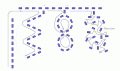
Here's KIND-A what I'm thinking with LED's. But it's going to be a whole lot of wires to be run. Will be hard to keep everything in order.

Marble Machine LED Light Path.gif
 

Bernard

Joined Aug 7, 2008
5,784
In post # 9 all LEDs were on with a single 0 circulating & now it is reversed? For a short video of all on with a circulating pattern using 74LS164's @ 5V, current limiting R 330 try YouTube, Jack Bernard, Stream.
I think 74HC164 should work for either pattern with ample brightness.
Memory, no problem, with a single circulating 1, when it falls out at the last stage with all stages "ORd" or NORd, the output of NOR would go hi as an input to stage 1 & cycle would start over.
Sorry it is River, not Stream.
 
Last edited:

Bernard

Joined Aug 7, 2008
5,784
74HC4017 or 74 HC 164, LED bright white piranha. Vcc 5V.
R.....mA.....V @ pin.
1.5k-- 1.36-- 4.9
470---4.6----4.8
220---8.9----4.7
150--12.2---4.6
100--15.2---4.5
68--18.7---4.4
47--23.6---4.3
LED is quite bright @ 5 mA.
 

Thread Starter

Tonyr1084

Joined Sep 24, 2015
9,744
In post # 9 all LEDs were on with a single 0
Work in progress. Changes coming rapidly. The idea of all of them being logic 1 except the one with the output, that was because I was going to strobe them. Hard to explain, but a cool effect. Turns out to be too much work that way. And since this is a kids entertainment toy, simple is good enough.

I'll investigate the brightness when I receive my parts. Should be here by Thursday late afternoon. Unless being delivered by UPS or FED EX.
 

Bernard

Joined Aug 7, 2008
5,784
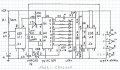
Monitoring a long shift reg. string uses a lot of ORing so here is one that needs just a 555 & open drain inverter & misc. parts. It furnishes a reset at power-up, insertion of a 1 at start of cycle & reset & 1 insertion at end of cycle - we hope. Just one SR is shown. A low is needed for reset. Not tested.
Reset at power-up needs help but the idea is for C5 to hold pin 2 on U5 low so that U5 comes on in a triggered state, resetting all SR stages to 0 s & charges C2. When U5 times out, U1 starts pulsing, inserting a 1 into the first SR stage which then dumps the charge on C2. Missing is 1M R across C2 to keep it low.
When the 1 advances to final stage the trailing edge triggers U5 & process starts over.Multi Chasers 00000.jpg
 

Audioguru

Joined Dec 20, 2007
11,248
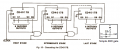
Datasheets of a CD4017 show how to cascade two or more of them using AND gates so a lighted dot goes around all of their outputs. A 74HC4017 is connected the same except its max supply is 6V and its max current output is much higher.
 

Attachments

Top