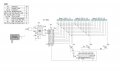
CD4017BD (datasheet for CD4017BCN) am I reading this right?

dl324

Joined Mar 30, 2015
18,359
Wait a minute. The Vcc pin on the 74LS06 ICs are not powered on the schematic so they will not work.
It is common practice to not clutter schematics with explicit power connections to ICs. My schematic editor doesn't include them and I don't add them.
 

Thread Starter

Tonyr1084

Joined Sep 24, 2015
9,744
The supply current for the 74LS06 is massive so I hope it does not overheat the little transistors.
No problem. I don't intend to use them.

For what it's worth, the circuit is now functional, with just a minor modification, that of swapping from using pins 13 as clock inputs to using pins 14. The PCB is built and I'm not going to rebuild it just to add more components that won't affect the outcome. And as for temperature of devices, I'm measuring a 2 degree F over ambient while operating. I have a small IR thermometer, and it's not likely very accurate, but for what it cost and what it's telling me, if it's 100% off then instead of 2 degrees rise I might be seeing a 4 degree rise. So I'm not worried in the least about how my circuit works. And I'm building it to plug into the machine. So if ever it has a problem I can always do a repair. If worse comes to worst I can completely redesign the board and go from there. I HAD entertained the idea of using a TL071CN to generate the clock pulse. In the past I built one of these (smaller) chase lights using just one CD4017 and a CD4013. I've used one of the FF's to switch between two transistors supplying ground to two stages of LED's while the other FF was used (set and reset) to act as the clock generator. And it worked nicely. In fact, I have that board laying on my bench right now just for reference. But because I'm using more than two stages I had to go with a separate clock generator. Hence, the need for one more chip. The 555.

So thanks for the recommendations. I'll keep all rec's in a file for future reference. But for now, I think I've achieved my goal. And thank you to everyone who has offered advice or even an opinion. Any and all comments have been appreciated.
 

Thread Starter

Tonyr1084

Joined Sep 24, 2015
9,744
I came up with 6.6 mA. Why do you say? Is there a problem? These are E-Bay LED's. And I've been running them for quite a while, and even when I power them up to full speed their temperature increase over ambient is only 1.5 degrees F. Sorry, but I'm not seeing any problems. Please let me know if I've overlooked something critical.

I want them to be bright enough to be seen in the daytime, so I'm happy with how they're working out.

Tell you what - I'll set up a single LED on my breadboard with a 330 Ω resistor and power them from my 5.1 volt supply and measure the temperature and let you know what I find with an LED that is lit 100% of the time. I'll burn it for 5 minutes. Should heat up to full temp by then.
 

Thread Starter

Tonyr1084

Joined Sep 24, 2015
9,744
2:57:30, start the timer. Ambient temperature is 70.0˚ F
2:59:00 temp is 76.5˚ F
3:00:30 = 76.5˚ F
3:02:30 = 76.0˚ F

3:07:00, 76.5˚ F

No, no fans are running. At the worst I may be slightly breathing on it, but I'm just not seeing any temperatures I need to consider worrisome. When I poke the IR Thermometer at the LED I'm placing the LED as close as possible to the sensor. Very little chance of influence from any other sources.

Sorry Mr. McDuck, just not seeing a problem.
 

Audioguru

Joined Dec 20, 2007
11,248
With a 5.1V supply and a 2.8V LED in series with 330 ohms the current is only (5.1V - 2.8V)/330 ohms= 7mA, a little low. Its maximum current is probably 30mA so with only 7mA it will be a little dimmed and not hot. Then your LEDs will be very bright with standard 20mA and will be warm.
 
Top