CD4017BD (datasheet for CD4017BCN) am I reading this right?

Bernard

Joined Aug 7, 2008
5,784
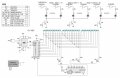
Is U3-14 still grounded? With clock at U3-13 , count will advance at U2 stage 5 ? With no provision for reset at power-up condition of U2-3 is unknown. Are both Clock Pulse Points connected ?
 

dl324

Joined Mar 30, 2015
18,362
but for now it shouldn't hurt anything.
The impact is insignificant in low speed designs. In high speed designs, it will introduce an RC delay.

I once knew a technician who inserted resistors between all TTL outputs and whatever they were driving. He learned very quickly from circuit reviews that that was an unusual practice.
 

Thread Starter

Tonyr1084

Joined Sep 24, 2015
9,744
At last test I moved pins 14 high. When tested, the 555 was putting out a high signal that was barely toggling between high and nearly high. Triangle wave appears to be normal. And it's responding to inputs from VR1 (by inputs I mean changes to resistance).

Maybe I should move clock pulses to pins 14 and just ground pins 13. This is confusing the heck out of me. And I'm sure my description of what I'm finding is somewhat confusing to all of you as well.

Spoke to wife. Said she had a breakfast burrito at McDonalds. Now I'm hungry! Maybe I should get something to eat and come back to this in an hour with a clear, fresh and undistracted mind.
 

Thread Starter

Tonyr1084

Joined Sep 24, 2015
9,744
What does "nearly high" mean?
4.6 volts. Hard to read scope. Had to rig up alligator clips so I could get a good measurement. Hoping they didn't introduce any error.

When I test my supply I get a pure 5.1 volts, no ripple. When connected to the board my power supply is square wave shifting between 4.6 and 5.1 volts. Nice square wave form between the two measurements.

What's changed? I moved pins 14 from ground to power. Now I get that strange square wave. When I probe the negative leg I get the same square wave from zero volts to 0.3 volts. The output on pin 3 (U1) is from 0.4 volts to 4.7 volts. I'm wondering if something is shorted. If so - then R8 may have saved U1.
 

Audioguru

Joined Dec 20, 2007
11,248
CIRCUIT PERFORMANCE: Odd thing is that with the counters NOT counting, I'm still not getting an output. In theory, with no clock pulse, at power-up, output 0 should be high. It's not.
The 0 output will be high at power up only if you use a resistor and capacitor to reset it at power up.

See my post #64. Is the output logic high voltage from the ordinary 555 high enough to clock the HC counter? Usually a Cmos 555 is used to clock a Cmos counter. I do not know if a pullup resistor at the output of a 555 will work so try it.
 

Thread Starter

Tonyr1084

Joined Sep 24, 2015
9,744
Using NE555P timer chip and 74HC4017AP counter chips. On my breadboard the circuit didn't work at first but when I inadvertently tested on a resistor I was using to drive a small LED suddenly the 74HC4017 started counting. Primarily, that's why R8 is still in the circuit - because it seemed to like it before on the breadboard.

I have yet to try clocking at pin 14 and holding pin 13 low (as per Bertus, post #87) and see what happens. But before I go there I now need to figure out why I'm having issues with the 555. Or IF I'm having issues with it. I've looked over the board several times and can not find any shorts. And the way I planned out the board the chance for shorts should have been minimized.
 

RichardO

Joined May 4, 2013
2,270
Be warned that a 555 timer (the bipolar transistor one, not the CMOS one) can have a nasty wiggle on the edge of the transition. The wiggle can cross the TTL threshold voltage twice causing a double clock into the counter. The counter will appear to only count even numbers when viewing the outputs with LED's.This wiggle is also hard to see with a scope without going to a fast sweep rate and just looking at the edges of the signal.

I suspect this wiggle is caused by poor power supply bypassing and/or poor grounding.
 

Audioguru

Joined Dec 20, 2007
11,248
Digikey does not sell a ULN2981 but its datasheet shows that it has an output voltage high that is 1.8V less than its supply voltage so +3.3V with your 5.1V supply. The saturation voltage of the transistors reduces the voltage available for the LEDs and their resistors to about 3V so you will need to buy thousands of blue LEDs, test them all and hope to find some with a forward voltage less than 3V. The ULN2981 has too much output voltage loss. Some 74HC4017 ICs also have too much voltage loss to drive 3V blue LEDs with a 5V supply. Use a higher supply voltage or use 1.8V red LEDs.
 

Audioguru

Joined Dec 20, 2007
11,248
Be warned that a 555 timer (the bipolar transistor one, not the CMOS one) can have a nasty wiggle on the edge of the transition. The wiggle can cross the TTL threshold voltage twice causing a double clock into the counter. The counter will appear to only count even numbers when viewing the outputs with LED's.This wiggle is also hard to see with a scope without going to a fast sweep rate and just looking at the edges of the signal.

I suspect this wiggle is caused by poor power supply bypassing and/or poor grounding.
An ordinary old 555 has old TTL technology. It produces a 400mA supply current surge each time its output switches that can easily upset the counters. The datasheet of an LM555 talks about it and the datasheet of an ICM7555 shows it and recommends the Cmos 555 instead to cure it.
 

Thread Starter

Tonyr1084

Joined Sep 24, 2015
9,744
I've removed U2 & U3 from the board (socketed) and am testing only the 555 chip. The two video clips attached show the waveform coming out of pin 3 of the 555 and out of pin 3 through R8. I've also made sure my probe was calibrated and tuned the capacitor to give me a perfect square wave representation, so the waveform you're seeing is accurate.

OK, can't upload a .MOV file. Will upload to Flickr and attach a link.
 

dl324

Joined Mar 30, 2015
18,362
An ordinary old 555 has old TTL technology. It produces a 400mA supply current surge each time its output switches that can easily upset the counters. The datasheet of an LM555 talks about it and the datasheet of an ICM7555 shows it and recommends the Cmos 555 instead to cure it.
But that doesn't mean it will always be problematic.

Case in point. I have a breadboard with NE555 clocking CD4015 shift registers. It is working flawlessly without decoupling capacitors or a pull-up resistor on the timer output.

Can mixing TTL with CMOS cause problems? Certainly. Does it always cause problems? No. As long as you know what to look for when things don't work as expected, you don't need to do an ultra conservative design all the time.
 

dl324

Joined Mar 30, 2015
18,362
Not using LM555, using NE555. Isn't there a difference?
They're both bipolar designs and have the same voltage specs and shoot through problem. But, as I just mentioned in my previous post, those "issues" aren't always problematic.

On the other hand, when things don't work and you've taken short cuts, you need to know what to look for to eliminate obvious potential sources of problems.
 

Thread Starter

Tonyr1084

Joined Sep 24, 2015
9,744
Here's what I'm going to try next: I have some CD4017's so I'll swap those in. I just have to change pins 13 and 14 so that I can enable the clock and input a clock pulse on pin 14.

Gosh, I really should be outside working on the marble machine. This is the last of the warm weather (high to be 68˚F [20˚ C]).

Yeah - I gotta step away from this for now. Getting overly frustrated. May have to go with a completely redesigned circuit. Maybe use a TL071 to generate my clock pulse.
 
Top