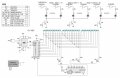
Because power up state isn't guaranteed. I know you're talking about U3, but if I hadn't studied the circuit, I wouldn't know that...Don't know why, but every time I power the circuit up pin 5 is high.
Bread board model seemed to work better with it in place. I'm not sure why but - - - . If need be I can bypass it. Easy to short across it and see what happens, but for now it shouldn't hurt anything.What is the purpose of R8?
The impact is insignificant in low speed designs. In high speed designs, it will introduce an RC delay.but for now it shouldn't hurt anything.
What does "nearly high" mean? What is the voltage on the other side of the series resistor?the 555 was putting out a high signal that was barely toggling between high and nearly high.
4.6 volts. Hard to read scope. Had to rig up alligator clips so I could get a good measurement. Hoping they didn't introduce any error.What does "nearly high" mean?
The 0 output will be high at power up only if you use a resistor and capacitor to reset it at power up.CIRCUIT PERFORMANCE: Odd thing is that with the counters NOT counting, I'm still not getting an output. In theory, with no clock pulse, at power-up, output 0 should be high. It's not.
An ordinary old 555 has old TTL technology. It produces a 400mA supply current surge each time its output switches that can easily upset the counters. The datasheet of an LM555 talks about it and the datasheet of an ICM7555 shows it and recommends the Cmos 555 instead to cure it.Be warned that a 555 timer (the bipolar transistor one, not the CMOS one) can have a nasty wiggle on the edge of the transition. The wiggle can cross the TTL threshold voltage twice causing a double clock into the counter. The counter will appear to only count even numbers when viewing the outputs with LED's.This wiggle is also hard to see with a scope without going to a fast sweep rate and just looking at the edges of the signal.
I suspect this wiggle is caused by poor power supply bypassing and/or poor grounding.
But that doesn't mean it will always be problematic.An ordinary old 555 has old TTL technology. It produces a 400mA supply current surge each time its output switches that can easily upset the counters. The datasheet of an LM555 talks about it and the datasheet of an ICM7555 shows it and recommends the Cmos 555 instead to cure it.
They're both bipolar designs and have the same voltage specs and shoot through problem. But, as I just mentioned in my previous post, those "issues" aren't always problematic.Not using LM555, using NE555. Isn't there a difference?