Datasheet gives incomplete info

Thread Starter

Samantha Groves

Joined Nov 25, 2023
161
So I bought the SN74LS02N Nor gate because I want to build a SR latch.However looking at the datasheet of SN74LS02N Click me if you click at the datasheet it defines the high level input voltage as 2V not a range and the low level input voltage as 0.8 not a range.I dont thin making exactly 2V or 0.8V is possible with available commercial products so I guess there should be a marginal error.Hiwever that marginal error is to up or to down(if my voltage level is 0.9V does it take it as high or low)?
 

WBahn

Joined Mar 31, 2012
32,725
So I bought the SN74LS02N Nor gate because I want to build a SR latch.However looking at the datasheet of SN74LS02N Click me if you click at the datasheet it defines the high level input voltage as 2V not a range and the low level input voltage as 0.8 not a range.I dont thin making exactly 2V or 0.8V is possible with available commercial products so I guess there should be a marginal error.Hiwever that marginal error is to up or to down(if my voltage level is 0.9V does it take it as high or low)?
No where are they saying that it is exactly 2 V or 0.8 V.

Read the datasheet.

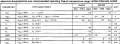
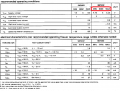
1777771134059.png
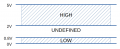
2 V is the MINIMUM input voltage that the device is guaranteed to recognize as a Logic HI.

0.8 V is the MAXIMUM input voltage that the decide is guaranteed to recognize as a logic LO.

As long as the input voltages you apply are no lower than 2 V for a logic HI and no higher than 0.8 V for a logic LO, the device will respond to them accordingly.

Any voltage you apply to an input that is between them may or may not be recognized properly and could even cause damage to the chip if applied too long.

To answer the broader question in your title -- no data sheet can give "complete" information because there will always be something that someone would like to know that isn't there, even if the datasheet were a hundred pages long. Manufacturers decide what information is necessary first. Then what information is the most useful to the most users. They also have to take into account how much it's going to cost to collect the data and how it can be presented in such a way that it is understandable without overloading the reader. Then you have datasheets for old parts that were from companies or product lines that were bought or merged. These often are just left unchanged even if there are known deficiencies, since new deficiencies often get added if an attempt it made to bring the datasheet inline with the current template.

This datasheet has a lot of the telltales of being a legacy datasheet that hasn't survived completely intact. For instance, Note 3 under the switching characteristics table says that "Load circuits and switching waveforms are shown in Section 1." Well, there is no Section 1 and there are no load circuits or switching waveforms anywhere. Likely, this was originally part of a larger collection of datasheets that shared that information.
 

WBahn

Joined Mar 31, 2012
32,725
So I bought the SN74LS02N Nor gate because I want to build a SR latch.However looking at the datasheet of SN74LS02N Click me if you click at the datasheet it defines the high level input voltage as 2V not a range and the low level input voltage as 0.8 not a range.I dont thin making exactly 2V or 0.8V is possible with available commercial products so I guess there should be a marginal error.Hiwever that marginal error is to up or to down(if my voltage level is 0.9V does it take it as high or low)?
Try to use your same reasoning on the output specifications that are given. Doing so makes no sense, because they give TWO values. So let's see what it's really telling you.

1777772525798.png

V_OH is the output voltage that you see when the device is supposed to be outputting a logic HI.

It says that it is typically 3.4 V, but is could be as low as 2.4 V.

But look at the test conditions specified. It is when the power supply is at its lowest, the input is at its highest (it's an inverting part) and the output is being loaded to the maximum amount specified -- plus this is over the entire recommended operating free-air temperature range. So what they are saying is that if we operate the chip in a condition that should result in the lowest possible output voltage, we guarantee that it won't be below 2.4 V. Since the parts that are being driven by this output are guaranteed to recognize any voltage that is at least 2.0 V as a logic HI, there is a 0.4 V safety margin built into the specification.

One thing you might notice is that, while V_OH is specified with V_CC = MIN, so is the V_OL. But it would seem like we would want to use the MAX supply voltage since this would seem to be likely to result in the maximum output voltage. But things aren't that simple. The key is that the worst-case test conditions are under max load, so the drive strength of the output matters, and drive string for TTL and CMOS both generally get weaker at lower supply voltages and this more than offsets the impact of a higher supply voltage's tendency to move the output voltage up a little bit.

One subtle point that many people miss when working with TTL (ask me how I know), is that the output, when HI, is NOT going to be very close to 5 V -- it is going to be closer to 3.4 V and will almost never be above 4 V. But people assume that it will be 5 V because it is a 5 V logic family and then are flustered when things don't work right because they relied on the output being 5 V, or very close to it.
 

MisterBill2

Joined Jan 23, 2018
27,231
Understanding component data sheets takes a bit of study, and also understanding what the values actually mean. It is not trivial! Consider that typically data sheets are aimed towards the designers of systems, not experimentors.
 

MrChips

Joined Oct 2, 2009
34,642
Again, read min and max specifications very carefully.
In some instances, it specifies the limit of operation. In other cases it is a guarantee of operation.
I have seen datasheets that get it wrong.
 
Top