CD4017BD (datasheet for CD4017BCN) am I reading this right?

Thread Starter

Tonyr1084

Joined Sep 24, 2015
9,744
I don't see a sink measurement but after all, it is a low power ic.
Says: "LOW level output current". I read that as - for the sake of clarity (forget accuracy) - the output is in the LOW state, meaning it's sinking 0.88 mA to ground with a 5 volt source at 25˚C.

Well, looks like my project just cost me a few more devices. Now I have to look up the 2N2222 to see how much current it takes to turn it fully on so it can act as an inverter. That is not a problem, as long as the 2222 will work.
 

Thread Starter

Tonyr1084

Joined Sep 24, 2015
9,744
have a look at the 74HC4017
Unfortunately I don't have any of those in stock. Time is not critical but it isn't wide open either. I'm building this thing for my grandchildren and want to have it done by Christmas. Surely, a circuit shouldn't take that long, but there's a lot of wood work going into building the various features of the machine. I want to accentuate three features: The marble climbing to the top rail. That's one chase light circuit. The one I'm trying to work out right now is the comet tail chase light that follows the marble across the top rail before it drops into various features, and the third is a figure 8 configuration where the lights endlessly loop forming a figure 8 (because the marble spins two wheels in opposite direction and I'd like the lights to chase in a similar fashion.

I can work out the circuits, I just need to be sure I'm reading these components correctly and knowing what they can handle and what they can't.
 

OBW0549

Joined Mar 2, 2015
3,566
https://media.digikey.com/pdf/Data Sheets/Fairchild PDFs/CD4017BC, CD4022BC.pdf
Looking at the output sink current (pg. 3). Is this saying this device can only sink 0.88 mA at 5 V source at +25˚C?

I mean my confusion is that what I think I'm reading is that it can sink 880 µA. IS THAT ALL?
Yes. 4000-series CMOS, except for buffers (e.g., CD4050), can't source or sink very much current. Some other CMOS logic families, such as 74ACxxx, can source/sink a lot more (≈20 mA or so).
 

Thread Starter

Tonyr1084

Joined Sep 24, 2015
9,744
20 mA is my target.

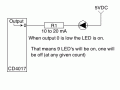
[edit] Let me be more specific: I want the output of the 4017 to bump against (positive to positive) against the LED. I'll draw a pic in a few. Repeat for each output.
 
Last edited:

Thread Starter

Tonyr1084

Joined Sep 24, 2015
9,744
You can't get 10-20mA from CD4017.
That's what I'm thinking. However, I've built a 20 LED chaser using just one 4017 and one 4013. Actually, one half of the FF is used to toggle between the first 10 LED's and the second. The other half of the FF is used to generate a clock pulse.

The FF turns on transistors that supply ground to one set of 10 LED's each. So alternately the FF turns on Q1 then Q2. Aside from the timing resistors and capacitors there's one more transistor. It controls either the SET or the RESET of the oscillating FF. Using a capacitor I pull (I think it was the) reset low for a short period of time, something like a few microseconds. Once a cap charges up the transistor shuts off and the FF goes into oscillation.

I powered this from a 9V battery and the 4017 provided direct power to the LED's. It still works, but honestly I want a bit brighter glow on my light show. Gotta be seen in the light of day.
 

dl324

Joined Mar 30, 2015
18,326
I powered this from a 9V battery and the 4017 provided direct power to the LED's.
Operating at 9V instead of 5V increases the sink/source current (about double).

You can draw more current from the outputs than what the datasheet specifies, but the logic level may no longer be considered a logic LOW and you need to calculate total package dissipation.

If you were trying to use any of the outputs that were being "abused", that would shout amateur to anyone looking at the schematic...
 

Thread Starter

Tonyr1084

Joined Sep 24, 2015
9,744
Operating at 9V instead of 5V increases the sink/source current (about double).
The main reason for considering using 5 volts is because the motor that drives the marbles up to the top rail is designed to run on 5 volts. I've run it on 12 volts and it doesn't self destruct, but I don't want to run the risk of blowing a motor out in short time. There are no other constraints to be considered. I could run the whole thing on 12 volts and just modulate the power to the motor, but that's another circuit to be built. Doable, but if I can make do on 5 volts then I'm happier that way. But 12 volts is definitely possible. I have plenty of power supplies that have more than 2 amps capability.

I'll consider 12 volts. But even then, I still want to run at least 10 mA to my super bright LED's. Depending on which circuit, their Vf will likely range from 1.95 to 2.97. One section under consideration is the STAR FIELD, where 20 LED's flash in turn but are arranged to simulate a random pattern. Those will be powered via 3 mm clear blue Superbright with a Vf of 2.8 v. I may strobe them so that would further enhance their appearance of randomness.
 

Thread Starter

Tonyr1084

Joined Sep 24, 2015
9,744
New question (considerations):

Can go with 12 volts, can go with 18 volts (these are the supplies I have) (or I could build something but would rather not)

Is there a better way to drive an LED with as much as 20 mA?

[edit] I have to keep in mind that I don't want to harm the children's eyes with an LED that is too bright. Any thoughts on that as well? I don't think 10 mA would be too low.
 

GopherT

Joined Nov 23, 2012
8,009
New question (considerations):

Can go with 12 volts, can go with 18 volts (these are the supplies I have) (or I could build something but would rather not)

Is there a better way to drive an LED with as much as 20 mA?

[edit] I have to keep in mind that I don't want to harm the children's eyes with an LED that is too bright. Any thoughts on that as well? I don't think 10 mA would be too low.

You should get a bunch of shift registers and cascade your pattern. There are some IC shift registers that can directly drive your LEDs. Load your pattern at one end and the pattern keeps getting pushed down the pipeline of outputs.
 

Thread Starter

Tonyr1084

Joined Sep 24, 2015
9,744
You should get a bunch of shift registers and cascade your pattern. There are some IC shift registers that can directly drive your LEDs. Load your pattern at one end and the pattern keeps getting pushed down the pipeline of outputs.
Thanks, but I'm not familiar with how to use shift registers.
 

Thread Starter

Tonyr1084

Joined Sep 24, 2015
9,744
I hope you post a photo or two. {edited}
Yeah, I will. Not a toy though. Meant to stimulate a young genius. (Not me. I'm not a genius.)

[edit] Most of it is scrap materials. The drive I used to wind the marbles up to the top was scavenged from a 3 CD stereo. Salvaged a lot of motors and gears too, but in the end I went with a worm drive. The hardest part was getting the Archimedes Screw right. That was done by hand by the way. And yes, I'll be proud to post pictures of it. Even if I scrap the idea of lights.

[edit #2] I'll probably be going with shift registers. They're not too expensive, and after searching YouTube for videos I think I have the idea of how to program it. Is their memory volatile?
 
Top