Problems with the Slayer Exciter Project

MisterBill2

Joined Jan 23, 2018
27,615
In the instance we were discussing there were NO COPPER PLATES. The portion of the circuit claimed to be coupling to"ground" was a very short length of wire at the top of a coil that was several inches away from the battery negative connection that was claimed to represent "ground". so the capacitance between the two points was very small. The capacitance that I was referencing was between the three turn collector coil and the bottom of the secondary coil that it was wrapped around. In classical Blooper systems, this would seem to be providing the collector to base feedback to get things started. And until oscillation starts there is no current flowing in that secondary coil to magicaly cause current to flow as feedback to the base.
Of course, in a blooper circuit there is no telling as to whatever coupling may be the result of component proximity or power source internal resistance.
 

MrAl

Joined Jun 17, 2014
13,716
Hi,

Oh so it's a short wire at the top, that's a little different.
However, in my previous posts i made it clear that you don't need the negative terminal of the battery to act as ground, even the positive terminal acts as a 'ground'. That's because 1000 volts doesn't care if it sees 0v or 9v, either of those will act like a ground for any capacitance. Remember any voltage difference will act with any capacitance if that capacitance is across the nodes where the voltage differences exists. Even 0.1v difference is enough.

In spite of that, if the wire is short then it must be shorter than the primary turns and so I would expect the same as you did, that the main capacitance comes from the unavoidable coupling between primary and secondary. We do have the secondary turns to think about too though, in that the turns are distributed across the core not just all at the top. That could make the wire at the top insignificant as compared to the secondary turns, and all the secondary turns would tend to act with any 'ground'. We'd have to come up with a test for this i guess. After thinking about it again maybe it is both: the primary to secondary turns coupling, and the secondary turns to ground coupling.

I am wondering if it would help to add a small value cap to get more well-defined oscillations.
 

nsaspook

Joined Aug 27, 2009
16,333
" After thinking about it again maybe it is both: the primary to secondary turns coupling, and the secondary turns to ground coupling"
Yes, it's both and all of the above but as the sims show: https://forum.allaboutcircuits.com/...he-slayer-exciter-project.144949/post-1833305
as you start to include coil to coil capacitance coupling the output voltage starts to be damped so it's a net negative to circuit operation.
https://forum.allaboutcircuits.com/...he-slayer-exciter-project.144949/post-1833256

These circuit are not hard to understand if you have the correct EM mental model for how they work.
 

nsaspook

Joined Aug 27, 2009
16,333
There is a classical blooper going on now in this thread, but it isn't the Slayer circuit.
Yes, there's a reason why just about every explanation of the circuit in the electronic explaining universe is modeled by capacitance from the top of the secondary to 'ground' instead of being called a 'Blooper'.
 
Last edited:

MisterBill2

Joined Jan 23, 2018
27,615
Some like to throw stones.

What would you call a circuit that utilizes random capacitance that does not show on the posted circuit As a critical path to operation?? any capacitance between the power supply wires and the top of the secondary coil is unpredictable and not mentioned in the description. That certainly is not the way to teach beginners about how circuits operate, nor is it a good way to deliver experimental projects.
SoI am indeed a critic of posting projects for beginners that are not likely to work, and have no description of how they are supposed to be working.
 

nsaspook

Joined Aug 27, 2009
16,333
Some like to throw stones.

What would you call a circuit that utilizes random capacitance that does not show on the posted circuit As a critical path to operation?? any capacitance between the power supply wires and the top of the secondary coil is unpredictable and not mentioned in the description. That certainly is not the way to teach beginners about how circuits operate, nor is it a good way to deliver experimental projects.
SoI am indeed a critic of posting projects for beginners that are not likely to work, and have no description of how they are supposed to be working.
I do throw stones at glass houses when there is IMO misinformation being presented. The circuits do work and there are tons of descriptions of how they work and can be designed to work better that I posted to this thread. I'm not a big fan of Tesla or Tesla coil type circuits but they do have value to dramatically demonstrate EM effects.

I do understand your position but random capacitance, that does not show on the posted circuit, is something that we deal with daily in circuits that deal with di/dt dv/dt signal values that require attention to detail with physical circuit construction. As a beginner they need to start thinking about the effects of fringe EM fields and non-lumped components even if they don't completely understand why they happen.
 

MisterBill2

Joined Jan 23, 2018
27,615
I would not expect a beginner in electronics to be very well versed in EMI and assorted capacitive coupling effects. Nor would I expect a beginner to realize that calling a circuit a Tesla coil does not make it a Tesla coil.
I do not even expect that every beginner will not understand that current does not flow in an open circuit. Evidently some beginners are much better educated than others.
 

nsaspook

Joined Aug 27, 2009
16,333
I would not expect a beginner in electronics to be very well versed in EMI and assorted capacitive coupling effects. Nor would I expect a beginner to realize that calling a circuit a Tesla coil does not make it a Tesla coil.
I do not even expect that every beginner will not understand that current does not flow in an open circuit. Evidently some beginners are much better educated than others.
I think it should be part of the task to teach them or at least give them clues about what to study so they do understand those effects at some level. IMO that's part of the problem, you don't need to be well vested in EM to understand basic EM principles on a Qualitative level (meanings, concepts definitions, characteristics, metaphors, symbols, and description of things).
IMO most of the reluctance to discuss field effects is because most of us were taught EM at the Quantitative (being able to actually compute and analyse given values/quantities through equations) level where there is detailed math, detailed measurements and lots of theory. That's not useful for a beginner in circuit theory but thinking they are not capable of thinking and leaning basic cause and effect of Qualitative EM is IMO dead wrong.
 

Danko

Joined Nov 22, 2017
2,172
if the three turns are close enough to the secondary winding , possibly wound on top of the secondarie's lower section, there will be a bit of capacitance between them, and so any disturbance in the collector voltage will couple back to the base, leading to a greater change in the collector voltage that gets capacitively coupled back to the base
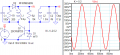
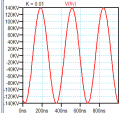
When L1 is tightly wound on L2, then coupling coefficient K is about 0.2.
You can see on diagram below plot for K = 0.2, where amplitude HV is 350 V only.
That voltage is enough for kindling fluorescent bulb because of high frequency.
But experiments with intensive ionizing air on top of coil L2 need much higher voltage.
Decreasing K leads to increasing HV. See diagram for K = 0.01, where HV is 140,000 V.
For К = 0,01 diameter of L1 should be 10 times more than diameter of L2.
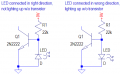
See picture of device, designed by professionals, below diagrams.
Notice how big is diameter of primary inductor.

1689196223261.png1689196743490.png

1689202961313.png
 

Attachments

Last edited:

MisterBill2

Joined Jan 23, 2018
27,615
When L1 is tightly wound on L2, then coupling coefficient K is about 0.2.
You can see on diagram below plot for K = 0.2, where amplitude HV is 350 V only.
That voltage is enough for kindling fluorescent bulb because of high frequency.
But experiments with intensive ionizing air on top of coil L2 need much higher voltage.
Decreasing K leads to increasing HV. See diagram for K = 0.01, where HV is 140,000 V.
For К = 0,01 diameter of L1 should be 10 times more than diameter of L2.
See picture of device, designed by professionals, below diagrams.
Notice how big is diameter of primary inductor.

View attachment 298211View attachment 298212

View attachment 298218
It does not seem likely that the voltages in the table are those produced when the power source is a nine volt battery and there is no external connection of the negative side to anything other than the drawn circuit. Also, the circuit shown in post#72 includes several components not present in post #1. The network in parallel with the primary, and the capacitors C1 and C2 will certainly make a difference, as will a power source with no internal resistance.

And for the actual Tesla coil shown, the feedback coil for the power oscillator is present but not mentioned at all. Also not mentioned is that with a Tesla coil, the feedback does not come from the high voltage coil, but from a separate feedback coil. Thus the feedback is not a direct function of the coupling to the high voltage secondary.
 

MisterBill2

Joined Jan 23, 2018
27,615
What I see is that with different circuits and different power supply capabilities there are different results. That is entirely reasonable, and certainly makes sense.
A good quality regulated lab power supply might possibly be able to emulate a small 9 volt battery, I doubt that was the case in the simulation results presented.
 
Top