Problems with the Slayer Exciter Project

lazaABT

Joined Feb 2, 2018
11
In the picture you posted it looks like one of the leads of the primary(white wire on the right) is not connected to anything, you might have missed the row.
First a little troubleshooting question, does the led stay lit when you remove the transistor? It should not light up when the transistor is removed. Also, what transistor are you using, i'm guessing a 2n2222?
A few tips:
Reduce the number of windings on the primary to 3-5(The fewer windings you add the higher the voltage on the secondary but the higher the strain is on the transistor and battery).
Add an electrolytic capacitor(10-100uf) in parallel with the battery.
Try reducing the resistor to 10k.
Not too important but try replacing the blue jumper with a shorter wire(you can use the same wire that you used on the primary).
It's not very easy to get the circuit working on a breadboard and especially with a battery, it works a lot better when the components are soldered together. When I was testing mine on a breadboard I needed a 12v wall supply to get it working reliably.
 

jsan

Joined Oct 3, 2019
2
The batteries are for just using it for a short period. These are for work for a decorating contest and we won't have access to a power source. The LED doesn't stay lit when I remove the resistor but I might need fewer turns on the primary. I am using a 2n2222a transistor and a 22k resistor.
 

lazaABT

Joined Feb 2, 2018
11
Try removing the TRANSISTOR, not the resistor.
If the led lights up when the transistor is there, but turns off when you take the transistor out, everything is working ok.
The only thing that might be a problem is the power output.
A smaller resistor or less turns on the primary will increase the power, but going too low might kill the transistor.
Also, do add a capacitor if you have one, it helps when working with batteries and short large current spikes.
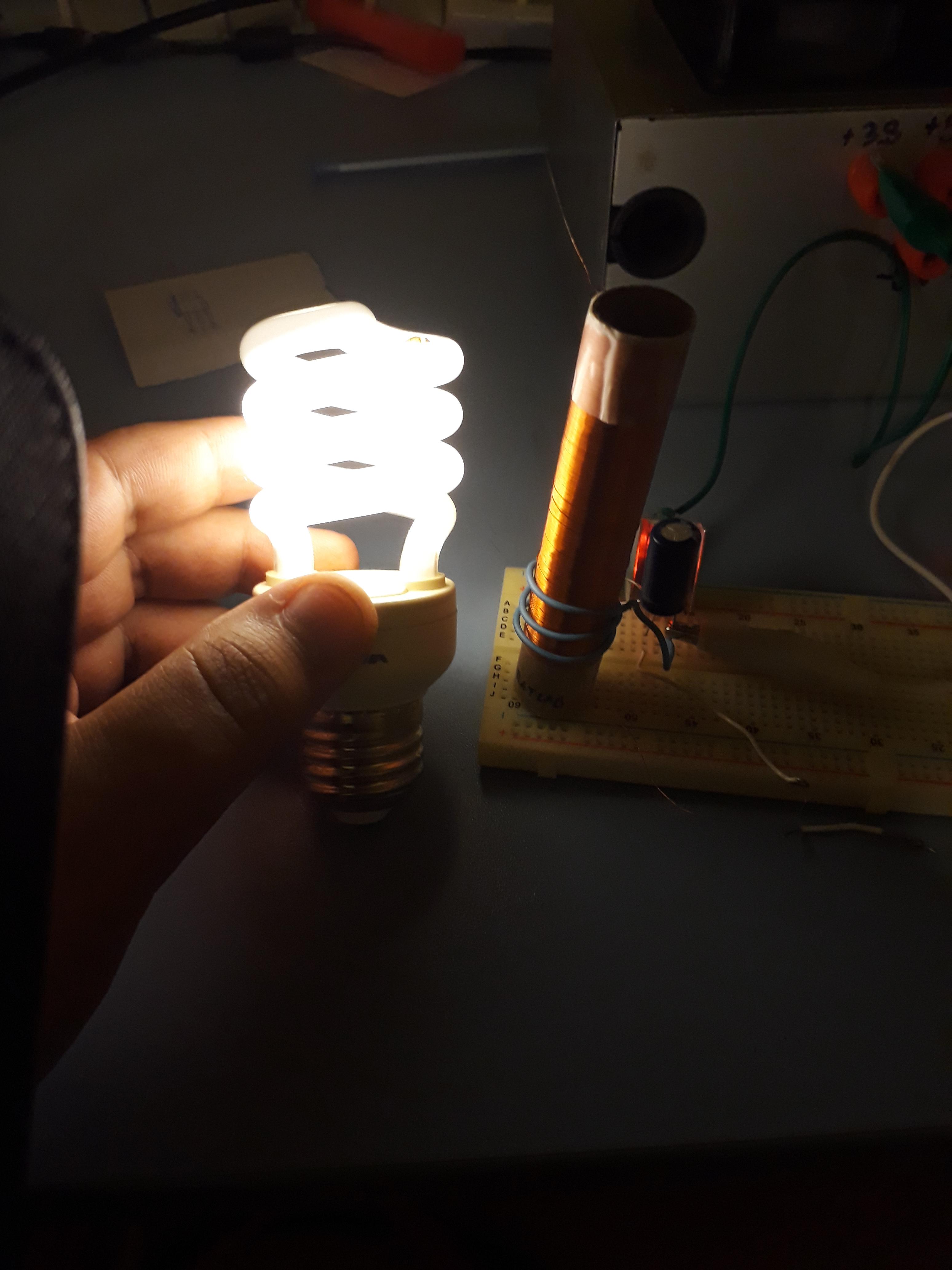
You might have a problem if your idea is to have it light up a light wirelessly, it helps a lot when you touch the light because this reduces the impedance to ground and makes it easier to light up, but if you have it sitting somewhere on its own it might have trouble lighting up. In that case you could try getting the wire from the secondary into contact with the light, I'm not sure if this will work, but it might be worth a try if you're having trouble.
 

lazaABT

Joined Feb 2, 2018
11
@shortbus
It actually does work with a CFL. The CFL lighting up does not imply there is current flow between it's electrodes. I also tried it with a fluorescent bulb that was shorted with a wire and it still worked, shorting the bulb reduced the brightness by about 10%(too lazy to upload a video though).


Aye1225

Joined Jan 10, 2022
1
@shortbus
It actually does work with a CFL. The CFL lighting up does not imply there is current flow between it's electrodes. I also tried it with a fluorescent bulb that was shorted with a wire and it still worked, shorting the bulb reduced the brightness by about 10%(too lazy to upload a video though).

Hello idk exactly why my circuit doesnt work i need a help ive been doing this for more than a day now
 

Attachments

MisterBill2

Joined Jan 23, 2018
27,620
Hello everyone. So I guess this place is sort of old now, but I've been trying to make my own Slayer exciter Tesla coil and have been running into some problems. For some reason, the current appears to be running through the base of the transistor and out of the emitter without anything being done to the 2 coils. They are both wound in the same direction. I'm using a mosfet transistor, a 40k ohm resistor, and a 9v battery. The primary coil has 4 loops, and the secondary has about 5000. Can anyone help?
This circuit is not like a Tesla coil, other than using a high ratio air core transformer. It is relying on the totally unpredictable capacitance feedback from the secondary coil to produce oscillation. In another era the oscillator circuit would have been called a"blooper", meaning that while it may function there is nothing to provide stability of any of the parameters.
Thus, without an adequate explanation of how it is working it is a very poor choice to suggest to those hoping to learn anything useful about electronics.
 

MisterBill2

Joined Jan 23, 2018
27,620
Hello idk exactly why my circuit doesnt work i need a help ive been doing this for more than a day now
The circuit operation depends a lot on the relative physical positioning between the primary and the secondary, as well as the capacitance between "whatever" and the top of the coil. In short, it is a very poor design totally dependent on the physical arrangement of most of the parts. The only feedback is capacitive feedback to the transistor base, and that depends entirely on the capacitive coupling to the coils, which is probably not even mentioned in whatever text comes with that circuit drawing.
 

MisterBill2

Joined Jan 23, 2018
27,620
In reference to post #1, to make this a really notable science fair project, a detailed description of how that "slayer" circuit actually functions, along with an illustration of the actual effective circuit, would be a prize winner for sure.
The published slayer arrangement operation is based on luck more than anything else, and it really is the enemy of anybody hoping to learn anything new about electronics. This can be verified simply by trying to explain the feedback that makes it oscillate.
An analysis of the circuit as published does not show any feedback path, does it?? Magnetic flux coupling requires current to flow in the driving loop, and there is no current flowing in the long coil, is there? At least not until the circuit is oscillating.
 

blueaquan

Joined Jun 25, 2023
1
Hi good evening or whatever time of the day it is in your timezone. Thanks to all your help and explanation, I was able to get this circuit going for my Son's school project, in fact in the process, I developed a lot of interest in this happened to spend more time with this project than my Son for whom it was intended.
Attaching a few photographs too FYI. This is not a troubleshooting post, but rather to further understand the working principle of the circuit, especially relating to these two things mentioned below.

1: I did a check on the potential difference between ground and the probe placed near the secondary coil and it shows around 900V, if there is such a high voltage near the secondary coil, why don't we get a shock when we bring our hands close to it...?
2: The bottom end of the secondary coil is given as a feedback to the base of the transistor, why is that..? And if the secondary has such a high voltage, shouldn't the feedback given to the base damage the entire circuit...?

Would really appreciate if someone could enlighten me these points. Thanks, Best wishes - BA
 

Attachments

MisterBill2

Joined Jan 23, 2018
27,620
OK, here is a late explanation as to how the blooper oscillator sort of functions. First, the 22K ohm resistor plus the green LED sets the transistor bias quite a way into the linear operation range. But there is no inductive feedback because with the circuit not oscillating there is no current at all flowing in the secondary. So there is no oscillating current in the primary turns either.
BUT if the three turns are close enough to the secondary winding , possibly wound on top of the secondarie's lower section, there will be a bit of capacitance between them, and so any disturbance in the collector voltage will couple back to the base, leading to a greater change in the collector voltage that gets capacitively coupled back to the base. The feedback would be greater if there is any resistance or reactance in the connection between the battery and the primary coil connection, and the internal resistance of the battery.
So now you have the explanation of how it can actually oscillate. The amount of feedback depends on how it is wired and how the coils are assembled, and how noisy the components are. The LED serves as a noisy bias reference device.
So with that information it should be clear that the operation depends on several variables that are not described at all in the build instructions. The variable would be tedious to quantify and very difficult to measure. THAT is why a better name would be a "Booper oscillator."
 

Danko

Joined Nov 22, 2017
2,172
https://steemit.com/technology/@elektr1ker/tesla-transformer-slayer-exciter-circuit
==========================
Below you find the slayer exciter circuit, where R is a resistor(to limit current), D is a Diode, C is the parasitical capacitor betweent the top load and earth, L1 is the primary and L2 the secondary winding and T is a bipolar transistor. As you can see we don’t need much components, so its cheap to build. The bad side is that this circuit is really inefficient compared to other solid state tesla circuits, but therefore it cant really hurt you ;)

1.jpg


How does it work?
As we know a transformer only works with AC-voltage and now we powering our circuit with a DC-Voltage, how can that work? We simply create our own crude AC-voltage with a changeable frequency by chopping the DC-Voltage with the transistor. The nice thing about this circuit is that it will tune itself automatic to the resonance frequency, so we don’t need to calculate and tune the circuit ourselfs.

The transistor works in this circuit basically as a switch, if we turn on our DC power source a base-emitter-current starts flowing and the transistor will reduce the resistance between collector and emitter and therefore become conductive (switch closed). A rising current will start flowing through the primary winding and create a magnetic field, which induces a rising voltage on the secondary. The air capacitor on top of L2 will resist the voltage change, which leads to a rising negative voltage and the bottom of L2.

0.jpg


If the negative voltage on the bottom of L2 is higher than the forward voltage of the diode D current will flow through it and through the secondary winding and the capacitor. If this happens the base-emitter current will stop flowing, because we now have a negative voltage on the base and therefore the transistor will become insulating between collector and emitter (switch open). This stops the current flow through L1 and therefore stops the voltage induction in L2. The magnetic field in L2 starts reducing. After that the process will start over and so the output voltage boosts itself higher and higher.

Because of the tank circuit on the secondary we get a sinusoidal voltage in the order of multiple hundred kHz to multiple MHz (depends on the values of L2 and C).
Because of the feedback from the secondary winding, the circuit will tune itself exactly to that resonance frequency, where we get hugh voltages to ground at the top of the secondary coil, which will produce these beautiful arcs.
 

MisterBill2

Joined Jan 23, 2018
27,620
An interesting alternative theory of operation in post #35, however, there is NO GROUND CONNECTION to any part of the circuit, and thus any capacitance to "ground" will not have an effect. Instead it is the capacitive coupling between the windings, which is a function independent of the non-existing "ground" connection.
 

Danko

Joined Nov 22, 2017
2,172
To @blueaquan and to some "experts" here:
https://www.build-electronic-circuits.com/what-is-ground/
1688853603791.png
"When you start learning about circuits, you’re bound to ask “what is ground?” at one point or another.
Are you actually suppose to connect your circuit into the ground??
First of all: grounding in electronics is different from the earth connection in wall outlets (although they sometimes are connected)..."
 
Last edited:

nsaspook

Joined Aug 27, 2009
16,333
An interesting alternative theory of operation in post #35, however, there is NO GROUND CONNECTION to any part of the circuit, and thus any capacitance to "ground" will not have an effect. Instead it is the capacitive coupling between the windings, which is a function independent of the non-existing "ground" connection.
Capacitive coupling is just the circuit theory way to say EM field energy where you can calculate the potentials from ground at infinity for point charges and dipoles.
https://phys.libretexts.org/Bookshe...tial/7.04:_Calculations_of_Electric_Potential

As you say, the physical GROUND CONNECTION is not the point. It's the path and phase of EM energy movement across space that matters for circuit feedback and oscillation.


As you can see his hand affects the circuit top-hat as it becomes an alternative energy path that damps and kills the oscillation.
 

MisterBill2

Joined Jan 23, 2018
27,620
Consider that in every instance of that circuit being assembled, the connection between battery negative, the transistor emiter terminal, and the LED was just a bit of wire, the concept of it having any effective capacitance to the top of the secondary coil is a very far stretch. The existence of some capacitive coupling between the two coils is much more reasonable, based on the much closer proximity. The fact that battery state of charge has a large effect on the operation further verifies that it is a capacitive voltage coupling between windings tends to back this up, as does the reality that the circuit does not function for many who try it.
 

nsaspook

Joined Aug 27, 2009
16,333
Consider that in every instance of that circuit being assembled, the connection between battery negative, the transistor emiter terminal, and the LED was just a bit of wire, the concept of it having any effective capacitance to the top of the secondary coil is a very far stretch. The existence of some capacitive coupling between the two coils is much more reasonable, based on the much closer proximity. The fact that battery state of charge has a large effect on the operation further verifies that it is a capacitive voltage coupling between windings tends to back this up, as does the reality that the circuit does not function for many who try it.
What you need is something more than just pure capacitive coupling between the two coils. That's a factor but IMO not the critical factor. Capacitive coupling between the two coils is an in-phase energy damper in the circuit, too much and it fails to work. The circuit depends on very short, high current peaks to generate the required di/dt for a high voltage field surrounding the coil. Battery SoC can limit the peak current due to increased battery internal resistance.

The effective capacitance to the top only needs to be very small because the effective electrical length of the secondary at the oscillation frequency provides a nice phase shift and a very high inductive impedance that only needs a very high impedance capacitive reactance for resonance to start storing energy in that resonance and form a oscillating HV electric field around it as the energy moves to each resonant element.
 
Last edited:
Top