I'm combining 2 ground planes. Analog and Digital. What potential problems can happen?

Thread Starter

tdengineer

Joined Oct 21, 2025
38
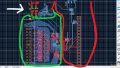
AGND AND DGND
BOTH ARE FULL PLANES TAKING UP THE ENTIRE SPACE OF THE BOARD
COLORED OUTLINES ARE JUST WHERE COMPONENTS WILL CONNECT TO THEIR RESPECTIVE GND'S
TOP LEFT WHITE ARROW IS POINTING TO NET TIE'S CONNECTING ANALOG AND DIGITAL GROUND ONLY IN THAT AREA OF THE BOARD

The ic on the top left is my analog power supply stuff, the one on the top right is the digital supply stuff

electrode inputs and array on the left side of board GREEN
MCU connections , spi, digital stuff on right side of the board RED

LAYER 1 = SIGNALS
LAYER 2 = DGND
LAYER 3 = AGND
LAYER 4 = SIGNALS
 

Attachments

WBahn

Joined Mar 31, 2012
32,752
In most designed, all of the various "grounds" will be connected at some point/manner, since they usually (not always) need a common reference. Connecting them at one point as close to the power-entry point is usually preferred.

One thing that you may need to contend with are the antenna loops created by image currents. Say your analog ground plane is above your digital ground plane. Now consider a digital signal that is routed on the top layer of the board. There is an image current that wants to travel in the ground plane directly below the digital signal. The higher the frequency, the more it wants to do this -- and digital signals that have fast edges have a lot of high-frequency content. But the analog ground plane shields the image current from the signal trace, forcing it to take a roundabout path, which creates a current loop that acts as both a transmitting and a receiving antenna for electromagnetic noise.
 

Thread Starter

tdengineer

Joined Oct 21, 2025
38
In most designed, all of the various "grounds" will be connected at some point/manner, since they usually (not always) need a common reference. Connecting them at one point as close to the power-entry point is usually preferred.

One thing that you may need to contend with are the antenna loops created by image currents. Say your analog ground plane is above your digital ground plane. Now consider a digital signal that is routed on the top layer of the board. There is an image current that wants to travel in the ground plane directly below the digital signal. The higher the frequency, the more it wants to do this -- and digital signals that have fast edges have a lot of high-frequency content. But the analog ground plane shields the image current from the signal trace, forcing it to take a roundabout path, which creates a current loop that acts as both a transmitting and a receiving antenna for electromagnetic noise.
Yes the digital signals reference the plane right below it.
 

WBahn

Joined Mar 31, 2012
32,752
I dont know what you mean
Are your analog signals on the layer adjacent to your analog ground plane?

If your signal line (analog or digital) crosses a gap in the ground plane, then the image signal must find a path around the gap. You want to keep those detours as small as possible.
 

Thread Starter

tdengineer

Joined Oct 21, 2025
38
Are your analog signals on the layer adjacent to your analog ground plane?

If your signal line (analog or digital) crosses a gap in the ground plane, then the image signal must find a path around the gap. You want to keep those detours as small as possible.
Theres no gaps
 

MrChips

Joined Oct 2, 2009
34,698
Here is the straight answer. Current has to flow through the ground plane. When current flows, there is a potential difference.
When there is a high current pulse through the ground plane from a high power device, other devices will experience the effect of that current pulse. Putting analog and digital devices on the same ground plane is going to adversely affect the performance of analog circuits. In mixed signal applications, pay attention to the ground planes and use separate ground planes for analog and digital circuits.

Here is one specific example. Every time a digital circuit switches state, current is drawn from the supply rails. The positive rail will experience a short drop while the ground will rise. This is known as "ground bounce". It gets worse when multiple gates switch at the same time, for example, when eight bits have to switch from 0 to 1 or 1 to 0 at the same time. When this occurs, ADC and DAC circuits are adversely affected.

In mixed signal applications, it is prudent to use separate ground planes.
If you layer the two planes one over the other, you are creating a capacitor between the two planes. A high current pulse in the digital plane is now coupled to the analog plane.
 

Thread Starter

tdengineer

Joined Oct 21, 2025
38
Here is the straight answer. Current has to flow through the ground plane. When current flows, there is a potential difference.
When there is a high current pulse through the ground plane from a high power device, other devices will experience the effect of that current pulse. Putting analog and digital devices on the same ground plane is going to adversely affect the performance of analog circuits. In mixed signal applications, pay attention to the ground planes and use separate ground planes for analog and digital circuits.

Here is one specific example. Every time a digital circuit switches state, current is drawn from the supply rails. The positive rail will experience a short drop while the ground will rise. This is known as "ground bounce". It gets worse when multiple gates switch at the same time, for example, when eight bits have to switch from 0 to 1 or 1 to 0 at the same time. When this occurs, ADC and DAC circuits are adversely affected.

In mixed signal applications, it is prudent to use separate ground planes.
I see a lot of people and experts saying to use a single ground plane and just separate analog and digital stuff by a big distance
 

WBahn

Joined Mar 31, 2012
32,752
I see a lot of people and experts saying to use a single ground plane and just separate analog and digital stuff by a big distance
There are multiple things to consider, some of them contradictory. Welcome to engineering, where the only reliably correct answer is, "It depends." and, much of the time, compromise is the key to finding an acceptable solution.
 

Thread Starter

tdengineer

Joined Oct 21, 2025
38
There are multiple things to consider, some of them contradictory. Welcome to engineering, where the only reliably correct answer is, "It depends." and, much of the time, compromise is the key to finding an acceptable solution.
I think my best best is to do the best I can and add testing spots onto my pcb to figure out why it doesn't work when it inevitably doesnt
 

WBahn

Joined Mar 31, 2012
32,752
I think my best best is to do the best I can and add testing spots onto my pcb to figure out why it doesn't work when it inevitably doesnt
That falls into the general category of "design by happening," in which you throw something together, almost at random, and hope that a miracle occurs and that it just happens to work. Sometimes, we are forced into that mode.

Test points will only tell you some of the story. If the issue you are dealing with is EMI/EMC, then test points probably won't be of much use.

The best place to start is to clearly define what it is you are trying to achieve. What is the specific problem you are trying to address/avoid? Be specific.
 

Thread Starter

tdengineer

Joined Oct 21, 2025
38
That falls into the general category of "design by happening," in which you throw something together, almost at random, and hope that a miracle occurs and that it just happens to work. Sometimes, we are forced into that mode.

Test points will only tell you some of the story. If the issue you are dealing with is EMI/EMC, then test points probably won't be of much use.

The best place to start is to clearly define what it is you are trying to achieve. What is the specific problem you are trying to address/avoid? Be specific.
Im trying to avoid the digital and analog return paths from interfering so my eeg electrode inputs dont get noise in them.
 
Top