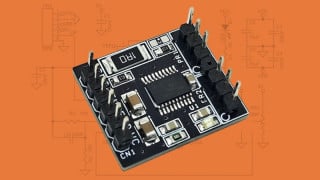
Combining LM2596 buck converter module with LM317 Linear Regulator

Thread Starter

Jerry-Hat-Trick

Joined Aug 31, 2022
775
I'm planning on using a 20V 3A supply to feed an LM2596 module (very cheap to buy) with the output going into an LM317 linear regulator to give me a very clean variable voltage output. I know there are other ways, but I have these components. I want to use the LM2596 to supply a voltage to the LM317 about 2 or 3 volts higher so the efficient buck converter does most of the work and the heat loss in the linear regulator is minimised.

I think if I use a 2 op amp LM358 powered by the 20V input I can somehow add the output of the LM317 (determined by a potentiometer) to 2 or 3V and difference this with the output voltage ofthe buck, by feeding this output to the FB pin of the buck I can automatically make the buck output 2 to 3V higher. The LM358 is not rail to rall but it does get close to the negative (ground) rail so the output can probably get down to the necessary 1.23V.

Is this possible? A schematic would be nice- I've searched and can find nothing like this.

Grateful for any ideas!
 

ronsimpson

Joined Oct 7, 2019
4,645
The opamp needs to be in a differential mode (use 4 resistors) so the output is (Vout of LM2596-Vout of LM317) Then take that "3V" and divide by about 3 to get 1.235V which goes to the FB pin on the LM2596.

I will look for a schematic.
----edited----
Not easy to find. LOL I know I have done it several times. There is an example in a data sheet somewhere.
 
Last edited:

Thread Starter

Jerry-Hat-Trick

Joined Aug 31, 2022
775
Thanks for the point in the right direction! I’m wondering, if the two input input resistors are 10K and the two feedback resistors are 3K3 whether this would give me a gain of 0.33 so one op amp with output fed to the FB pin would do the trick. I’m still not sure I can get my head around why the whole feedback loop actually works but I’m hopeful….
 

ronsimpson

Joined Oct 7, 2019
4,645
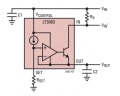
Most people use the LM317 or similar. I like the LT3083. It has a max input of 18V which might be a problem. The good point is that it can output as little as a fraction of a volt. It can be set to zero volts while the LM317 cannot be set to zero volts.
There are other versions of the part. The RT3083 and LT3083 parts have a very low dropout voltage! I think the RH part is slightly higher in voltage.
1765040066676.png
I cut off part of the schematic because it is too big to post. They use four LT3083s in parallel. (they parallel nicely)
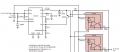
Lets use only one Linear regulator, and use your LM2596. The LT3083 needs only a fraction of a volt (input to output). The transistor has its Emitter on Vout of the PWM and its Base looks on Vout of the linear regulator. When the voltage is about 0.6V the transistor pulls up on VfeedBack. If you are using the LM317 then we need to add a V to E resistor in the transistor that makes it turn on at 3V. In another version of this schematic they used a P-MOSFET (small one). It takes about 3V to turn on the P-FET.
1765041752582.png
Hope this helps
RonS.
 

ronsimpson

Joined Oct 7, 2019
4,645
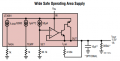
I went back in my notes and this is the part I used.
Almost the same but: Needs 1.5V in to out voltage. Works to 36V. Has a temperature function and current limit!
1765042624759.png
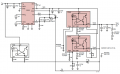
Here is their schematic. There are some functions in this version that you don't need.
See the current limit.
Also see how they used a P-MOSFET to watch for the voltage across the linear regulator. The 6V Zener is to protect the Gate.
1765042807524.png
This one: On the FB pin 100k/4.99k sets the max voltage. The P-fet turns on when the voltage across the linear regulator is more than some voltage.
 
Last edited:

crutschow

Joined Mar 14, 2008
38,316
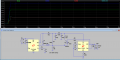
Below is the LTspice sim of a simplified circuit modified from post #5 using the LM317 and a switcher I had the model for:

You will likely have to change the value of D2 to get the desired input to output voltage value, depending upon the MOSFET Vth and the operation of the LM2596 you want to use.
D2 could be changed to a forward biased LED to get the desired drop. The color of the LED determines its drop.

The value of C5 may also need adjusting to insure loop stability.

1765218043307.png
 

schmitt trigger

Joined Jul 12, 2010
2,027
One very important aspect related to low noise:
The LM317’s ripple rejection is only characterized at 120 Hz. It rapidly deteriorates at higher frequencies. For additional rejection specifically at higher frequencies, utilize the recommended capacitor from the adjustment pin to ground.
Details on the data sheet.
 

crutschow

Joined Mar 14, 2008
38,316
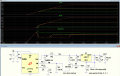
Below is the sim for Ian0's circuit:
I had to modify the BJT's resistor values since the LT1074 has a 2.2V FB reference voltage.
The base resistor was added to avoid anomalous operation at low voltages.

1765260403898.png
 

Ian0

Joined Aug 7, 2020
13,097
Below is the sim for Ian0's circuit:
I had to modify the BJT's resistor values since the LT1074 has a 2.2V FB reference voltage.
The base resistor was added to avoid anomalous operation at low voltages.

View attachment 360254
Thanks for doing the SPICE simulation for me - it was getting late here when I thought of it! I wondered what might happen at voltages around the minimum output of the LM317 because it corresponds to the feedback voltage, but I wanted to let other members have a look at it.
 

ronsimpson

Joined Oct 7, 2019
4,645
Below is the sim for Ian0's circuit:
Thanks for the circuit.
Here is what I did. Same thing, I think.
I used the LT3081 because I like it and it was open in another window.
L2 C1 added to reduce 100khz ripple.
R4 is current limiting.
R3 is to set the max voltage on the output of the switcher. Could be removed.
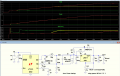
(Approximately) V on R2=2.21V, V on R10 about 2.2V, Voltage across U3 is about 2V
1765291335590.png
Red=FB voltage. Blue=Voltage (U3 in - U3 out), Green=Vout of U3, Blue-dark is Vout of switcher.
 

Attachments

Thread Starter

Jerry-Hat-Trick

Joined Aug 31, 2022
775
How about this?
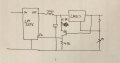
The circuit will maintain 1.23V across the 4.7k resistor, so about 1.8V across the 6.8k resistor, plus 0.6V for the base-emitter junction, will maintain about 2.4V across the LM317
Brilliant! Elegantly simple - and I appreciate the quick hand sketch. The module comes with a 10K trimpot to adjust the output voltage, connected to a 270R resistor connected to ground - I think I have to take these out to make it work. I may increase the 6K8 resistor to give a bit more headroom to the LM317.

Cheekily, I'm wondering if there is an easy way to add a variable current limit.....
 

Ian0

Joined Aug 7, 2020
13,097
Cheekily, I'm wondering if there is an easy way to add a variable current limit.....
make that 6.8k variable.
if you look at the datasheet, you’ll see that the drop-out voltage varies with output current. If you only allow it a limited dropout voltage it will restrict the output current. How accurate do you need it?

In the OnSemi datasheet there is a circuit for a laboratory power supply using two cascaded LM317s, which has current limiting, and TI’s datasheet has a current limited battery charger.
 

crutschow

Joined Mar 14, 2008
38,316
if there is an easy way to add a variable current limit.....
Depends upon the range of the limit variation you want.
Full range down to zero would likely require an added op amp to sense the load current that would then increase the value of the LM2596 FB input voltage.
That would provide efficient current limiting with no increase in power dissipation.
 

Thread Starter

Jerry-Hat-Trick

Joined Aug 31, 2022
775
Depends upon the range of the limit variation you want.
Full range down to zero would likely require an added op amp to sense the load current that would then increase the value of the LM2596 FB input voltage.
That would provide efficient current limiting with no increase in power dissipation.
I was thinking along these lines, a small resistor value in series with the LM317 output before the feedback resistor which would need an increase in the necessary buck output voltage. Difference the voltage across the resistor with gain, then use a comparator to compare this to a pot wiper connected between +ve and ground. When this swings to the rail it would pull the transistor base high to turn it off….
Hoping this would work, or am I overthinking?
 
Top