Combining Multiple AC Outputs Onto A Single Bus

Thread Starter

Angstrom

Joined Aug 29, 2025
17
I'm looking to produce a single 24v AC output to be used for controlling a self-holding circuit.

The output needs to be generated as an IF-ANY of 8x 24v AC control wires from thermostats. The thermostat outputs need to remain isolated so as to provide further independent control function.

My thought is to connect each of the thermostat wires to the coil of its own seperate SPST normally open relay. The input of the 8 SPST NO relays would be connected to a common 24v AC power supply. The outputs of the relays would be connected in parallel to a common wire.

My question is about the wisdom or lack thereof in connecting the outputs together on a common wire. It seems like I would have taken a single phase input and potentially converted it into an eight phase output due to the unequal distances of each current path.

Is the effect small enough to be ignored?

Is the approach I described above common and accepted, or is it strictly verboten?

I'd appreciate any feedback you can give.
 

BobTPH

Joined Jun 5, 2013
11,463
seems like I would have taken a single phase input and potentially converted it into an eight phase output due to the unequal distances of each current path.
That might be a problem if the frequency was in the GHz. At 60. Hz, not at all.
 

Thread Starter

Angstrom

Joined Aug 29, 2025
17
That might be a problem if the frequency was in the GHz. At 60. Hz, not at all.
Thanks for the input Bob! That confirms my gut feeling. The question has been kind of gnawing at me, as some things can do when you just don't know the answer.
 

Thread Starter

Angstrom

Joined Aug 29, 2025
17
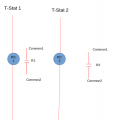
Tsat 1 and 2 are ?
RC 1 and 2 are
R1 and r2 are capacitors ?

Try a hand sketch , take picture and post that
T-Stat 1 and 2 are thermostats 1 and 2 24v AC. RC1 and RC2 are relay coil 1 and relay coil 2. R1 and R2 are relay 1 and relay 2 contacts.

Sorry if my low quality diagram made things more muddled instead of less. I can't easily upload a picture at the moment, but please let me know if this post clarified things a bit.
 

drjohsmith

Joined Dec 13, 2021
1,548
T-Stat 1 and 2 are thermostats 1 and 2 24v AC. RC1 and RC2 are relay coil 1 and relay coil 2. R1 and R2 are relay 1 and relay 2 contacts.

Sorry if my low quality diagram made things more muddled instead of less. I can't easily upload a picture at the moment, but please let me know if this post clarified things a bit.
Well I can't see any connection or control there ,so , can you try again pls.
 

Thread Starter

Angstrom

Joined Aug 29, 2025
17
Well I can't see any connection or control there ,so , can you try again pls.
Relay coil 1 controls relay contacts (normally open). Relay coil 2 controls relay contacts 2 (also normally open). Common 1 is 24vac input. Common 2 is the output signal, active if any of Thermostats 1-8 are active.
 

BobTPH

Joined Jun 5, 2013
11,463
In other words 8 SPST relays wired in parallel to switch a single 24VAC circuit.

Nothing wrong with that arrangement as far as I can see. It works whether there is one or nine sources of 24VAC.
 

Thread Starter

Angstrom

Joined Aug 29, 2025
17
Relay coil 1 controls relay contacts (normally open). Relay coil 2 controls relay contacts 2 (also normally open). Common 1 is 24vac input. Common 2 is the output signal, active if any of Thermostats 1-8 are active.
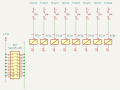
Here's another, hopefully clearer sketch.


TStat Relays 2.png
 

Thread Starter

Angstrom

Joined Aug 29, 2025
17
In other words 8 SPST relays wired in parallel to switch a single 24VAC circuit.

Nothing wrong with that arrangement as far as I can see. It works whether there is one or nine sources of 24VAC.
You're summing it up perfectly. Thank you again!
 

Tonyr1084

Joined Sep 24, 2015
9,744
Late entry here: You're controlling one unit from eight places? Sounds like a single heater with 8 zones. As long as you keep polarity correct you should be good to go. But have you thought this through?

All zones are set for heat when below 72˚F.
Zone 1 is 73˚ [no heat needed]
Zone 2 is 75˚ [no heat needed]
• • •
Zone 8 is 71˚ [heat needed]

If zone 8 turns the furnace on then all zones will be heating. Heating zone 8 to 73˚ also means heating zone 2 to 77˚. Is that OK? Or do you have additional plans for controlling which zones get heat? If your heating is Hydronic then only the zone(s) that need to be active can open a solenoid valve to allow heated water to warm that (those) zone(s). But if your heating is ductwork then it will be hard to control all eight zones.

Even if all eight zones are set to different heats, when one comes on - all zones will be getting heat. Unless it's hydronic (hot water) heat, and each zone controls hot water supply via an electronic valve.
 

Thread Starter

Angstrom

Joined Aug 29, 2025
17
Late entry here: You're controlling one unit from eight places? Sounds like a single heater with 8 zones. As long as you keep polarity correct you should be good to go. But have you thought this through?

All zones are set for heat when below 72˚F.
Zone 1 is 73˚ [no heat needed]
Zone 2 is 75˚ [no heat needed]
• • •
Zone 8 is 71˚ [heat needed]

If zone 8 turns the furnace on then all zones will be heating. Heating zone 8 to 73˚ also means heating zone 2 to 77˚. Is that OK? Or do you have additional plans for controlling which zones get heat? If your heating is Hydronic then only the zone(s) that need to be active can open a solenoid valve to allow heated water to warm that (those) zone(s). But if your heating is ductwork then it will be hard to control all eight zones.

Even if all eight zones are set to different heats, when one comes on - all zones will be getting heat. Unless it's hydronic (hot water) heat, and each zone controls hot water supply via an electronic valve.
That's not really what I'm trying to do. The output from above is used for a different purpose, to power a self holding circuit for other stuff.

I do totally agree with the point you've made though and I definitely wouldn't wish to do that without some very specific reason. It would sort of be creating 1 zone out of many for no particular purpose.
 

Tonyr1084

Joined Sep 24, 2015
9,744
The output from above is used • • • to power a self holding circuit.
Self latching. OK. I'm going to assume you have a scheme for de-latching the circuit. The whole thing is ridiculously easy. So easy it's hard to imagine unless you have a lot of experience. I'll bang out a picture in a few min's.
 

Tonyr1084

Joined Sep 24, 2015
9,744
OK, two different latching circuits. Note: the only way to de-latch is to cut power to the transformer. You CAN put a normally closed push button on the upper line to break the current and drop out the latch.

View attachment 355089
The above circuit will allow you to use 24VAC to control the relay. The upper part of the relay can switch whatever you wish (provided you're within the specs of the relay contacts.

View attachment 355090
THIS circuit will direct 24VAC to the NO contacts (Normally Open). When the Tstat closes the relay activates and remains active until you reset it somehow. Stand by for yet another drawing.
 

Thread Starter

Angstrom

Joined Aug 29, 2025
17
Wow! You're a real pro with these drawings. This gives me somethings to think about and some skills to aspire to. I eagerly await your next post. :D
 

Tonyr1084

Joined Sep 24, 2015
9,744
Wow! You're a real pro with these drawings.
No. Just use AutoCAD for my business. Custom Cabinet Maker. Since I have the program I can bang out some drawings, but for sure, I'm not a pro. I'm not an engineer. Just a guy who took drafting in college and knows a FEW things.
 

Tonyr1084

Joined Sep 24, 2015
9,744
Oh, you MIGHT want to substitute SW 1 with a toggle switch so you can turn whatever it is off when you want. Otherwise your thermostat might keep things on. Press SW 1 and the relay will drop out. But if the thermostat is still active (closed) as soon as you let go of the push button the circuit will immediately come right back on. This is all part of what you need to consider and decide on as for how your circuit functions. Understand all possible configurations good and bad before you run forward with your project.

Now I'm off to enjoy the rest of my Saturday.
 
Top