Problems with the Slayer Exciter Project

Danko

Joined Nov 22, 2017
2,172
if the three turns are close enough to the secondary winding , possibly wound on top of the secondarie's lower section, there will be a bit of capacitance between them, and so any disturbance in the collector voltage will couple back to the base, leading to a greater change in the collector voltage that gets capacitively coupled back to the base.
Instead it is the capacitive coupling between the windings, which is a function independent of the non-existing "ground" connection.
CHECKED:

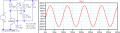
Conventional explanation:
1688891474750.png

@MisterBill2's assumption:
1688891490216.png
 
Last edited:

nsaspook

Joined Aug 27, 2009
16,333
CHECKED:

Conventional explanation:
View attachment 297993

@MisterBill2's assumption:
View attachment 297994
As is expected you can model the EM field energy feedback in several circuit theory models using physical lump circuit (parasitic capacitor) component values instead. The parasitic capacitance to ground exists because of fundamental electromagnetics, not circuit theory. There's nothing special about circuit 'grounds', they are just reference nodes for EM potentials in space.
 
Last edited:

MisterBill2

Joined Jan 23, 2018
27,615
None of the original documentation of that circuit references coil polarity as making any difference. And how many "newbies"would understand it ???
Besides that, the phase delay with haywire assembly is a random function. And the base-emitter capacitance will also have an effect.
 

nsaspook

Joined Aug 27, 2009
16,333
None of the original documentation of that circuit references coil polarity as making any difference. And how many "newbies"would understand it ???
Besides that, the phase delay with haywire assembly is a random function. And the base-emitter capacitance will also have an effect.
Nobody expects that newbies "would understand it" but experts should understand it, in at least a couple of different ways to explain it to them as was done here. Understanding the Barkhausen stability criterion as a necessary condition for oscillation but not a sufficient condition is important to understand why the haywire assembly still mostly works as it's the properly phased EM energy coupling in space that's the deciding factor.
http://mapoly.co.in/wp-content/uploads/2020/03/Oscillators-.pdf
Barkhausen Criteria
 

MisterBill2

Joined Jan 23, 2018
27,615
Nobody expects that newbies "would understand it" but experts should understand it, in at least a couple of different ways to explain it to them as was done here. Understanding the Barkhausen stability criterion as a necessary condition for oscillation but not a sufficient condition is important to understand why the haywire assembly still mostly works as it's the properly phased EM energy coupling in space that's the deciding factor.
http://mapoly.co.in/wp-content/uploads/2020/03/Oscillators-.pdf
Barkhausen Criteria
My point is that newbies especially should not be presented with a "Blooper" circuit that depends very much on exactly how it is assembled and the particular component valuse, along with the wiring arrangement, to even function. Providing a specious description of how the circuit works, when it can not be working that way, is not helping them understand anything. The primary purpose of educational projects is to develop insight, not to confuse folks. So to explain oscillators with inductive feedback, show them a Hartley oscillator. The way that circuit operates is easily explained.
 

nsaspook

Joined Aug 27, 2009
16,333
My point is that newbies especially should not be presented with a "Blooper" circuit that depends very much on exactly how it is assembled and the particular component valuse, along with the wiring arrangement, to even function. Providing a specious description of how the circuit works, when it can not be working that way, is not helping them understand anything. The primary purpose of educational projects is to develop insight, not to confuse folks. So to explain oscillators with inductive feedback, show them a Hartley oscillator. The way that circuit operates is easily explained.
What fun would that be? Newbies get exited by shiny things that spark and seem magical. They will be confused and not understand but the ones will talent will continue. One might say yours is the specious description but that would be as wrong as saying the other (and most popular because it's truer to actual EM theory) is specious because they are IMO both correct within the limits of circuit theory.

They will see "Blooper" circuits (a lot of what we do is to deal with parasitic effects that are confusing using pure circuit theory like PCB design, high speed digital and RF) for the rest of their technical lives. IMO the key for insight is seeing beyond circuit theory using blended electrical science methods that combine EM theory with HS math in parallel with circuit theory.
 
Last edited:

MisterBill2

Joined Jan 23, 2018
27,615
What fun would that be? Newbies get exited by shiny things that spark and seem magical. They will be confused and not understand but the ones will talent will continue. One might say yours is the specious description but that would be as wrong as saying the other (and most popular because it's truer to actual EM theory) is specious because they are IMO both correct within the limits of circuit theory.

They will see "Blooper" circuits (a lot of what we do is to deal with parasitic effects that are confusing using pure circuit theory like PCB design, high speed digital and RF) for the rest of their technical lives. IMO the key for insight is seeing beyond circuit theory using blended electrical science methods that combine EM theory with HS math in parallel with circuit theory.
Throwing garbage at beginners is not an appropriate way to teach anything, as I see it. And the blooper circuit that depends on capacitive coupling that is not shown in the circuit, as well as depending on things being "just so" is not a way to provide understanding.
Why defend a whole presentation that starts out by calling this blooper a Tesla coil? Why not point out that the whole explanation of how it works is a fabrication created to mislead?? The several threads that I have seen asking about why this circuit does not work have been by those who did not get it working and had no background to see what was not right about it.
 

MrAl

Joined Jun 17, 2014
13,716
An interesting alternative theory of operation in post #35, however, there is NO GROUND CONNECTION to any part of the circuit, and thus any capacitance to "ground" will not have an effect. Instead it is the capacitive coupling between the windings, which is a function independent of the non-existing "ground" connection.
Hello there,

This is interesting. I am not sure what you are describing here though when you said no ground connection.

It seems that when we have a 5v power supply the ground is at 0v of that power supply in most cases. When we have a 10v power supply same thing. When we have a 50v, 100v or so power supply, pretty much the same thing. The 'ground' in these cases is pretty well defined.

When we go up in voltage like 1000v or 5000v things are a bit different i think because then almost anything looks like a 'ground'. Even a +5v power supply voltage looks like a ground. That's because ratiometrically 5v is not much different than 0v when compared to 1000v or higher (roughly speaking).

With this, i think it is ok to describe the ground as being from the secondary output to 'ground' even though it may be partly from the actual ground and partly from the positive power supply, which means it is somewhat indistinguishable from leakage from the secondary to the primary of the 'transformer'.

Does that make sense to you or do you have an alternate reasoning for this action?

I should also mention that I have not done a thorough analysis of this circuit yet.
 

MrAl

Joined Jun 17, 2014
13,716
My point is that newbies especially should not be presented with a "Blooper" circuit that depends very much on exactly how it is assembled and the particular component valuse, along with the wiring arrangement, to even function. Providing a specious description of how the circuit works, when it can not be working that way, is not helping them understand anything. The primary purpose of educational projects is to develop insight, not to confuse folks. So to explain oscillators with inductive feedback, show them a Hartley oscillator. The way that circuit operates is easily explained.
Hi,

Yes i agree, but some newcomers are not looking so much for a good education as just getting their hands dirty with some cool electronic stuff that they can build themselves. Tesla coils have been like a mainstay for newcomers looking for a thrill in the electronics sector of hobbies and i guess the Frankenstein arcs are most attractive to them.

Now with reference to the subject material at hand, a parodic moment in history...

Long time ago there was a sort of contest between Edison and Tesla. It was to be decided which of their respective technologies was to be used for which purposes. After a long and heated debate, the decision had been handed down, and I quote it here:

"Ok, so Mr. Edison we will use your technology to light up the whole world, and Mr. Tesla we will use your technology in the background of Frankenstein movies".

<big chuckle>
 

MisterBill2

Joined Jan 23, 2018
27,615
Dealing with a "blooper" circuit that does not perform as promised, without having a clue as to why or what may be the problem will discourage a lot of folks. And calling this package a TESLA COIL is just a lie.
And as for "ground", most of the attemps have used a single 9-volt battery, not a mains powered supply, and so there is no connection to that mythical magical "ground plane" that has been referred to. Most beginners wisely start out with a battery, avoiding the hazard of mains connections and the expense of manufactured power supplies.
 

nsaspook

Joined Aug 27, 2009
16,333
Dealing with a "blooper" circuit that does not perform as promised, without having a clue as to why or what may be the problem will discourage a lot of folks. And calling this package a TESLA COIL is just a lie.
And as for "ground", most of the attemps have used a single 9-volt battery, not a mains powered supply, and so there is no connection to that mythical magical "ground plane" that has been referred to. Most beginners wisely start out with a battery, avoiding the hazard of mains connections and the expense of manufactured power supplies.
Real TESLA COIL's are a mainly useless curiosity that people build just for fun that often does not perform as promised.

I'll say again 'ground' here is a electromagnetic field theory reference point, not a circuit theory ground. The mythical magical "ground plane" electromagnetically exists (and is easily proven so most EE's will use that to describe circuit operation to a beginner) and is modeled in circuit theory as a capacitor to 'ground' to make it work in circuit theory simulations (like LTSPICE ) and equations.
https://www.electroboom.com/?tag=slayer-exciter

https://web.mit.edu/6.013_book/www/chapter1/1.0.html

For those who have an interest in electromechanical energy conversion, transmission systems at power or radio frequencies, waveguides at microwave or optical frequencies, antennas, or plasmas, there is little need to argue the necessity for becoming expert in dealing with electromagnetic fields. There are others who may require encouragement. For example, circuit designers may be satisfied with circuit theory, the laws of which are stated in terms of voltages and currents and in terms of the relations imposed upon the voltages and currents by the circuit elements. However, these laws break down at high frequencies, and this cannot be understood without electromagnetic field theory. The limitations of circuit models come into play as the frequency is raised so high that the propagation time of electromagnetic fields becomes comparable to a period, with the result that "inductors" behave as "capacitors" and vice versa. Other limitations are associated with loss phenomena. As the frequency is raised, resistors and transistors are limited by "capacitive" effects, and transducers and transformers by "eddy" currents.

Anyone concerned with developing circuit models for physical systems requires a field theory background to justify approximations and to derive the values of the circuit parameters. Thus, the bioengineer concerned with electrocardiography or neurophysiology must resort to field theory in establishing a meaningful connection between the physical reality and models, when these are stated in terms of circuit elements. Similarly, even if a control theorist makes use of a lumped parameter model, its justification hinges on a continuum theory, whether electromagnetic, mechanical, or thermal in nature.
 
Last edited:

MrAl

Joined Jun 17, 2014
13,716
Dealing with a "blooper" circuit that does not perform as promised, without having a clue as to why or what may be the problem will discourage a lot of folks. And calling this package a TESLA COIL is just a lie.
And as for "ground", most of the attemps have used a single 9-volt battery, not a mains powered supply, and so there is no connection to that mythical magical "ground plane" that has been referred to. Most beginners wisely start out with a battery, avoiding the hazard of mains connections and the expense of manufactured power supplies.
Hi,

Still not sure what you are trying to say here. Why are you so worried about a 'ground plane' ?
You don't have to have a ground plane to have a ground. Maybe it was explained wrong before this I'm not sure, or if I understand what your motivation is for mentioning this. It does sound interesting though so I hope you can elaborate.
 

MisterBill2

Joined Jan 23, 2018
27,615
Hi,

Still not sure what you are trying to say here. Why are you so worried about a 'ground plane' ?
You don't have to have a ground plane to have a ground. Maybe it was explained wrong before this I'm not sure, or if I understand what your motivation is for mentioning this. It does sound interesting though so I hope you can elaborate.
My complaint about the use of the term in explaining the operation of this particular circuit is that "ground" is not a part of it. No matter how hard one wishes it to be part of the operation, it is not.That is my complaint. claiming a connection exists when it does not.
 

nsaspook

Joined Aug 27, 2009
16,333
My complaint about the use of the term in explaining the operation of this particular circuit is that "ground" is not a part of it. No matter how hard one wishes it to be part of the operation, it is not.That is my complaint. claiming a connection exists when it does not.
Your complaint is completely, absolutely and totally specious. NOBODY (except maybe beginners that don't understand) is claiming a physical connected per a circuit theory diagram. They, as anyone versed in the art would do, is using it in a model of that circuit to explain how it operates using circuit theory. IMO twisting a perfectly valid explanation, rooted in perfectly valid electromagnetics, is the worst possible straw-man argument..
 

BobTPH

Joined Jun 5, 2013
11,548
On the other hand, I built one of these and it did not oscillate until I attached the top of a tin can to the top of the coil. So capacitive coupling, rather than inductive seems right to me.
 

MisterBill2

Joined Jan 23, 2018
27,615
On the other hand, I built one of these and it did not oscillate until I attached the top of a tin can to the top of the coil. So capacitive coupling, rather than inductive seems right to me.
Capacitive coupling could work IF IT WAS PRESENT!! In the original view the end of the coil was unattached and many inches away from the wires associated with the battery negative connection. That is a portion that is not mentioned, but certainly can make a difference. And it shows the flaw of the blooper circuit, which is that it depends on conditions not specified or even mentioned, that certainly would not be grasped by a beginner.
The capacitance between the collector coil and any part of that secondary is never mentioned in the explanations, and yet if the top of the secondary does not have enough capacitance to anything to allow a bit of feedback current to the base, nothing will happen.. Thus any oscillation would be beginners luck, with the reality quite well hidden. And hiding reality from beginners is a poor choice. At least as I see it.
 

nsaspook

Joined Aug 27, 2009
16,333
I think the circuit (as a interesting device) is a very useful teaching tool as it shows, in a simple circuit, the limits of circuit theory as an electrical science investigative (and predictive) tool for why something works or doesn't work. Circuit theory is for calculating practical electrical results (a very important theory that we all use daily) , it doesn't actually explain why the results happen. To gain actual circuit intuition you need a deeper understanding even if it's superficial at first.
 
Last edited:

BobTPH

Joined Jun 5, 2013
11,548
That is a portion that is not mentioned, but certainly can make a difference. And it shows the flaw of the blooper circuit, which is that it depends on conditions not specified or even mentioned, that certainly would not be grasped by a beginner.
The article I read when I built mine did mention the tin can top or a metal dome in top would help if it did not oscillate.
 

MrAl

Joined Jun 17, 2014
13,716
Capacitive coupling could work IF IT WAS PRESENT!! In the original view the end of the coil was unattached and many inches away from the wires associated with the battery negative connection. That is a portion that is not mentioned, but certainly can make a difference. And it shows the flaw of the blooper circuit, which is that it depends on conditions not specified or even mentioned, that certainly would not be grasped by a beginner.
The capacitance between the collector coil and any part of that secondary is never mentioned in the explanations, and yet if the top of the secondary does not have enough capacitance to anything to allow a bit of feedback current to the base, nothing will happen.. Thus any oscillation would be beginners luck, with the reality quite well hidden. And hiding reality from beginners is a poor choice. At least as I see it.
Hi again,

Here is the way i see it. If you have a plate of copper connected to the positive terminal of a battery or AC supply and you have another plate of copper connected to the negative terminal of the battery (or other lead of a AC supply) you have capacitance.
Start with two plates 1 meter square each, spaced 1 meter apart.
Now move those plates apart, the capacitance decreases but never goes precisely to zero.
Next, decrease the surface area of one or both of the plates, the capacitance decreases but never goes to zero.

In both cases the capacitance goes lower but we always have some capacitance. This makes it very hard to say that there is no capacitance between any two points of a circuit, no matter how small their surface area is, and no matter how far apart they are. This means there is going to be capacitive coupling between all points of a circuit, with some capacitance being larger than others. The smaller capacitive coupling of course has less effect than the larger coupling, so the larger coupling will dominate the workings of the circuit.

In fact, in theory points in space have capacitance between them and inductance between them as well. There's no getting away from this all we can do is make the surface area smaller (or larger) or increase (or decrease) the distance between them.
With that in mind, the closer together points will have more capacitance than the ones farther apart for a given unit surface area. The ones with larger surface area will have more capacitance than the ones with smaller surface area for a given unit distance.
This last one hits home I think because of the talk about adding a 'dome' or something like that, which is adding surface area and therefore there is an increase in capacitance. If that is a major factor in getting something to function properly, then I would presume that the capacitance due to that surface area had a significant role in how and why the circuit worked and so was responsible for its operation.
 
Top