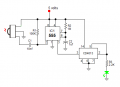
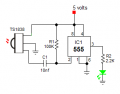
Well, thank you for the alternatives... At the moment, I don't have either of the ic's in order to build the circuit. This project has been a good experience for me. I always thought that once somebody put together something and shows that it works, anyone could do the same. Because of that, I would like to make a question to you or anyone who can make sense of this.
Q: my project is simple, straight forward in how someone can put it together in a short time. Also is not like a power supply that once under load it must keep up with the power delivery.
So, my only drive a component with very low power requirements, but still fails.
Without connection to a transistor or mosfet, works as it should, but once connected to a bjt or mosfet start to behave unpredictable. The video I saw the circuit is connected through a relay and works and behave as spected, it's controlling the relay that's all.
Sometime could explain what's happening, without going to particle physics behavior in the IR receiver. But something that makes some sense why it doesn't work as it should.
Thank you all for the help and time.... I'm very appreciative on the effort on your part.
In that video he may be experiencing the same problem a minute later, who knows. I can't explain why it's not reliable without one of those touch sensor modules to compare.
Recapping, the touch sensor works OK with the mosfet but when the TS1838 is connected the problem begins, correct?
Well, thank you for the alternatives... At the moment, I don't have either of the ic's in order to build the circuit. This project has been a good experience for me. I always thought that once somebody put together something and shows that it works, anyone could do the same. Because of that, I would like to make a question to you or anyone who can make sense of this.
Q: my project is simple, straight forward in how someone can put it together in a short time. Also is not like a power supply that once under load it must keep up with the power delivery.
So, my only drive a component with very low power requirements, but still fails.
Without connection to a transistor or mosfet, works as it should, but once connected to a bjt or mosfet start to behave unpredictable. The video I saw the circuit is connected through a relay and works and behave as spected, it's controlling the relay that's all.
Sometime could explain what's happening, without going to particle physics behavior in the IR receiver. But something that makes some sense why it doesn't work as it should.
Thank you all for the help and time.... I'm very appreciative on the effort on your part.
In that video he may be experiencing the same problem a minute later, who knows. I can't explain why it's not reliable without one of those touch sensor modules to compare.
Recapping, the touch sensor works OK with the mosfet but when the TS1838 is connected the problem begins, correct?
No, the touch sensor and the IR receiver works good until I connect them to the transistor or a mosfet in order to power the 12v lamp. That's why is puzzling me .
No, I never did measure it. But I used 2 different IR receiver, one it was the tsop1738, this one has a negative output and the second one was vs838 combined with the touch sensor, this sensor has a positive output pin. I think, not sure that their datasheet could mention that parameters.
The lamp is a 12v led, it's total power consumption is 3watts.
Because of the "testing fase" I am doind, I connected it with a wire around 30cm long. So, I don't think the lamp will interfere at all. It is a self made lamp.
No, I never did measure it. But I used 2 different IR receiver, one it was the tsop1738, this one has a negative output and the second one was vs838 combined with the touch sensor, this sensor has a positive output pin. I think, not sure that their datasheet could mention that parameters.

 Facebook
 Google
 GitHub
 Linkedin