Driving a GPO Telephone bell with MOSFET

Thread Starter

kevinyea

Joined May 27, 2024
2
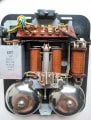
I have a vintage GPO telephone. The bell inside is circa 70V a.c. It comprises two coils (centre tapped) - effectively 2 x 35V coils. Which I want to drive with a DC pulse.
I took the centre-tap as 0V and connected the two coils (with flyback diodes) to MOSFET based modules (FR120N) which are being driven with 2 x square waves (below) from a microprocessor to emulate the British 1970's ring.

I can hear the hammer oscillate exactly as I remember the old phone used to ring but there is not enough energy being produced for the hammer to strike the bell. As part of diagnostics, I'm now working with just one coil.

I put the scope on the coil end and, instead of being a clean square, it's anything but - just a tall spike.
Any ideas what I can do to fix this? I've turned the voltage up on my desktop PSU to 90V (which helps) but that isn't a solution.

Any thoughts would be appreciated

1717173018838.png


Many thanks
Kevin
 

BobTPH

Joined Jun 5, 2013
11,463
How long are the pulses?
What is the coil resistance?

Perhaps they are too short. What you want to scope is the current through the coils.
 

eetech00

Joined Jun 8, 2013
4,704
I have a vintage GPO telephone. The bell inside is circa 70V a.c. It comprises two coils (centre tapped) - effectively 2 x 35V coils. Which I want to drive with a DC pulse.
I took the centre-tap as 0V and connected the two coils (with flyback diodes) to MOSFET based modules (FR120N) which are being driven with 2 x square waves (below) from a microprocessor to emulate the British 1970's ring.

I can hear the hammer oscillate exactly as I remember the old phone used to ring but there is not enough energy being produced for the hammer to strike the bell. As part of diagnostics, I'm now working with just one coil.

I put the scope on the coil end and, instead of being a clean square, it's anything but - just a tall spike.
Any ideas what I can do to fix this? I've turned the voltage up on my desktop PSU to 90V (which helps) but that isn't a solution.

Any thoughts would be appreciated

View attachment 323576


Many thanks
Kevin
What is the frequency of the square wave?
You might try using a lower frequency or increase the duty cycle.

Can you post an image of the scope waveform display? and maybe an image of the bell circuitry?
 

Ian0

Joined Aug 7, 2020
13,097
I think it should be 100V AC @ 25Hz.
That means that your power supply should be about 70V.
If your circuit has clamp diodes between drain and positive supply, that will probably stop it working.
You need the OFF MOSFET drain to go to double the supply voltage (140V), so you need 200V MOSFETs
 

Thread Starter

kevinyea

Joined May 27, 2024
2
Hi thanks for the replies so-far.
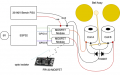
This is a schematic of sorts outlining the working digital side connected to the analogue side. On the right is the bell assembly (formerly ac). The flyback diodes are centre-tapped between ground and the two mosfet outputs.

BellDiagram.drawio.png
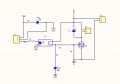
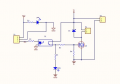
This is the schematic of the mosfet module
FR120N_Isolated_MOSFET_schematic.jpeg
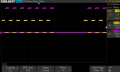
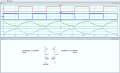
Below is the scope showing the digital side and it is representative of the output of the mosfet in the disconnected state.
The two channels are showing out of sync (as per the design, although note the voltages are set to 1v and 2v to separate them out a bit more)
SDS00003.png
I haven't got the screen capture when connected to the coil but the peak shows a ramp up then drop (spikes).
To note also, the faint sound of the bell armature oscillating is exactly the same as per the expected ring tone but the hammer goes nowhere near the bell. As Ian said earlier about the voltage, these mosfets are (I recall 90V) I'm pretty sure if I whack the voltage up it will eventually strike the bell. However, I am surprised if there is no way of driving the coils at a lower voltage and connect tap the wires direct to the psu, there is plenty of umf at 35 volts and I get a proper magnet and bell strike.
 

ericgibbs

Joined Jan 29, 2010
21,391
hi kev,
An alternating square wave drive is not the same as a sine wave drive.
Modify your ESP32 Sketch to send the left coil pulse, delay period and then right coil pulse, then delay period ......

E
 

Ian0

Joined Aug 7, 2020
13,097
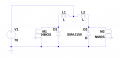
You need something like this:
Screenshot from 2024-06-01 09-10-48.pngThe flyback diodes that you have added will prevent it working. The drain voltage must be allowed to go to double the supply voltage.
 

ericgibbs

Joined Jan 29, 2010
21,391
hi kev,
Using a 20Hz square 50:50 M/S ratio, this is the current that flows in coils.
I have assumed 100mH and 10R coils.
E
EG57_ 1782.png
 

eetech00

Joined Jun 8, 2013
4,704
Hi thanks for the replies so-far.
This is a schematic of sorts outlining the working digital side connected to the analogue side. On the right is the bell assembly (formerly ac). The flyback diodes are centre-tapped between ground and the two mosfet outputs.

View attachment 323628
This is the schematic of the mosfet module
View attachment 323629
Below is the scope showing the digital side and it is representative of the output of the mosfet in the disconnected state.
The two channels are showing out of sync (as per the design, although note the voltages are set to 1v and 2v to separate them out a bit more)
View attachment 323630
I haven't got the screen capture when connected to the coil but the peak shows a ramp up then drop (spikes).
To note also, the faint sound of the bell armature oscillating is exactly the same as per the expected ring tone but the hammer goes nowhere near the bell. As Ian said earlier about the voltage, these mosfets are (I recall 90V) I'm pretty sure if I whack the voltage up it will eventually strike the bell. However, I am surprised if there is no way of driving the coils at a lower voltage and connect tap the wires direct to the psu, there is plenty of umf at 35 volts and I get a proper magnet and bell strike.
If the coils are designed for AC, and you attempt to operate them at the same DC voltage, they might be damaged. You have to determine the impedence of the coils at the intended operating frequency.
Are the solenoids still AC? or did you change them to DC solenoids?
Can you measure and post the DCR and inductance of one or both of the solenoids?

If AC is available, an SSR might be an option to drive the solenoids.
 
Last edited:

crutschow

Joined Mar 14, 2008
38,321
For the module circuit below, connect the common bell coil connection to +Ve bell supply.
Connect P2-2 of each module to each of the other coil connections.
Connect the triangle ground to the 5V ground, and the dashed ground to the bell supply ground.

The external 1N4007 diodes are not needed since the modules already has protection diodes.

1717251518889.png
 

Ian0

Joined Aug 7, 2020
13,097
Original ringers are designed for AC. They are coupled to the telephone line through a 1.8uF capacitor.
 

Ian0

Joined Aug 7, 2020
13,097
True, but that doesn't mean they won't operate properly with alternating DC of the appropriate voltage and frequency.
But if you clamp the flyback voltage with a diode, they get pulsing DC. I don't know whether that will work or not.
 

eetech00

Joined Jun 8, 2013
4,704
I think if you know the impedence of the coil at the original design frequency, then, determine the rms current, and match the DC drive current to the RMS current, to get the same mechanical "force", without burning up the coil.
 

Ian0

Joined Aug 7, 2020
13,097
My suggestion would be to get a 230V primary 24-0-24V secondary mains transformer. Drive it push-pull using two MOSFETs from 12V @ 25Hz and it should give 110V AC on the 230V winding.
Most tranformers that size are wound on double section bobbins, so the leakage inductance would round off the squarewaves a bit.
 

MisterBill2

Joined Jan 23, 2018
27,181
In post #8,, IAN WAS RIGHT!!! Get rid of the diodes!. AND, if your device looks like the one in post #15, the bell coils have self-interrupting contacts and so they can operate on DC.
ALSO, I have not seen any phone where the two coils are not simply in series, nothing like a center tap. ALSO, if you have the polarity wrong on one of them then the forces will tend to cancel. The phone company did it the way they did for a good reason.
 
Top