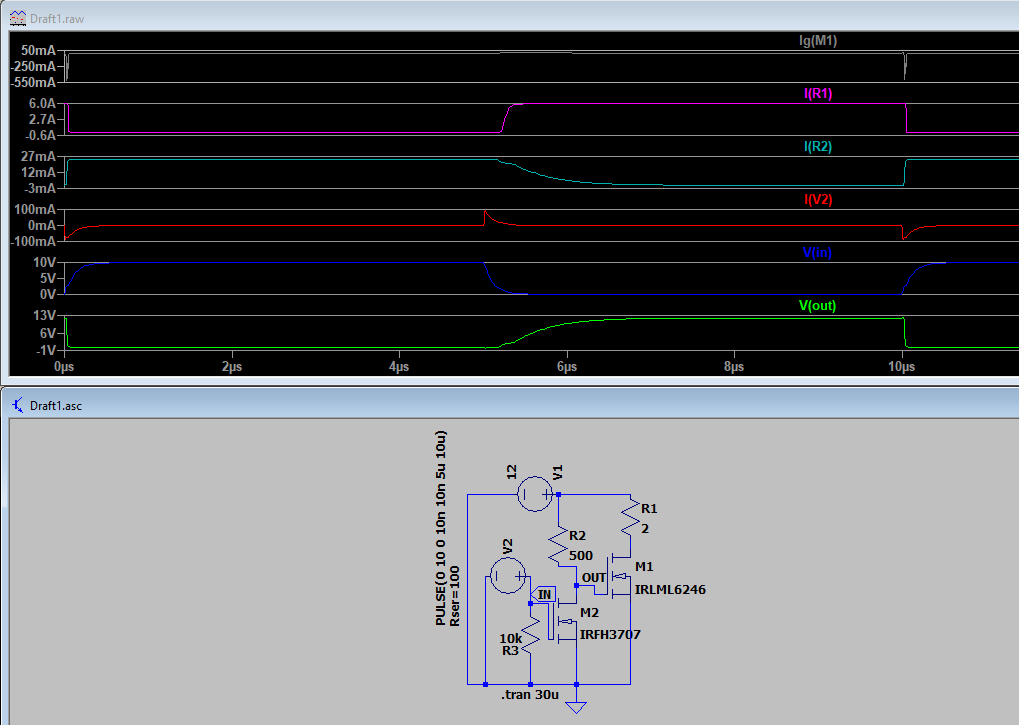
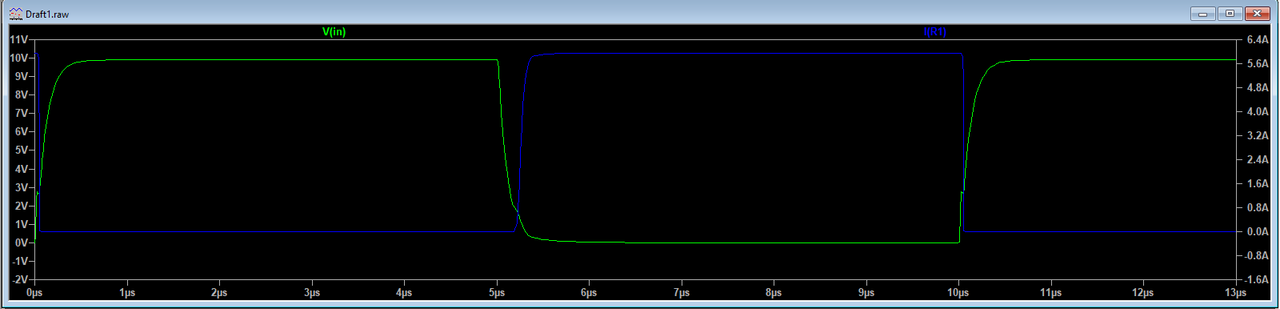
Don't do that - current will flow through the base-collector diode of Q1, and you will need a new Q1.if I set V1 at 16V square wave with a 12V (V2), transistor (Q1,Q2) get hot
Hi, yes you are right. Q1 is the hottest. So, what should I do to feed the gate of mosfet with 16V square wave if V1 is not allowed at 16V because the voltage fed into gate of mosfet is determined by the magnitude of V1? Thank youDon't do that - current will flow through the base-collector diode of Q1, and you will need a new Q1.
You can't drive 16V into the MOSFET unless your power supply (V2) is >16VHi, yes you are right. Q1 is the hottest. So, what should I do to feed the gate of mosfet with 16V square wave if V1 is not allowed at 16V because the voltage fed into gate of mosfet is determined by the magnitude of V1? Thank you![]()
Yes, I know. I am just curious, if V2 is 20V and V1 is 16V square wave, the transistors should be working fine right? So, are you saying that V2 must always be greater than V1 for the circuit to work effectively (transistor not hot) ? Thank you, sirYou can't drive 16V into the MOSFET unless your power supply (V2) is >16V
Why do you want to drive 16V into the MOSFET? It is unlikely to work any better than if you use 12V.
Yes. Absolutely.So, are you saying that V2 must always be greater than V1 for the circuit to work effectively
Hi, if V2 is 20V and V1 is 16V square wave, the transistors should be working fine right? I am planning to test it outYes. Absolutely.
Usually, whatever voltage supplies the circuitry that generates V1 also supplies V2.
Much more common is V1=5V and V2 = 12V or higher. In that case you need to amplify the voltage, for which I would recommend a gate driver IC.
Yes.Hi, if V2 is 20V and V1 is 16V square wave, the transistors should be working fine right? I am planning to test it out![]()
HI, I have tested it. The problem is the transistors buzz and suddenly pop and get spoiled when I use V2 is 20V and V1 is 16V square wave. Hmm, I think I will stick with V2 (12V) and V1 (12V) . I think is because I applied a too high base voltage for the transistors, thats why it buzz and popYes.
Careful, though. Most MOSFETs don't like more than 20V on the gate.
There are hundreds to choose from. I like MCP1401 and MCP1402. Search for "Low Side driver", there are inverting types, non-inverting types, types with additional logic functions etc.May I know what are the most common mosfet driver available in the market?
That circuit is not designed for an input voltage greater than V2.if I set V1 at 16V square wave with a 12V (V2), transistor (Q1,Q2) get hot.
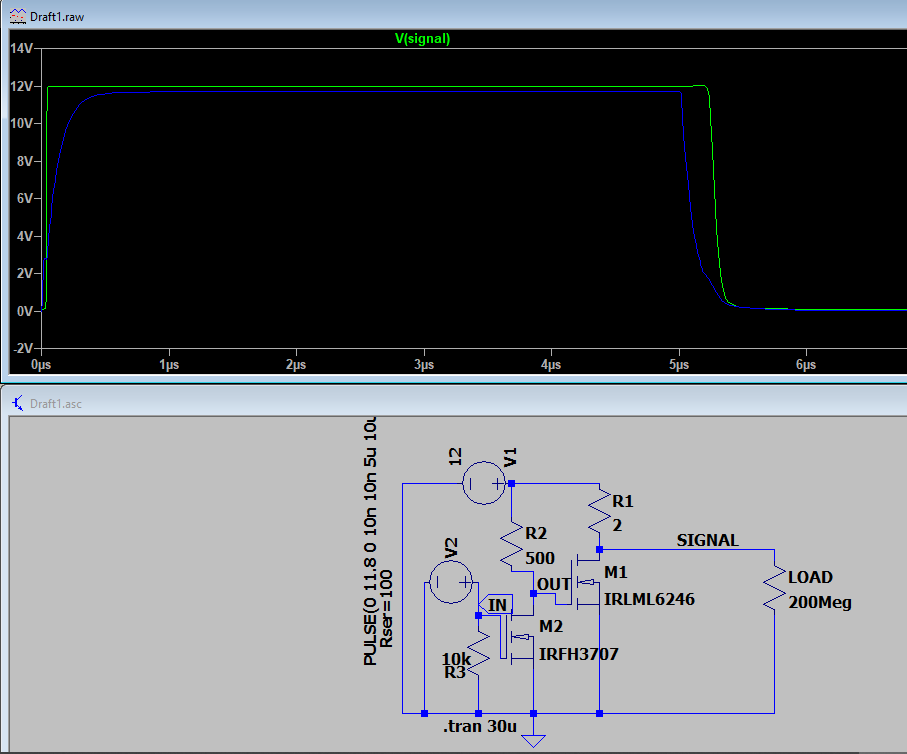
Hi sir, I attached my schematic below. Am i connecting it properly? In this case, I am using V2 lower than V1 because when I tested V2 greater than V1, the transistors becomes hot.That circuit is not designed for an input voltage greater than V2.
The transistors become incorrectly biased and draw a large current.
Why do you want an input voltage greater than V2?
That serves no useful purpose.

V1 and V2 should be equal.In this case, I am using V2 lower than V1 because when I tested V2 greater than V1, the transistors