Electromagnetic brake

MisterBill2

Joined Jan 23, 2018
27,523
I see this one has an output of 12volts +/- .3volts.
Dose this sound like a better unit ?
It does not match what I would expect from a switching regulator able to boost the input voltage. And none of the components in the PCB photo match a switcher regulator.
So it is not a device that can compensate for an input voltage drop. It is only a linear voltage regulator. It is not at all what the application requires. The input voltage range lower limit is 15 volts.
 

Thread Starter

rgsawmill

Joined Apr 13, 2025
103
It does not match what I would expect from a switching regulator able to boost the input voltage. And none of the components in the PCB photo match a switcher regulator.
So it is not a device that can compensate for an input voltage drop. It is only a linear voltage regulator. It is not at all what the application requires. The input voltage range lower limit is 15 volts.

I did not notice the input lower limit being 15 volts.. at a quick view I just noticed the output tolerance being +/- .3 volts.
 

MisterBill2

Joined Jan 23, 2018
27,523
While the heat sink gives the illusion that it might be a switcher, the specifications show otherwise. T compensate for an input voltage drop you need a switcher.
 

Thread Starter

rgsawmill

Joined Apr 13, 2025
103
I did not notice the input lower limit being 15 volts.. at a quick view I just noticed the output tolerance being +/- .3 volts.
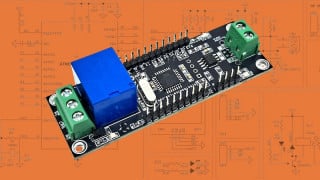
I know it may not make sense but I do like that the regulator I have is perfect dimensionality. It is able to piggyback the relay module perfectly saving space. I still have to mount glands to supply pwr in, motor pwr out, direction relay signal in, brake signal out and eventually I should have limit switches up and down. Space is running out . Do you have a recommendation of a switching regulator with boost/buck capabilities that will work ?
 

Irving

Joined Jan 30, 2016
5,123
1746628930188.png

Input: 3-40V DC • Output Voltage: 5-45V

[edit] reviews suggest this might not be boost-buck though advertised as such on Amazon UK.....
 
Last edited:

Thread Starter

rgsawmill

Joined Apr 13, 2025
103
I know it may not make sense but I do like that the regulator I have is perfect dimensionality. It is able to piggyback the relay module perfectly saving space. I still have to mount glands to supply pwr in, motor pwr out, direction relay signal in, brake signal out and eventually I should have limit switches up and down. Space is running out . Do you have a recommendation of a switching regulator with boost/buck capabilities that will work ?
Or do I even need Boost/Buck ? I hope to not see the voltage from the battery drop below 12 volts however from what I have been reading it is hard to regulate voltage when the input voltage is so close to the desired output voltage.(12 v in- 12 v out with engine not running/ 14 v in 12 v out with engine running) I would just like not to see a 3 volts drop I guess.
 

Thread Starter

rgsawmill

Joined Apr 13, 2025
103
View attachment 348638

Input: 3-40V DC • Output Voltage: 5-45V
View attachment 348638

Input: 3-40V DC • Output Voltage: 5-45V

[edit] reviews suggest this might not be boost-buck though advertised as such on Amazon UK.....
This unit is stating that output voltage must be higher than input voltage. With engine running the battery voltage will be 14 volts. Dose that mean the output needs to be higher ? If so I'm afraid we will be back where we were with the relay module not functioning properly.
Tks Bob G.
[edit] reviews suggest this might not be boost-buck though advertised as such on Amazon UK.....
 

Irving

Joined Jan 30, 2016
5,123
Or do I even need Boost/Buck ?
Probably not.

One of the reasons you are seeing a 3v rather than 2v differential is the fact the input is not polarised so has a 4-diode bridge rectifier in front of the regulator. This gives an additional 0.6 - 0.7v voltage drop. You could recover this by removing the diodes and bridging two of their locations. That might be a worthwhile 1st step in case of problems.

If need be, replace the 7812 in your current regulator with a Microchip MIC29150-12T, or a Texas Instruments LM2937ET-12. Both are pin compatible with the 7812 and feature a 0.2v input-output differential rather than 1.25 - 2v offset.
 

Thread Starter

rgsawmill

Joined Apr 13, 2025
103
Probably not.

One of the reasons you are seeing a 3v rather than 2v differential is the fact the input is not polarised so has a 4-diode bridge rectifier in front of the regulator. This gives an additional 0.6 - 0.7v voltage drop. You could recover this by removing the diodes and bridging two of their locations. That might be a worthwhile 1st step in case of problems.

If need be, replace the 7812 in your current regulator with a Microchip MIC29150-12T, or a Texas Instruments LM2937ET-12. Both are pin compatible with the 7812 and feature a 0.2v input-output differential rather than 1.25 - 2v offset.
Ok that sounds like a plan. I will run it as it is for now and check for any mechanical gremlins. I do have an other regulator and may try replacing the 7812 with one of your suggestions. That is the component that the heat sink is mounted to correct?
 

Irving

Joined Jan 30, 2016
5,123
Ok that sounds like a plan. I will run it as it is for now and check for any mechanical gremlins. I do have an other regulator and may try replacing the 7812 with one of your suggestions. That is the component that the heat sink is mounted to correct?
Correct.

Of course, if you do remove the diodes you must be careful to wire it up the right way round or the magic smoke will be let out!
 

MisterBill2

Joined Jan 23, 2018
27,523
If there are no problems then you don't need to change the regulator. That part about the voltage drop was what had me going about it. Another option that will be physically close to the same size is a regulator that does not require as much supply voltage, called a :low dropout" regulator. Aside from that, it may be that someplace in your system there is a poor connection that produces the voltage drop. Or maybe OK connections but one segment of the circuit with wire not thick enough. That has caused problems for other folks in the past. Quite hard to find, but simple to fix.
 

Thread Starter

rgsawmill

Joined Apr 13, 2025
103
If there are no problems then you don't need to change the regulator. That part about the voltage drop was what had me going about it. Another option that will be physically close to the same size is a regulator that does not require as much supply voltage, called a :low dropout" regulator. Aside from that, it may be that someplace in your system there is a poor connection that produces the voltage drop. Or maybe OK connections but one segment of the circuit with wire not thick enough. That has caused problems for other folks in the past. Quite hard to find, but simple to fix.
The supply voltage to the regulator is 12.6 or 13.9 depending on if the engine is running or not. The supply and ground wires are 18 gauge, that should be plenty for the current requirements. The drop 3 volts drop is within the regulator. Advertised drop is 2 v max. I bench tested the other one I got in the two pack has the same 3 v drop. I have been looking but so far it seems I can't find one exactly right. Either the input voltage needs to be greater than the output by more than I have or amp max is off or something. I may not be know knowledgeable enough to select the right components.
Tks. Bob G.
 

Thread Starter

rgsawmill

Joined Apr 13, 2025
103
It may be that the current draw is above the regulator's limit. That could be a challenge to check.
I will see if I can figure it out from the relay modules spec. Sheet. It shouldn't be over 1 amp I wouldn't think. The regulator is only energizing the winding side of the relay.(I guess there are LED's are involved also)
Also on an other topic: limit switches. Are the proximity type switches a reasonable alternative to mechanical switches ?
 

MisterBill2

Joined Jan 23, 2018
27,523
"Proximity switches" covers a fairly wide realm of devices. There are two basic classes, which are two wire and Three wire types. A caution on the "two wire" variety is that they are always conducting some current to operate. So they are never "totally off", although they are very useful in spite of that. But they will not work in a circuit that demands an open circuit in the off state. Three wire switches have a power feed wire and so need additional wiring.
AND ALL of the DC devices have specific output characteristics that must be respected, which is that they either sink current or they source current. The AC proximity switches can do both.
 

Irving

Joined Jan 30, 2016
5,123
t may be that the current draw is above the regulator's limit. That could be a challenge to check.
The relay module draws less than 50mA. The 3v drop is two diodes in the input bridge rectifier plus the native drop of an LM series regulator, hence 3v. There's no need to muddy the waters with speculation. I've given Bob options of removing the diodes plus dropping in an LDO should it be needed. Those two approaches would go from 3v to 0.2v differential and would be relatively easy fixes. My advice to Bob is run it as-is and see if problems rise in actual use.

Are the proximity type switches a reasonable alternative to mechanical switches ?
Possibly if you can ensure enough clear space around them to avoid false triggering. I use them on my CNC machine and they are faster acting than mechanical switches, and water-proof, but considerably more expensive. Also being electronic they would need something more to integrate into your setup, unless the Micron has suitable inputs for limit switches. Another option to consider is magnetic reed switches such as used on door alarms. They are cheap, sealed, and easy to integrate.
 

Thread Starter

rgsawmill

Joined Apr 13, 2025
103
The relay module draws less than 50mA. The 3v drop is two diodes in the input bridge rectifier plus the native drop of an LM series regulator, hence 3v. There's no need to muddy the waters with speculation. I've given Bob options of removing the diodes plus dropping in an LDO should it be needed. Those two approaches would go from 3v to 0.2v differential and would be relatively easy fixes. My advice to Bob is run it as-is and see if problems rise in actual use.


Possibly if you can ensure enough clear space around them to avoid false triggering. I use them on my CNC machine and they are faster acting than mechanical switches, and water-proof, but considerably more expensive. Also being electronic they would need something more to integrate into your setup, unless the Micron has suitable inputs for limit switches. Another option to consider is magnetic reed switches such as used on door alarms. They are cheap, sealed, and easy to integrate.
Thank you gentlemen.
So I'm assuming that a magnetic reed switch would be suitable to open a ground circuit. It would not need an external power source a magnet (target) would open a normally closed switch? Is that correct thinking? I will look them up.
 

Thread Starter

rgsawmill

Joined Apr 13, 2025
103
Thank you gentlemen.
So I'm assuming that a magnetic reed switch would be suitable to open a ground circuit. It would not need an external power source a magnet (target) would open a normally closed switch? Is that correct thinking? I will look them up.
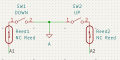
I guess I should explain what and where I would like to place the limit switches.
I figured that putting NC switches in series with the motor control command circuit would be the best location so a switch would open the path to ground stoping motor function in that direction however function in the opposite direction would still be allowed.
Example: A1= up when connected to A.
A2= down when connected to A.
So if I put a switch in the A1 and A2 lines the function will stop when a switch is open.
Am I stuck with a mechanical switch if I just want an open or closed circuit?
I know I have tested proximity switches in the past that do not require power to function .
 

Irving

Joined Jan 30, 2016
5,123
Thank you gentlemen.
So I'm assuming that a magnetic reed switch would be suitable to open a ground circuit. It would not need an external power source a magnet (target) would open a normally closed switch? Is that correct thinking? I will look them up.
You can get NO, NC and changeover reed switches.

So if I put a switch in the A1 and A2 lines the function will stop when a switch is open.
Exactly so. Reed1 detects lowest point of travel, Reed2 detects highest point of travel. AFAIK, the only form of proximity switch that doesn't need power is a magnetic one...

1746716173972.png
 
Top