[Review Request] A simple on/off circuit for an electromagnetic brake

Thread Starter

samsam0510

Joined Jan 16, 2025
9
1747240741497.png

Hi all,
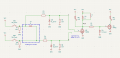
I'm making a circuit for my electromagnetic brake project.
The system has two buttons(SW1 and SW2), and these buttons generate two signals (A, B):
A = SW1
B = SW1 + SW2 (SW1 or SW2)

I've implemented the analog OR signal with diode, and added a zener diode to cut the voltage to 12V so that I can protect my mosfet gate.(Vgs max: 20V)

I will add a jumper pin to select either signal A or B for the gate of Q3, which will turn the brake on and off.

So, if A is selected, the brake will be turned on only with SW1.
On the other hand, if B is selected, the brake will turn on with SW1, SW2 or both.

Also, when the brake is off, Red LED (D6) will turn on and Green LED (D5) will turn off, and vice versa.


I wonder if I designed the low-side switching for the inductive load properly.
Also, I used a simple diode to implement an OR logic with the analog circuit, but if this is not the best, please tell me more!

I need some reviews from you experts before proceeding PCB layout.
Every review and comment will be welcomed.

Thanks!
 

Thread Starter

samsam0510

Joined Jan 16, 2025
9
I do not see any problems, although the area inside the dashed lines looks rater strange. Not wrong, just strange.
Thanks for reviewing:) Can I know more reasons about why it looks strange?
I've searched some online resouces for analog OR circuit and that approach was the simplest.
Is there a better way to do it?
 

MisterBill2

Joined Jan 23, 2018
27,173
What your switch circuit shows is a "wired OR" function when connection to "B" is wired. Often a dashed-line box is used to define an assembly of some sort, composed of the items enclosed by the box. So it is not wrong, it is just that only one item, a single diode, is all that is inside the box. And actually, the diode will probably be mounted to terminals , which will be "an assembly" .
The other reason is that a "wired OR" is obvious and does not need an explanation, at least not for many of us. So I was not trying to be critical with my comment.
 

panic mode

Joined Oct 10, 2011
4,864
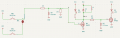
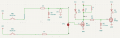
the only problem is that LEDs do not have series resistor. and if you are going to design PCB where you can select "connects to A or B", you may want to add a solder jumper or similar. you need something to assign suitable footprint. also circuit could be simplified...
1748016353463.png

or

1748016578693.png
 
Last edited:

Thread Starter

samsam0510

Joined Jan 16, 2025
9
Thanks for the comments and feedbacks with a detailed schematic.
One more thing I am concerned is that Q4's gate is not pulled down with a resistor.
I thought of pulling it down but then some current will flow through that pulldown resistor when it should not, and will have unintended operations.
Should I need a pull down or do you think it's good to go without it?
 

MisterBill2

Joined Jan 23, 2018
27,173
THE GATE OF q4 is pulled up towards Vcc by the current thru L1 and R2, in addition to the current thru D6 and it's series resistor, when Q3 is not conducting.
 

AnalogKid

Joined Aug 1, 2013
12,043
1. I vote for Panic's lower schematic with the more simple switch arrangement.

2. Q4 does not need a pull-down resistor. It always has a DC path to a low impedance voltage, either through L1 to Vcc or through Q3 to GND.

BTW, what is the value of Vcc?

ak
 
Top