What ICs (Analog and Digital Logic) to Buy for Study and Learning Home Lab?

Status
Not open for further replies.

dl324

Joined Mar 30, 2015
18,490
As far as "Cost" of ICs if I eliminate Amazon and Ebay, what prices am I looking at for ICs for 2 or 3 of each with reputable dealers you mentioned?
I haven't bought many components recently. Many simple CD4xxx gates were less than $0.50 in low quantity. I usually bought quantity 100 to get a price break.

I got my associate's degree in the mid-70's, so I tend to use components from that era. LM358 and LM339 were in the same ballpark.

I have components for barter in the bartering thread. If you don't have anything to barter, I'd sell them at about market price, and you pay postage.
Oh No ! Not SMD?
I hate those things. You can barely see them, they are tedious and difficult to solder and if you have a sneeze they will blow away.
SMD is just a fact of life. Some components are only available in surface mount packages.

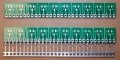
There are adapters that you can use:
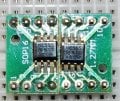
sipAdapterWithLeads.jpgSOP8From16Adapter.jpg

For more expense, and area, you can get inexpensive solderless adapters for SOIC from AliExpress:
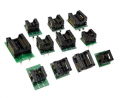
1746652481997.png
 

MrChips

Joined Oct 2, 2009
35,271

Lightium

Joined Jun 6, 2012
320
Back in the day, you could get a paper Mouser catalog with data for many parts. I would read and study it to familiarize myself with them.
 

Wendy

Joined Mar 24, 2008
23,857
Don't forget test equipment, a bench power supply and a DVM (digital volt meter) at the very least. Modern DVMs include Frequency counter options. Current bench power supplies are quite reasonable price wise
 
Last edited:

crutschow

Joined Mar 14, 2008
38,912
For simple, slow digital circuits I like the old CD4000 series CMOS ICs since they are close to the ideal logic circuit, as they can operate from a supply of 3V to 15V, require no static power or input current, and their output signal voltage is 0V to the rail voltage.
You just need to take basic ESD precautions to avoid static discharge when handling them, otherwise you can zap an input, and always connect all unused inputs to power or ground.
 
Last edited:

Thread Starter

RUSTYWIRE

Joined Aug 28, 2023
113
Back in the day, you could get a paper Mouser catalog with data for many parts. I would read and study it to familiarize myself with them.
That's sort of what I am looking for. I suspect there may be a book out there with pages of ICs organized into groupings
, i.e., "amplifiers", "oscillators", "logic gates" (different types), RF, or WHATEVER etc. etc. regarding what they are, what they do
and various specs. Maybe something like "1980 to 2010 or 1975 to 2000 or ALL ICs manufactured up to 2024 etc. or categorizing
in that manner, including manufactuer and availablity. That way I (or anyone) could flip through the pages to find what they need or see a type of IC they want to tackle.
 

Thread Starter

RUSTYWIRE

Joined Aug 28, 2023
113
I agree with your goal, I would suggest doing projects as you go. You will need a selection of parts to run your experiments:
Project Parts Reference V2.0
Wendy's Index
Wendy's Protoboard Circuits Cookbook

I strongly suggest you decide whether you want to play with analog or digital, an focus on one or the other first.
Like I said above, I took Boolean algebra (and digital electronics) as well as AC and DC, various circuit analysis (nothing super
complicated) solid state and even tubes-valves and a microprocessor course (the old type 8080 or 6502) plus basic electricity electronics in the Navy so I have some idea what I'm doing. I just need to get deeper into it. I could handle both
at the same time and get familiar with the different types of ICs. out there since I did not do much IC training.
 

Thread Starter

RUSTYWIRE

Joined Aug 28, 2023
113
Don't forget test equipment, a bench power supply and a DVM (digital volt meter) at the very least. Modern DVMs include Frequency counter options. Current bench power supplies are quite reasonable price wise
I have 3 DVMs, a cheap power supply (3-5 volts) a cheap signal generator (1-1MHz) and a cheap hand held Oscope.
Times are tough. I suppose I need to get a better power supply. I'm just experimenting though not building NASA gear.
I'm looking to get a better digital Oscope (maybe $200, $300 at most) however there are so many available, it is difficult
to decide which one but that is down the road a bit (not too long). I know 2 channel, perhaps 100 MHz is good. Many say
"Get an old Tektronix scope on Ebay for $75" but I'm not sure I want to go that route. "Money talks BS walks" as it is said.
 

Thread Starter

RUSTYWIRE

Joined Aug 28, 2023
113

Thread Starter

RUSTYWIRE

Joined Aug 28, 2023
113
I haven't bought many components recently. Many simple CD4xxx gates were less than $0.50 in low quantity. I usually bought quantity 100 to get a price break.

I got my associate's degree in the mid-70's, so I tend to use components from that era. LM358 and LM339 were in the same ballpark.

I have components for barter in the bartering thread. If you don't have anything to barter, I'd sell them at about market price, and you pay postage.

SMD is just a fact of life. Some components are only available in surface mount packages.

There are adapters that you can use:
View attachment 348669View attachment 348671

For more expense, and area, you can get inexpensive solderless adapters for SOIC from AliExpress:
View attachment 348672
The solderless adapters are for SMDs? that would make things easier. How do they attach to the mounting pads for SMDs?
 

Thread Starter

RUSTYWIRE

Joined Aug 28, 2023
113
For simple, slow digital circuits I like the old CD4000 series CMOS ICs since they are close to the ideal logic circuit, as they can operate from a supply of 3V to 15V, require no static power or input current, and their output signal voltage is 0V to the rail voltage.
You just need to take basic ESD precautions to avoid static discharge when handling them, otherwise you can zap an input, and always connect all unused inputs to power or ground.
I have a desk static pad and arm band. Where do I get those ICs? Elaborate on the advantage of getting those?
 

dl324

Joined Mar 30, 2015
18,490
The solderless adapters are for SMDs? that would make things easier.
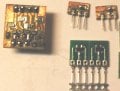
Yes. They're often used with 0.025" square male headers for inserting in breadboards (or boards). You can also use leadframes, if you can find them.
How do they attach to the mounting pads for SMDs?
With solder. Lower right example in the picture below.
smtAdapters.jpg
The others are homemade. The one on the left uses male headers. The others use leadframes.

Here's a discrete voltage regulator I made using some SMD transistors:
discreteMosfetRegulatorFinalAsBuilt.jpg
 

crutschow

Joined Mar 14, 2008
38,912
Where do I get those ICs?
The suppliers listed in Post #12 ( Jameco, Mouser, Newark, etc ) should have them.
Make note of the shipping charges, which can vary.
Elaborate on the advantage of getting those?
Standard TTL (Transistor-Transistor-Logic) parts fabricated with old BJT technology, require 5±0.25V power, consume power even when static, and have a low impedance, current-driven input.

The CD4000 CMOS parts operate from 3V-15V, consume no static current (other than a very low leakage value) so a small battery can power than for a long period, and they have a near infinite input-impedance, so it's easy to build RC time-delay circuits or RC oscillators with high value resistors and low value capacitors.
The also have a rail-rail output voltage with symmetrical output sink and source current capability, whereas TTL has only about a 3V output, and the output max sink current is significantly larger than than source current.

There is no good reason to use standard bipolar TTL parts (7400, 74LS00, etc.) anymore.

If you need high-speed operation (i.e. much over 1 MHz), there are 5V CMOS parts (e.g. 74xx00 where xx is HC or AC) that emulate all the TTL part function/types.
These directly interface with the slower CD4000 parts operated at 5V.
Interfacing TTL parts with CMOS parts is more difficult and normally avoided.
 
Last edited:

schmitt trigger

Joined Jul 12, 2010
2,275
I do have some TTL ICs, but last time they were actually used, was before the turn of this century.
Only CMOS from then on because the advantages mentioned earlier.
 

LowQCab

Joined Nov 6, 2012
5,102
~28 out of the ~30 ICs that I provided Spec-Sheets for are available in Trough-Hole versions.
For me, this is part of the value of this list.

Regarding which ICs are better suited to a particular type of Circuit .............
this is why You should should start studying the PDFs and defining the Specifications and
what those Specifications could mean in the context of the Circuit that You want to design.

Minimum and Maximum Power-Supply requirements ?

Quiescent-Current demands ?, ( important for Battery-Powered-Designs )

Input-Offset-Current ?
Input-Bias-Current ?
Input-Impedance ?
Slew Rate ?

Noise ?

Output-Current-Capacity ?

Rail-to-Rail-Inputs ?
Rail-to-Rail-Outputs ?

Available in Single, Dual, and Quad, Packages ?

Future replacements available ?
There are some ICs that will remain available, and cheap, and in Through-Hole-Packages,
because they can be used as a direct-replacement for numerous older-part-numbers.


If price is not a huge factor,
there are very High-Performance-ICs that can replace almost any other IC and
make your Circuit-Designing easier,
that is, if You don't mind paying ~$9.oo each. LM6144
.
.
.
 

Wendy

Joined Mar 24, 2008
23,857
When designing logic circuits I prefer CMOS because of the wide range of voltages available and the extremely low current draw. The only drawback is the ESD hoops you have to jump through. The only reason TTL exists is it draws the same amount of curd whether it is a 1 or a 0 out, all logic families draw more current if there's a lot of switching going on. Which is why CPUs tend to be such heat generators.
https://www.allaboutcircuits.com/textbook/semiconductors/chpt-9/electrostatic-discharge/
Something I wrote for the open source text book when I was fairly new to this site.
 
Last edited:
Status
Not open for further replies.
Top