TR switching and receiving echo signals

Thread Starter

demir-ali

Joined Jul 13, 2024
321
HI demi,
That is puzzling.
Try using your other OPA types and check for oscillation.
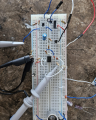
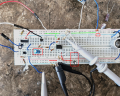
Post a photo of the layout, In know it's a PITA, but I may be able to see a problem.
E
Before I need to note that I also tested the circuit without piezo and I got the same output. Also I could not understand what do you mean as "PITA".
I only have NE5532 and LF353 yet but I can buy some other as their budget friendly , 10$ for an OPA is way too high for the budged of this project.
1721823683884.png
1721823717554.png
 

Thread Starter

demir-ali

Joined Jul 13, 2024
321
Hi demi,
Sorry to say, but that layout will give you problems, with a high gain tuned system.
E
View attachment 327712
The first blue capacitor is 1uF due to it transmits burst pulses. When I start the circuit without it , there is still same noise appearing at the output. Right top corner capacitor was connected when testing , to be sure I repeated connected.
Right bottom cap is 10uF , going to gnd.
 

Thread Starter

demir-ali

Joined Jul 13, 2024
321
Hi Eric, I replaced LF353 with an NE5532 and output is readable. I do some analysis. I will upload anything obtained.
 

MisterBill2

Joined Jan 23, 2018
27,555
Unintended coupling by means of the power positive and negative supply conductor resistance is quite common and is usually avoided by the addition of capacitors in parallel with the supply terminals of each active device.
The coupling problem is common enough that the capacitors are often included even without analysis, in many designs.
I did not see such capacitors in the experimental construction photos.
 

Thread Starter

demir-ali

Joined Jul 13, 2024
321
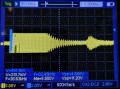
Hi MisterBill and Eric, I replaced both opas with NE5532 and I have perfect traction of echo signal I guess.If I could increase the gain by time it would be really perfect. I want to share a short video of traction of echo signal with you. I will try to upload here , if it does not work I do plan to upload youtube than share with you.
 

Thread Starter

demir-ali

Joined Jul 13, 2024
321
Unintended coupling by means of the power positive and negative supply conductor resistance is quite common and is usually avoided by the addition of capacitors in parallel with the supply terminals of each active device.
The coupling problem is common enough that the capacitors are often included even without analysis, in many designs.
I did not see such capacitors in the experimental construction photos.
MrBill , you are right but the noise is continious signal unlike parasite.
 

Thread Starter

demir-ali

Joined Jul 13, 2024
321
Now I need to dedect the peak and calculate the tof. I can do it with a opamp comparator but the echo wave's magnitude changes so I need to change the Vref. Can I get some hint pls ?
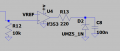
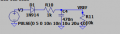
This is the comparator I made. Seems working. We have discussed about it before.
1721838781150.png
 

ericgibbs

Joined Jan 29, 2010
21,445
Hi demi,
Look at this option.
As this is a college project, I cannot give complete answers.

The strength/amplitude of the echo will vary with distance, also the size/shape and material of the reflecting surface.
You have to work out a swept gain method that works.
Also consider the Vref being a function of time after the TX.

OPA do not make good comparators, a comparator device like a LM393 is better.

EG57_ 1987.png
 

Attachments

Thread Starter

demir-ali

Joined Jul 13, 2024
321
Hi demi,
Look at this option.
As this is a college project, I cannot give complete answers.

The strength/amplitude of the echo will vary with distance, also the size/shape and material of the reflecting surface.
You have to work out a swept gain method that works.
Also consider the Vref being a function of time after the TX.

OPA do not make good comparators, a comparator device like a LM393 is better.

View attachment 327738
I will look for swept gain..
Since both RC circuit and echo wave drops voltage exponentially , I thought a circuit like this would be usefull.
1721842394542.png
 

Thread Starter

demir-ali

Joined Jul 13, 2024
321
Hi demi,
Look at this option.
As this is a college project, I cannot give complete answers.

The strength/amplitude of the echo will vary with distance, also the size/shape and material of the reflecting surface.
You have to work out a swept gain method that works.
Also consider the Vref being a function of time after the TX.

OPA do not make good comparators, a comparator device like a LM393 is better.

View attachment 327738
Hi demi,
Look at this option.
As this is a college project, I cannot give complete answers.

The strength/amplitude of the echo will vary with distance, also the size/shape and material of the reflecting surface.
You have to work out a swept gain method that works.
Also consider the Vref being a function of time after the TX.

OPA do not make good comparators, a comparator device like a LM393 is better.

View attachment 327738
I am missing u4 I guess it must be LM393.
Since the output is not crystal clear would it be ok using this type of build ?
 

Thread Starter

demir-ali

Joined Jul 13, 2024
321
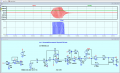
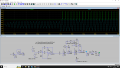
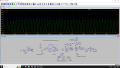
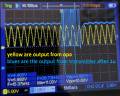
Hi Eric, I made a impedance switch module for my circuit which lets me increase gain digitally. My plan is to set constant Vref and switch gain after enough time passes so the gain increases.
Signal is constant and continuous , at 0.5ms impedance switches.
Green and blue traces are marked on the circuit.
Please review.
I need to note that I first used LM393 at comparator stage but it did not responded as I wanted so I changed it back to an opamp. I may rechange.
1721864184941.png
 

Thread Starter

demir-ali

Joined Jul 13, 2024
321
Hi, I've tested the cirucuit and with correct resistor values I guess its working but the gain switch is so sharp. I researched about time sensible gain but could not find any example or lectures. Do you have suggestions? I also found that most the noise at the output is due to opamps. But since NE5532 is verycheap its okay.
 
Top