TR switching and receiving echo signals

Thread Starter

demir-ali

Joined Jul 13, 2024
321
Hi demir,
I would suggest you try to measure echo signal strengths of the returned Echo at different angles to the plane of the Piezo.
As you may know, the ultrasonic beam is Cone shaped, so the echo strength falls as you move the 'target' away from the beam centre.
Being off the centre of the beam also slightly changes the measured distance.

The other problem is the shape/ and angle of the echo surface material effects the echo strength.

Do you know how to construct a simple test surface to check the echo distance/strength?

E.
Actually , I track the echo peak through the scope screen. To be able to track closer distances , I set step gain. If I can not catch it through stage1 then I go for stage 2.
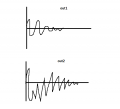
The issue I have with that opamp is , firstly I am having need to add an resistorto the ground at the output of opamp. Else , it does not produce output. Then , when I straight connect that output to opamp2's input since the output is well biased and them opas are in same package , I get an weird output like this in the picture. Increasing that resistors at the outputs value around 10k-75k kind of fixes it.
I used to use NE5532 and there was no such problem like this.
Now I also ordered new opas to test.
I add the circuit I use.
1727521837386.png
 

Attachments

Thread Starter

demir-ali

Joined Jul 13, 2024
321
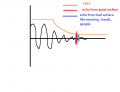
The other problem I mention is here. My Vref works fine with flat and hard surfaces but the material makes huge difference.
1727522126226.png
 

ericgibbs

Joined Jan 29, 2010
21,445
Hi demir,
When designing a piece of equipment, it is important that you design for a particular application.
In that way, you will set the performance to suit the application.

If you design for a universal application, the performance will be limited in some way for most projects.

One basic method is to add adjustable components in the design, so that you can trim the 'specification' to suit the project.

In your basic sounder project you would require to add Power output, Gain and Sensitivity controls.

Decide the basic specification which meets your requirements, post it, and then we design to suit.

E

As a note:
When dealing with your future clients, never start the product design until you have an agreed written specification document.
 

Thread Starter

demir-ali

Joined Jul 13, 2024
321
Hi demir,
When designing a piece of equipment, it is important that you design for a particular application.
In that way, you will set the performance to suit the application.

If you design for a universal application, the performance will be limited in some way for most projects.

One basic method is to add adjustable components in the design, so that you can trim the 'specification' to suit the project.

In your basic project you would require to add Power output, Gain and Sensitivity controls.

Decide the basic specification which meets your requirements, post it, and then we design to suit.

E

As note:
When dealing with your future clients, never start the product design until you have an agreed written specification document.
Yeah you are right. Thanks for advice. But for example a car park sensor can dedect both people and flat walls. Or shall I go for different comparsion methods ? Any suggestions releated or not related at all ?
 
Top