Facebook
 Google
 GitHub
 Linkedin

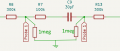
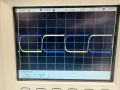
I have this setup: HV507 output -- 300k ohm resistor -- 30pF capacitor -- 100k ohm resistor -- 300k ohm resistor -- hv507 output. The hv507 both output pulses, except they are phased 180 degrees from one another. Essentially this setup forms a different square wave. I wanted to understand why the voltage is reduced by roughly 10%. For instance, I ran a pulse setup where I run from 50v to 0v and the rms of that pulse is 21.5v when it should be 25v. What is the math behind this?
1. When I did a test where I removed both the 300k resistors, the waveform possessed more squared edges and the RMS that is displayed the top right corner was closer to 25v. This is the chip data sheet that is driving this setup (https://ww1.microchip.com/downloads...-Push-Pull-Outputs-Data-Sheet-DS20005843B.pdf). Also there are two HV3418 outputs, one at each end. The waveforms (pulses) produced from each of these outputs are phased 180 degrees from another. I want to understand what the reason is for the reduced RMS and how to calculate it. Also is there any way to somehow use these results and understand what the RMS would look like for another chip with slightly different characteristics (ex: less current sourcing/sinking from each output), specifically the HV507 (https://ww1.microchip.com/downloads...OTH/ProductDocuments/DataSheets/20005845A.pdf)
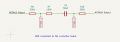
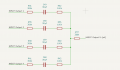
2. Also a another question, I want to be able to gauge how many outputs being active the chip can handle. For instance this what the circuit would look like, except instead of 4 outputs going into the output 5 (going to be referred to as the ref pin) with maybe 10 - 20 outputs. What are the calculations behind this?
1. When I did a test where I removed both the 300k resistors, the waveform possessed more squared edges and the RMS that is displayed the top right corner was closer to 25v. This is the chip data sheet that is driving this setup (https://ww1.microchip.com/downloads...-Push-Pull-Outputs-Data-Sheet-DS20005843B.pdf). Also there are two HV3418 outputs, one at each end. The waveforms (pulses) produced from each of these outputs are phased 180 degrees from another. I want to understand what the reason is for the reduced RMS and how to calculate it. Also is there any way to somehow use these results and understand what the RMS would look like for another chip with slightly different characteristics (ex: less current sourcing/sinking from each output), specifically the HV507 (https://ww1.microchip.com/downloads...OTH/ProductDocuments/DataSheets/20005845A.pdf)
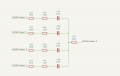
2. Also a another question, I want to be able to gauge how many outputs being active the chip can handle. For instance this what the circuit would look like, except instead of 4 outputs going into the output 5 (going to be referred to as the ref pin) with maybe 10 - 20 outputs. What are the calculations behind this?