TDK-Lambda i7C converters hiccup when switching motor between +24V and −16V rails

Thread Starter

GiosefHV

Joined Feb 19, 2026
11
Hi all, I'm using DC-DC converters to generate 16V and 24V rails from a 12V vehicle battery. The 12V input comes directly from the vehicle battery, and the outputs are switched to DC motors through relays controlled by a motor controller.

The motor drive is polarity switching:
  • Motor sees +24V when controller commands forward
  • Motor sees −16V when controller commands reverse
  • This is done using relay switching between the two converter outputs

Issue:
  • With no load, both converters output the correct voltages
  • When a motor is connected, the output appears to short
  • The converter starts making a faint "whirring"/hiccup sound
  • Voltage collapses when the motor is connected
  • Measuring only with a multimeter (no load), everything behaves normally

Input source:
  • 12V automotive battery

Components used:
  • DC-DC Converter: I7C2W020A120V-PF3-R
  • Relays: CB1-P-12V automotive SPDT 40A
  • Schottky diode: STPS60L45CW (45V 30A dual)
  • Protection diodes: 1N5404 (3A)
  • Flyback diodes: 1N4007 (1A)
  • Trim resistors:
    • 6.49kΩ (MF0207FTE52-6K49)
    • 1.5kΩ (RNF14FTD1K50)

Architecture:
  • Two DC rails (16V and 24V)
  • Relay-based polarity reversal
  • Motor connected to switched output
  • Shared ground plane PCB

It seems like the converter is entering short-circuit or current limit protection when the motor is connected. Has anyone seen this behavior when using DC-DC converters to drive motors with relay-based polarity switching?

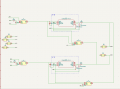
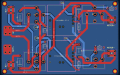
Schematics and PCB layout attached.

This is my first larger PCB project, so I’d really appreciate a sanity check in case I’m missing something obvious.


Thanks for all the help :)!
1774304215083.png
1774304227616.png
 

ronsimpson

Joined Oct 7, 2019
4,645
The stall current of a motor is very high. (current when rpm=0) Startup current starts out at stall current then drops back.
If a motor is running and you reverse the power the current is more than stall current while the motor is running against the current.
You should be thankful the PWM have current limit.
 

MisterBill2

Joined Jan 23, 2018
27,159
RON S is totally correct ! In addition, if you are simply switcing the motor between +24 volts and -16 volts, without stopping it first, THAT WILL produce a much larger current spike!!
There are a few ways to reduce that problem, "MAX" probably can describe them better than I would. And certainly themotors should be stopped before reversing. And a speed ramp-up will reduce the surge quite a bit. A slow-rising drive voltage is a goos second choice.
 

ronsimpson

Joined Oct 7, 2019
4,645
Another thing. The turn on time and the turn off time of a relay is different.
If you turn off the forward relay and turn on the backward relay you will have a short time when both relays are on. You have +24 shorted to -16.
---edited---
There are many different types of relays made in different ways.
On the on vs off time; the open up time is often listed with no diode across the coil. You must have a diode.
I found a relay where it comes with or without a built-in diode. That relay said 15mS to close. 5mS; to open with no diode, and 20mS to open with a diode. With this relay you would short out the supplies for 5mS. (times vary with temp and other factors)
I think you should try; open relay, delay 10mS, close relay. See if that helps.
 
Last edited:

MisterBill2

Joined Jan 23, 2018
27,159
IF you happen to get the polarity reversed on one of the "hidden diode" relay installations you can waste a lot of time searching for the problem. AND in a DC powered controls system it certainly WILL cause problems.
 

Thread Starter

GiosefHV

Joined Feb 19, 2026
11
Another thing. The turn on time and the turn off time of a relay is different.
If you turn off the forward relay and turn on the backward relay you will have a short time when both relays are on. You have +24 shorted to -16.
---edited---
There are many different types of relays made in different ways.
On the on vs off time; the open up time is often listed with no diode across the coil. You must have a diode.
I found a relay where it comes with or without a built-in diode. That relay said 15mS to close. 5mS; to open with no diode, and 20mS to open with a diode. With this relay you would short out the supplies for 5mS. (times vary with temp and other factors)
I think you should try; open relay, delay 10mS, close relay. See if that helps.
I’ll have to give this a try. I’ve finally been able to test the circuit, and what we’re essentially doing is jacking a car’s corner faster by switching supply levels—running the normal 12V system up to 16V on the way up, and up to 24V on the way down.


I ran into the exact issue you mentioned: when the motor direction changes instantaneously, the relays chatter and the system ends up tripping. It works reliably if there’s a small dead-time between switching (on the order of ~50–100 ms or even less), but the problem shows up when the control button is released mid-sweep and the direction change happens immediately.


That’s when I’m likely getting the brief overlap condition you described, where both relays are effectively on for a short window and the supplies momentarily fight each other. I’m going to try your suggestion of forcing a deliberate delay between opening one relay and closing the other to see if that cleans it up
 

MisterBill2

Joined Jan 23, 2018
27,159
Besides everything else, trying to follow the circuit schematic in post #1 is very difficult! In fact, I simply do not get it at all. I see graphics that I suspect are supposed to represent relays, but they are not symbols that I have ever seen in my many years of experience. They are not JIC or NEMA symbols for relays. Are the symbols part of some simulator software??
 

Thread Starter

GiosefHV

Joined Feb 19, 2026
11
Besides everything else, trying to follow the circuit schematic in post #1 is very difficult! In fact, I simply do not get it at all. I see graphics that I suspect are supposed to represent relays, but they are not symbols that I have ever seen in my many years of experience. They are not JIC or NEMA symbols for relays. Are the symbols part of some simulator software??
They are supposed to be relays. I do agree with you—they are kind of hard to follow. I’m using KiCad to build the PCB, so I just pulled the symbols from the DigiKey ECAD/EDA library and, for convenience, went with what they had. They do work as expected, though.


It’s a bit easier to follow in the PCB Editor view, sorry for the confusion. I think it’ll be better practice for me going forward to not be lazy about it and switch everything over to the standard symbols.
 

MisterBill2

Joined Jan 23, 2018
27,159
Certainly there are standard symbols that have not changed!!
The situation is a lot like the interviewer changing languages during a job interview, when language skill is not part of the jobs requirment!
There are the JIC symbols and the NEMA symbols that are common and available with no copyright issues or costs. There might even be a "symbols" section somewhere in this website.
 
Top