Three stages power amplifier school project

Audioguru again

Joined Oct 21, 2019
6,826
The simulation program does not know that beta is a range of numbers. The sim program simply uses the "typical" beta number then when a transistor with low beta or high beta might not work when the circuit is built.

A simulation program is also stupid enough to allow a low power transistor to be severely overloaded but not show any problem.
 

Ylli

Joined Nov 13, 2015
1,092
The simulation program does not know that beta is a range of numbers. The sim program simply uses the "typical" beta number then when a transistor with low beta or high beta might not work when the circuit is built.

A simulation program is also stupid enough to allow a low power transistor to be severely overloaded but not show any problem.

The part .model does provide a specific value for beta, Bf, but the value is only good under very specific conditions. Other variables such as Vce and actual Ic will push that value one way or the other in the .model.
 

Audioguru again

Joined Oct 21, 2019
6,826
I think a simulation program should be smart enough to "sweep" the range of beta to show you if a transistor will be cutoff or saturated if it has passing low or high beta.
 

Thread Starter

Lucky-Luka

Joined Mar 28, 2019
181
Regarding the simple output stage (not the sziklai one)
I thought that the current source just needed to be greater than the maximum Ib at Ie_peak=1.4A
The gain of that transistor is 66 (from LTSpice parameters) so I did Ie_peak/66=Ib_peak=21mA
I left 4mA for the Vbe multiplier and I thought I was ok.
I don't understand how I can choose that value. Just trying to increasing it and looking at the result?
 

Thread Starter

Lucky-Luka

Joined Mar 28, 2019
181
I'm confused.
The current that you mentioned are quiescent currents right? Is there a way to choose them? I think the answer to my question is related to that. Which Ic is right for the output transistor? The answer is related to the distortion that I can accept, right?
The current I mentioned are peak currents and I thought I dimensioned them right.
Maybe I was wrong since beta can vary...
 

Audioguru again

Joined Oct 21, 2019
6,826
Since you cannot select the beta of a transistor, if you want every circuit to work properly then you design with the minimum beta printed in the datasheet for the current you need. The curves in a datasheet are usually only for a "typical" device but many devices have lesser spec's.
Or you could buy many extra transistors, test them all and throw away or sell the minimum ones on ebay.
 

Ylli

Joined Nov 13, 2015
1,092
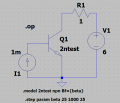
I don't think AG believes in sims. How did you determine that the 2n3055 .model had a beta of 66 at IC=1.4 amps? I see Bf=73 in the .model, but that value usually falls at higher IC.

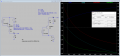
Simple test circuit attahed
 

Attachments

Thread Starter

Lucky-Luka

Joined Mar 28, 2019
181
Simple test circuit attahed
Great simple test circuit.
I haven't thought about it.
I've done the same for the other BJT.
So, at the end of the day I have to look at the greater Ib current of those two transistor at peak Ic (considering beta variation as in the image explained) and that should be the minum current (plus the current for the Vbe multiplier) that my current source should give to the circuit. Right?
Cheers
 

Attachments

Last edited:

Thread Starter

Lucky-Luka

Joined Mar 28, 2019
181
Hi all
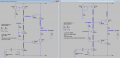
I've compared a Darlington version of the circuit with a Sziklai one.
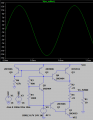
I can't understand why I cannot have the full +-14V swing at the output with the Darlington one.
Have I done something wrong? How can I improve the situation?
I don't understand if that's due to something wrong I did with the Darlington version of the circuit or it's due to the fact that Sziklai have half tension across Vbe multiplier.
Happy new year
 

Attachments

Jony130

Joined Feb 17, 2009
5,598
Are you going to build this amplifier in real life or only in the virtual world of simulation?
 
Last edited:

Thread Starter

Lucky-Luka

Joined Mar 28, 2019
181
Are you going to build this amplifier in real life or only in the virtual world of simulation?
This is just an electronics college course exercise. Maybe in the future I will try to build it using proper transistors and so on but for now it's just a theoretical project.
 

Thread Starter

Lucky-Luka

Joined Mar 28, 2019
181
Amazing... In just a few minutes... I thought that if I couldn't get the full swing at that stage I could not proceed. May I ask why did you set the input impedence at 22k? At least I think that's the purpose of R11.
Are R7 and R8 speedup resistors? Is it better to connect them like that than connecting base emitter of Q1 and Q2?
Thanks
 

Jony130

Joined Feb 17, 2009
5,598
May I ask why did you set the input impedence at 22k? At least I think that's the purpose of R11.
Why not? Also, you wrote: "amplifier input resistance >= 10kohm" and for sure 22kΩ is larger than 10kΩ.

Are R7 and R8 speedup resistors?
Yes, they help to discharge the Cbe capacitance. And they help improve the thermal stability of an output stage.

Is it better to connect them like that than connecting base-emitter of Q1 and Q2?
What will be the difference if R1 = R2 = 0.22Ω
 
Top