Facebook
 Google
 GitHub
 Linkedin
Hello everyone,
We are currently developing a three-phase energy meter based on a non-isolated ("Hot MCU") architecture. In this design, the low-voltage section (MCU, AFE, and Ground) floats at line potential, with the measurement front-end referenced directly to the mains via high-value resistive dividers.
We are seeking feedback on the robustness of our current analog front-end implementation, specifically regarding our biasing strategy and signal conditioning for production-grade reliability.
System Architecture Overview:
Our Primary Concerns:
We would appreciate any insights on whether this implementation is suitable for a production-grade meter or if we should pivot toward a more decoupled architecture.
Thanks in advance for your expertise!
We are currently developing a three-phase energy meter based on a non-isolated ("Hot MCU") architecture. In this design, the low-voltage section (MCU, AFE, and Ground) floats at line potential, with the measurement front-end referenced directly to the mains via high-value resistive dividers.
We are seeking feedback on the robustness of our current analog front-end implementation, specifically regarding our biasing strategy and signal conditioning for production-grade reliability.
System Architecture Overview:
- Power Supply: 5V SMPS-based supply (non-isolated).
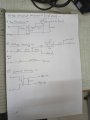
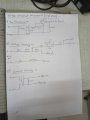
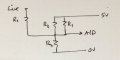
- Voltage Sensing: High-impedance resistive divider (2 X 680KΩ + 2.2KΩ ). This is followed by an op-amp unity-gain buffer.
- Current Sensing: Internal Current Transformers (1000:1 ratio) with a 300Ω burden resistor.
- Biasing: We use an op-amp stage to generate a 2.5V mid-bias (Virtual Ground). Both the voltage buffers and the CT burden resistors are referenced to this single Vgnd point.
- Filtering: Standard RC low-pass stages before entering the MCU ADC pins.
Our Primary Concerns:
- Global Virtual Ground (Vgnd): Is it acceptable to use a single op-amp-buffered virtual ground for all three voltage channels and three current channels? We are concerned about potential crosstalk or stability issues when multiple ADC sampling transients hit the same bias rail.
- Differential vs. Single-Ended: While this single-ended approach (referenced to Vgnd) is cost-effective, would moving to a fully differential sensing approach provide significant gains in noise immunity for a "hot" design, or is it overkill given the lack of isolation-related common-mode noise?
- Phase Shift & DC Offset: Given we are using unity-gain buffers and a shared bias, what are the best practices for compensating for op-amp input offset voltages and phase shifts introduced by the CTs and RC filters in firmware?
- Production Robustness: For those with experience in industrial or utility-grade metering, are there any "gotchas" regarding long-term drift of the high-value dividers or protection against mains transients (4kV + bursts) in this specific floating-ground topology?
We would appreciate any insights on whether this implementation is suitable for a production-grade meter or if we should pivot toward a more decoupled architecture.
Thanks in advance for your expertise!