Technics SU-VX800 amplifier

Thread Starter

Marius83

Joined Dec 28, 2017
423
@pvanb, thanks, it's altso metioned earlier in this thread, but as i understand it will not work very well in this case.

@Mr.Chips:

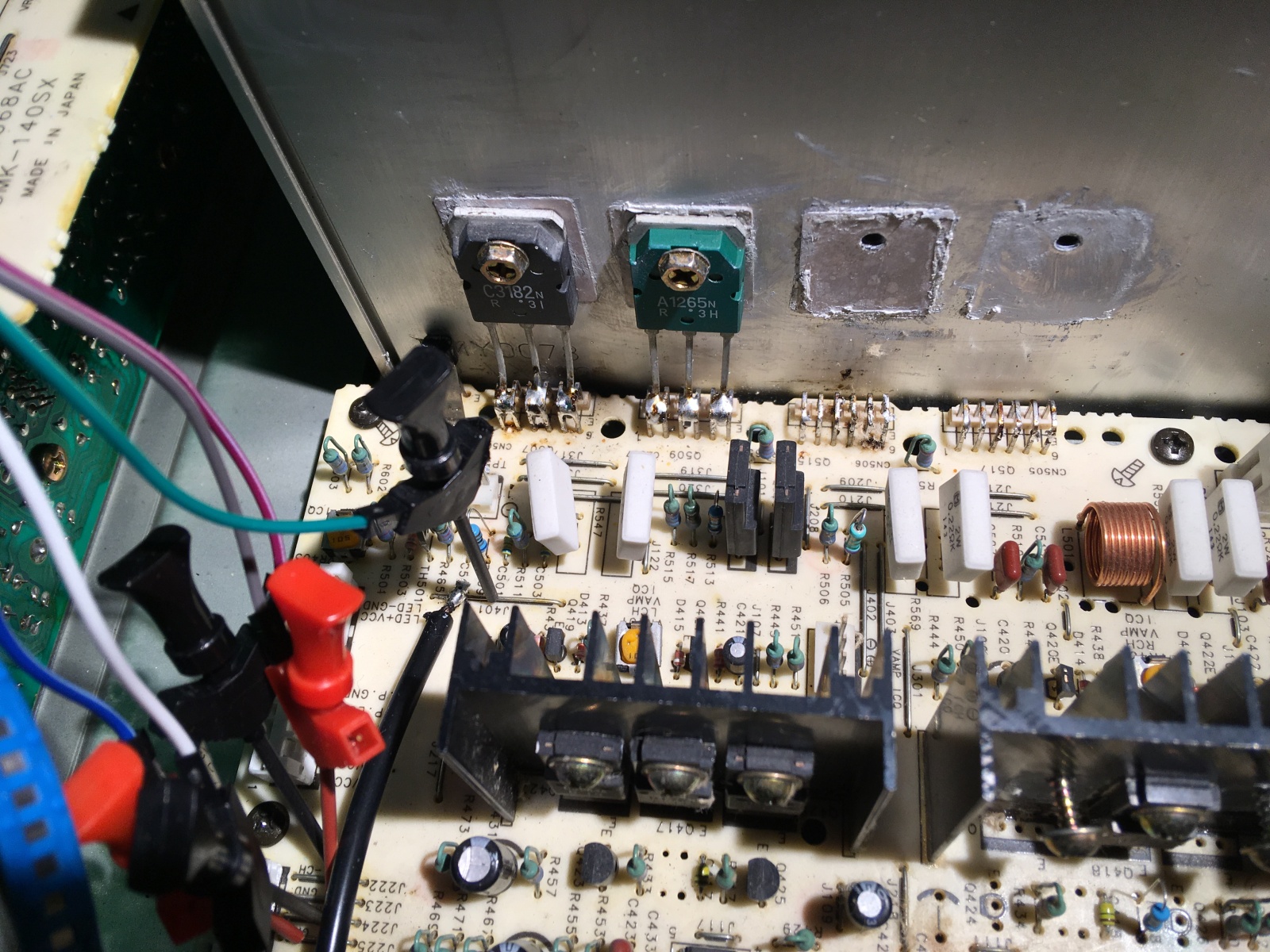
So i installed, Q501, Q503, Q505 , and i have replaced R513 and R509 earlier.

Power on.
No smoke.

Measuring R513: +5,4 Volt / +4,2 Volt

So i did not proceed with installing Q507 and Q509
 

Thread Starter

Marius83

Joined Dec 28, 2017
423
I have now ordered replacements for the transistors we found out was bad, and Q420, plus spares, it might take some time till they're here.
 
Last edited:

MrChips

Joined Oct 2, 2009
34,829
I have now ordered replacements for the transistors we found out was bad, and Q420, plus spares, it might take some time till they're here.
Ok, sounds good.

Make a note of how R401 is adjusted, i.e. the position of the yellow pointer.
While measuring the voltage at one leg of R513, adjust R401 fully counter clockwise (CCW) and the fully clockwise (CW).
Record the two readings you get.
See if you can find a position of R401 when the reading at R513 is somewhere between +0,5V and -0,5V.

Ideally, one leg of R513 should be at +0,5V while the other leg is -0,5V.
 

Thread Starter

Marius83

Joined Dec 28, 2017
423
So i hooked my DMM on to one leg of R513 and adjusted R401, there was no difference in voltage from fully CCW or full CW.
+5,4 Volt the whole time i was turning it.
And the other side was +4,2 Volt.

But i could hear the 50hz humming was getting stronger at full CW, from almost quiet full CCW, so something is happening :)
 
Last edited:

MrChips

Joined Oct 2, 2009
34,829
+5V is too high. We need to find why that is the case.
Set R401 to the mid-range.

Please measure voltages at:

R453
R455
R457
R461
R467
R471
R473

R501
R509
R511

Measure the voltages at the two pins on TP501.
Connect either pin of TP501 to GND (J401).
Repeat the voltage measurements on the resistors above.

(Sorry for all the work I 've given you.)
 

Thread Starter

Marius83

Joined Dec 28, 2017
423
Thank you for all the work you are giving me :D

As i understand, i was going to connect either pin on TP501, but i don't dare until you see what i measured first.
The pins are also marked with + and - ... so which one? Doesn't matter?

My measurements, without connecting anything to one of the pins at TP501:

R453: 0 Volt
R455: 0 Volt
R457: 0 Volt
R461: +3,7 / -7,7 Volt
R467: 0 Volt
R471: 0 volt
R473: 0 volt

R501: +6,3 / +4,4 Volt
R509: +6,2 / +6,3 Volt
R511: +3,7 / +3,7 Volt

TP501:
+Pin: 0 Volt
- Pin: 0 Volt
 

Thread Starter

Marius83

Joined Dec 28, 2017
423
Ok.
So i connected one pin (-) at TP501 to GND

New readings:

R543: 0 Volt
R455: 0 Volt
R457: 0 Volt
R461: -6,7 / -7,6 Volt
R467: 0 Volt
R471: 0 Volt
R473: 0 Volt

R501: -6,4 / -5,5 Volt
R509: -5,6 / -5,6 Volt
R511: -6,8 / -6,8 Volt
 

MrChips

Joined Oct 2, 2009
34,829
Remove the connection at TP501.

Install
Q507 2SC3182
Q509 2SA1265 (new one, of course)

Cross your fingers and turn ON power.

Measure voltage at (with respect to GND, as always)
TP501 +
TP501 -

If you get 0V on both pins, and no smoke anywhere, breathe a sigh of relief. :D
 

Thread Starter

Marius83

Joined Dec 28, 2017
423
Removed connection at TP501.

Installed
Q507
Q509
both new ones of course

Turned power on.
No smoke.

Measured the pins at TP501, 0 Volt at both ! :):)


MrChips

Joined Oct 2, 2009
34,829
That is very encouraging news!:)
We are making good progress here.
We will omit Q515 and Q517 for now. Basically, the LEFT channel is looking good at this point. We just have a few more tests and adjustments to make.

The next step is to wait for supplies to arrive and we can start working on the RIGHT channel.
 

redrooster01

Joined Jul 15, 2014
93
Get yourself a DBT (Dim Bulb Tester) with a 100w or 75w bulb so your new expensive power transistors dont pop when you power on, you may still have a short somewhere? If you dont have a short the DBT bulb will glow bright for a second then fade to nothing or just have a slight glow. If you still have a short the bulb will keep shining bright, if it does that, turn the power of right away. A DBT is easy to make and it certainly wont be the last time you use it. Make sure you have the volume on the amp turned right down, with no inputs/outputs connected when you use it! You will need to do an electrolytic capacitor re-cap of your power supplies when you have this sorted. After 40+years they tend to dry out and deteriorate the sound. I would change out the relays for new ones too. The cracked transformer solder joint makes me think the amplifier may have been dropped? So I would carefully inspect the boards for cracked tracks, etc...Good luck mate, thats a nice amplifier you have there.
 

Alan Cashin

Joined Jan 19, 2018
1
I am loving this thread. MrChips is so patient and Marius83 must be learning heaps. I have an old hybrid amplifier in storage (transistor output stage, valve preamplifier, can't remember the brand) not working. I think it was several thousand dollars new. Haven't been game to tackle it but this is inspiring stuff. Just need a spare week or two (and some spare bench space).
 

MrChips

Joined Oct 2, 2009
34,829
I am loving this thread. MrChips is so patient and Marius83 must be learning heaps. I have an old hybrid amplifier in storage (transistor output stage, valve preamplifier, can't remember the brand) not working. I think it was several thousand dollars new. Haven't been game to tackle it but this is inspiring stuff. Just need a spare week or two (and some spare bench space).
Glad to hear that you enjoy this thread. Patience is a virtue.
Successful trouble shooting is not hit and miss. There is a systematic procedure that one follows. Sometimes you just get lucky.

You can wait until we finish with this repair job, whichever way it turns out, before we have a go at yours. Or you can start on it anytime.
In any case, start a new thread for your amp. Make sure you can find the schematic drawings.
 

Thread Starter

Marius83

Joined Dec 28, 2017
423
@redrooster, thanks for the tip, but in this case i've understood it will not function very well.
I don't know if it need new capacitors, this is "only" 28 years old :D
Doesn't look like it's been dropped actually, was just a bad solderjob at the factory, i guess it's an ok amp, thanks.

@alan, thanks, Mr.Chips sure is patient, i am enjoying this thread very much myself :)
 
Last edited:

MrChips

Joined Oct 2, 2009
34,829
Let's wait for the other parts to arrive.

As for advice on an oscilloscope, I am ambivalent on this and don't have a definitive answer. I can only give you my opinion and observations. Of the many options available, here are the three most prominent that stand out in my mind.

1. Low cost "hobby" scope, kit or assembled (US$5 - $15) as you have linked
2. Used analog oscilloscope ($50 - $100)
3. New digital oscilloscope ($350 - $500)

I would like to use the similarity with hobby drones (quad-copters). When they hit the shelves a few years back, I wanted one just to play. Prices were $100 and up ($5k). I got two because they were so inexpensive ($25) and played with them for awhile. Now they are packed away somewhere. Prices have fallen out of the sky (pun intended) and you can get a serious one with camera, GPS, live view, etc. for under $1000. Would I get a better one now? No, because I don't have a serious use or need for one. (Note the difference between need and want.)

Where could you benefit with having an oscilloscope on this particular amplifier repair job?

1. To examine ripple voltage on DC power supply, e.g. at C425
2. If the amplifier passes all voltage tests but still no sound from loudspeakers
3. Sound output is weak or distorted

An oscilloscope could also become an indispensable tool further on your educational journey should you want to experiment further with analog or digital electronics. For example, with some simple additional components you can use the scope to measure the capacitance and effective series resistance (ESR) of capacitors.

US$15 is a not a lot of cash to throw away on a "hobby" scope. If it tickles your fancy and you can spare the cash, go for it. I saw and tested one briefly last week. You get what you pay. I don't recall the max input signal frequency (even though it says 1Msps) but don't expect to be able to look at any signals above 100kHz with any degree of fidelity.

(Funny how words get altered in translation. We never weld electronic kits. We assemble kits by soldering components.):D
 

Thread Starter

Marius83

Joined Dec 28, 2017
423
(Funny how words get altered in translation. We never weld electronic kits. We assemble kits by soldering components.):D
I saw it too,hehe.:)
Thanks for clearing up.
I ordered a cheap hobbyscope just in case.
 
Last edited:

mjaa

Joined Dec 11, 2011
5
wow - I admire your determination! Like maybe your friend who was going to trash it, I would have quit while I was only just behind!
cheers and thanks for a truly captivating saga
:) Mark
 
Top