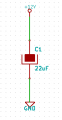
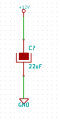
I'm not sure I understand. Distinguish between electrolytics and the IC e-coupling capacitors? I used different symols. C8 an C9 are the only electrolytics. At least that was my intention.
I assume they should also be close to VDD and VDDA pins. Or not needed?
Another thing I need to know, is which capacitors needs to be tantalum and which need to be ceramic. Can anyone tell me?
Or better, tell me when I should chose one or the other. Same applies to know when capacitors needs to be close to the pins and when they can be at longer distances, so that I don't need to be asking each time I want to build some project.
Tantalum usually offer the larger values in a smaller footprint than electrolytic, use ceramic etc for the decoupling values below 1μf as a general rule., they should be mounted as close as possible to the device they are protecting.
See my previous post #81 about indicating electrolytic or Tantalum.
Electrolytic capacitors, and all other polarized capacitors, always need the + (positive) terminal identified on the drawing. That is because not all the folks involved can understand which side is positive by examining the circuit.
Tantalum usually offer the larger values in a smaller footprint than electrolytic, use ceramic etc for the decoupling values below 1μf as a general rule., they should be mounted as close as possible to the device they are protecting.
See my previous post #81 about indicating electrolytic or Tantalum.
6 & 7 might be the way you would indicate Tantalum or any small capacitor that was polarized, but not electrolytic in nature.
There are also capacitors that do not consist of polarized material, but have a GND side marking, these are often use in HF decoupling circuits where the stripe is the one indicating the outer layer of foil etc, and should be connected to the chassis GND.
6 & 7 might be the way you would indicate Tantalum or any small capacitor that was polarized, but not electrolytic in nature.
There are also capacitors that do not consist of polarized material, but have a GND side marking, these are often use in HF decoupling circuits where the stripe is the one indicating the outer layer of foil etc, and should be connected to the chassis GND.
I'm sorry for the questions but I'm a bit confused. So how one distinguish polarized from electrolytic capacitors??
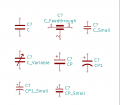
Also, to be able to change the symbols, which caps should be of which symbol, taking into account the 1 to 8 numbering I used when I posted the symbols I have in my KiCad version? I mean, KiCad only has unpolarized and polarized capacitor symbol descriptions. I was thinking the only ones needed polarity would be the ones on both terminals of L1. All other would be unpolarized. Since KiCad doesn't distinguish between tantalum and ceramic, I used symbol 1 (or 3, small version) for all other capacitors.
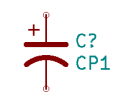
See the caps at 6 & 7 (CP1) , they have a curved line for the bottom plate, this signifies non-electrolytic but polarized.
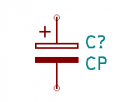
The Electrolytic use the two different shaded/unshaded plates for +/- .
The electrolytic in post #81 was used in earlier versions of Kicad, it is the same as at 5 & 8 on your list.
Let's get a few things straight.
Decoupling/filtering are terms loosely used, sometimes incorrectly, that have no association with polar vs non-polar capacitors.
Capacitors have generalize and specific functions and should be discussed within the context of the specific application and circuit topology.
As for your Kicad options, ignore 2 and 4 for your context.
1 and 3 are non-polar capacitors.
5, 6, 7, 8 are polarized capacitors. If you see a + sign, it is polarized.
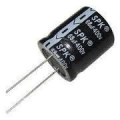
Electrolytic capacitors are in general polar capacitors, i.e. the capacitor must be biased in a defined direction. There are different materials used such as aluminum and tantalum.
There are non-polar electrolytic capacitors as well.
See the caps at 6 & 7 (CP1) , they have a curved line for the bottom plate, this signifies non-electrolytic but polarized.
The Electrolytic use the two different shaded/unshaded plates for +/- .
The electrolytic in post #81 was used in earlier versions of Kicad, it is the same as at 5 & 8 on your list.
Let's get a few things straight.
Decoupling/filtering are terms loosely used, sometimes incorrectly, that have no association with polar vs non-polar capacitors.
Capacitors have generalize and specific functions and should be discussed within the context of the specific application and circuit topology.
As for your Kicad options, ignore 2 and 4 for your context.
1 and 3 are non-polar capacitors.
5, 6, 7, 8 are polarized capacitors. If you see a + sign, it is polarized.
Electrolytic capacitors are in general polar capacitors, i.e. the capacitor must be biased in a defined direction. There are different materials used such as aluminum and tantalum.
There are non-polar electrolytic capacitors as well.
I know those terms has nothing to do with the polarity.
My confusion was rather with distinguish the symbols according with the material they are made of (ceramic, tantalum, etc) and if they were electrolytic or not.
So, as far as I understand, electrolytic has nothing to do with polarity.
And for my project, all capacitors must be polarized? Or which ones need to be and which don't need to be polarized?
And after this selection, I will have to choose the tantalum and ceramic and others...
Edited; @MrChips you say at the end of your post that there are also non-polar(ized) electrolytic capacitors. Wikipedia says electrolytic capacitors are polarized. I think Wikipedia is outdated on this detail???
I know those terms has nothing to do with the polarity.
My confusion was rather with distinguish the symbols according with the material they are made of (ceramic, tantalum, etc) and if they were electrolytic or not.
So, as far as I understand, electrolytic has nothing to do with polarity.
Still a little confusion.
*3 is non-electrolytic, - non polarized, ex. 1nf ceramic.
You will find various component types out there that can be vague as to type,
For example CP1_small in your other list could be a polyester type with a outer foil as I explained earlier, this capacitor could be used with regard to polarity when making sure the outer foil is the GND terminal, but it could just as well be used with no regard for polarity, in a general usage circuit.
It can be confusing at first.
Your actual circuit does not care what symbol you use in Kicad.
In other words, use any symbol in Kicad. It is the actual physical component that really matters.
#1 and #3 are just different sized icons for non-polar capacitors, often used for ceramic disc capacitors.
#5, 6, 7, 8 are all the same, just different styles of drawing polarized capacitors.
Your actual circuit does not care what symbol you use in Kicad.
In other words, use any symbol in Kicad. It is the actual physical component that really matters.
#1 and #3 are just different sized icons for non-polar capacitors, often used for ceramic disc capacitors.
#5, 6, 7, 8 are all the same, just different styles of drawing polarized capacitors.
I know they are just symbols to represent/draw the components. I know they do not matter for the KiCad construction, ERC, etc.
But if I can match the symbol with the actual component the best I can, the better.
And I have more things to discuss about capacitors, after clearing the actual discussion.
And @MrChips , you don't agree with @MaxHeadRoom choice for the symbols he mentioned (except C8 and C9 being different, which I don't understand why) ??
Did you come up with the type of symbols? or was this from a current design?
Because you have two different symbols for C8 and C9, Identical types could be used, but the C9 indicates that the outer-foil method should be implemented or circuit -mounted for this particular one.
The symbol does not matter so much as the function.
If you see a + sign then it is polarized.
In general, if the value is less than 1μF it will be non-polarized.
If it is 1μF or greater it is likely to be polarized. There are many cases where >1μF call for non-polarized capacitors.

 Facebook
 Google
 GitHub
 Linkedin

 2 KB Views: 0