How do i make a compact transformer-less power supply for my project?

Status
Not open for further replies.

Thread Starter

Lucas :-)

Joined Jan 10, 2025
6
Hello!

I’ve been searching for a reliable transformer-less power supply circuit for quite some time now.

After going through countless circuits on Google, I still can’t find any compact designs that seem trustworthy.

Companies have been creating super compact and safe power supplies for years, so why can’t we?

I’m looking to convert 230VAC (±0 to 10V) mains to something more manageable, like 12V, 5V, or even 3V DC. I can use a DC regulator later to fine-tune the voltage to exactly what I need, so it doesn’t have to be too specific.

If anyone could provide a solution, I would be endlessly grateful.

Thank you!

– Lucas
 

MisterBill2

Joined Jan 23, 2018
27,181
There are a lot of switch mode power supplies that will provide that sort of step down AND not pose a shock hazard. There are also a bunch of non-isolated supplies on the cartoon channel that are all set to give you a rather fatal shock. Or at least a really nasty jolt. For simple, and cheap, transformer-less DC supplies fed from the 220 mains You will not find anything safe.
 

Thread Starter

Lucas :-)

Joined Jan 10, 2025
6
There are a lot of switch mode power supplies that will provide that sort of step down AND not pose a shock hazard. There are also a bunch of non-isolated supplies on the cartoon channel that are all set to give you a rather fatal shock. Or at least a really nasty jolt. For simple, and cheap, transformer-less DC supplies fed from the 220 mains You will not find anything safe.

Hi MisterBill2,

Thanks for the quick reply!

I’m having trouble finding any compact switch-mode power supplies. All I seem to come across are the large ones with big transformers, filters, and capacitors, which are kind of inappropriate for my needs.

Do you happen to have any links or suggestions?

I have no idea how to make something like that compact—haha!

Thanks agian,
- Lucas
 

Thread Starter

Lucas :-)

Joined Jan 10, 2025
6
You don't mention what your load current requirements. Transformerless supplies are usually used for loads of less than 100 mA.
This in addition to the lack of main isolation and the certainty of receiving a shock.

Oh, you’re right. I’ll probably need more than 100mA, depending on the project. I’d say I need something like 500mA or more.

And yeah, electric shocks are definitely not ideal, to be honest. Are there any other power supply types that are super compact?

Thanks for responding! :)

- Lucas :)
 

Jon Chandler

Joined Jun 12, 2008
1,560
As Mister Bill said, THERE ARE NO SAFE SIMPLE TRANSFORMERLESS LINE VOLTAGE TO LOW VOLTAGE DC POWER SUPPLIES.

Contact with any part of a circuit powered by a transformerless supply is a severe shock hazard.
 

Danko

Joined Nov 22, 2017
2,135
I’m looking to convert 230VAC (±0 to 10V) mains to something more manageable, like 12V, 5V, or even 3V DC. I can use a DC regulator later to fine-tune the voltage to exactly what I need, so it doesn’t have to be too specific.
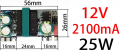
Buy this module, reverse engineer it and DIY.
Price $2.11, free delivery.
https://aliexpress.ru/item/10050019...&traffic_source=recommendation&type_rcmd=core
1736549225208.png
Test item:
AC input (VAC): AC70-277V (AC85-265V recommended)
DC input (VDC): DC100-390V (DC110-370V recommended)
Frequency range (Hz): 47-63
Input current (A): 0.12/115VAC / 0.06/230VAC
Inrush current (A): Cold start: 10A/230VAC
Efficiency (TYP): 77%-83%
No-load standby (mW): 80MW
Linear adjustment rate: full load: ±1%
Load regulation rate: 10-100% load: ±3%
Switching frequency (KHz): 0.8-65 (frequency conversion control chip)
Insulation voltage (VAC): input to output test: 60S 5mA=1000V
Insulation resistance (MΩ): input to output test: 500VDC=100
Short-circuit protection: rated input voltage: long-term short-circuit, self-recovery
Overcurrent protection: rated input voltage: full load constant current mode
Start delay time (ms): Vin: 230VAC =500ms
Power-down hold time (ms): Vin: 230VAC=25ms
 

AnalogKid

Joined Aug 1, 2013
12,044
Many (most - ?) low-current, transformerless power supplies use a capacitor as the main voltage-dropping element. If you are familiar with Ohm's Law and the capacitor equations, you can calculate the cap value. At 240 V and 0.5 A, I get 4 uF. That's a 4 uF cap rated for 240 Vac continuous duty. That is not a small component. Here is what Digi-Key has in stock. You would need either a single 4 uF, or two 2.0 uF or 2.2 uF parts in parallel.

https://www.digikey.com/en/products...wYxAAFoSqgoFIAdsDO4lsQwe4NuVdFUDO0nBALHwlPigA

Please share your size requirements.

Separate from that is a major safety issue with this type of circuit, one that is less often discussed: the lower the load current, the higher the output voltage. The 4 uF cap will produce 5 V peak across a load *only* if the load current is 500 mA. At 50 mA it is 50 V peak, way over the limit for most 3-terminal regulators.

NOTE that these numbers need a bit more work to improve their accuracy, such as figuring in the voltage drop through a bridge rectifier, regulator chip minimum input voltage requirements, etc. But the main point is valid - a variable load current is a dangerous problem.

ak
 
Last edited:

sghioto

Joined Dec 31, 2017
8,633
[QUOTE="Lucas
However, I’m looking for a circuit that I can recreate on a PCB.
[/QUOTE]
For a 5 volt supply removed the pcb from just about any 5 volt USB charger.
I've done this for several projects and find them in thrift stores.
 

MisterBill2

Joined Jan 23, 2018
27,181
Most of the honest reliable electronics distributors sell switch-mode power supplies, often up to over 500 watts. And much less as well. They cost more there but you can know exactly what it is you are getting, instead of just having some description like "we sold 300 of them last week so they must be really good". You get actual specifications that are accurate and specific.
I have also had good luck recovering power supply boards and modules from scrapped large screen TVs, and obsolete modems, available cheap at assorted swaps and flea markets. Mostly the power supplies are OK but other portions are failed, and only good for salvaging some parts, and hardware.
 

LowQCab

Joined Nov 6, 2012
5,101
Start-out with a generic ~20-Volt LapTop-Power-Supply, they're free, or almost free,
at any Computer-Repair-Shop, and quite often at Thrift-Stores like Good-Will.

Then all you'll need is an appropriate Voltage-Regulator.

Virtually all of these Power-Supplies will supply around ~3-Amps, some even higher.
And, they are Isolated from the Mains, and therefore, reasonably safe.
.
.
.
 

Thread Starter

Lucas :-)

Joined Jan 10, 2025
6
r Bill said, THERE ARE
Many (most - ?) low-current, transformerless power supplies use a capacitor as the main voltage-dropping element. If you are familiar with Ohm's Law and the capacitor equations, you can calculate the cap value. At 240 V and 0.5 A, I get 4 uF. That's a 4 uF cap rated for 240 Vac continuous duty. That is not a small component. Here is what Digi-Key has in stock. You would need either a single 4 uF, or two 2.0 uF or 2.2 uF parts in parallel.

https://www.digikey.com/en/products/filter/film-capacitors/62?s=N4IgjCBcoKwBwE4qgMZQGYEMA2BnApgDQgD2UA2iAMxwAsc8IxA7HGAGwAMnIAusQAcALlBABlIQCcAlgDsA5iAC+LTs2Qg0kLHiKkK1MACYwnJMSrGwxpoZNhat9nHYcYty-ffFaRo1TNbX38wKiC-KipzEGCqX3DLWm8YkJgjPkERSHEpOUUVcCMEdOhNDBwCYjJISg4jODgw4jAYZnZ62zA4I2YejJBhUQkZBWVmhEQNLR1K-RqQHl4Co05aJFLpir1qyloAOmYAAgBWgDFbIz2jE-Pia7P+weyAVVlpIQB5dABZfExcACuknwYxAAFoSqgoFIAdsDO4lsQwe4NuVdFUDO0nBALHwlPigA

Please share your size requirements.

Separate from that is a major safety issue with this type of circuit, one that is less often discussed: the lower the load current, the higher the output voltage. The 4 uF cap will produce 5 V peak across a load *only* if the load current is 500 mA. At 50 mA it is 50 V peak, way over the limit for most 3-terminal regulators.

NOTE that these numbers need a bit more work to improve their accuracy, such as figuring in the voltage drop through a bridge rectifier, regulator chip minimum input voltage requirements, etc. But the main point is valid - a variable load current is a dangerous problem.

ak

Hi, thank you for the reply.

I’m looking for an extremely compact power supply—so small that even most through-hole capacitors are too big.

I need a stable output voltage, which I realize is difficult to achieve without a transformer.

The reason I’m asking about such a power supply is that I once disassembled a TP-Link router that plugs directly into the outlet (no external adapter). Its power board only had a bridge rectifier, a small 6-pin IC, and a few passive components. That was it—it was incredibly small. I’ve been wondering if I could replicate something like that, but I can’t find this PCB anywhere to reverse-engineer it, unfortunately.

I’m hoping to find a circuit with few components—or at least many small ones—that can convert the power into something more manageable. The projects I work on have varying load currents because different components are constantly turning on and off.

I’ll definitely look further into your recommendations to see if they’re a valid and solid path forward.


Thank you, AK :)

- Lucas
 

MisterBill2

Joined Jan 23, 2018
27,181
That tiny supply shown in post #10 had a transformer right in the middle of the assembly. A HIGH FREQUENCY transformer.
Why can't the average experimenter duplicate that??? Mostly because of not being able to duplicate the assembly. Unlike most other kinds of circuits, switcher supplies demand a whole lot of understanding about the current in every connecting link between components, and then creating the layout based on the currents. The complexity of switcher design is not just a bit of gossip, it is the truth!
 
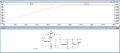
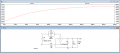
This circuit is the bare minimum for a transformer-less power supply. The components have been chosen so that Vin=120VAC, Vout=5V, Rload=500Ω+

C1 sets the max current (reactance). R1 discharges C1 to prevent shocks when unpowered. R2 limits in-rush current. D1 (zener) sets output voltage. C2 sets voltage ripple. There should be a MOV across the input but for demonstration I left it out.

The problem with this kind of circuit is that it has to be tuned for a specific load range. If the load is too small, the voltage will sag as well as increased ripple. Take a look at these two simulations:

tps1.png

tps2.png

In the second simulation, the current is higher but it's at a lower voltage with greater ripple. This is fine for large ohmic loads but anything else will lead to unexpected behavior. I can go through the calculations for each component but I highly recommend you stay away from transformer-less power supplies.

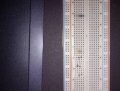
It's a fun project to learn about but can be dangerous if you don't know what you are doing (swap L and N for example) or choose the wrong components. Just to drive this point home, here is a photo of a breadboard I melted while playing around with this topology.

thumbnail_IMG_20250111_062916992.jpg

Edit: I used a full bridge for full wave rectification but you can use a single diode for half wave. If you do, you'll have to compensate for the increased voltage ripple.
 

Attachments

Last edited:
Status
Not open for further replies.
Top