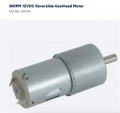
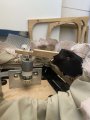
12VDC reversible gearhead motor through Compact switch mode Lab power supply

Thread Starter

natpenn

Joined Jan 13, 2025
5
Hello,

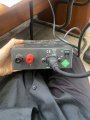
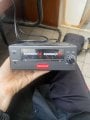
I'm an artist who sometimes uses small DC motors in my artwork to create kinetic works. I usually run them through a relay and Arduino to use a sensor so the works aren't constantly running. I'm very novice and have only used this one particular set up but I was wondering if it's possible to just run the pictured 12VDC reversible gearhead motor directly through the pictured power supply if I wire them up through the banana plugs, without the Arduino etc. Or will this be a problem?
Is it okay to run these motors non-stop? I always used motion sensors so the work wasn't moving unless someone was in the gallery.

Any help would be much appreciated!

Thanks
 

Attachments

LowQCab

Joined Nov 6, 2012
5,101
You are using a cheap Brushed-Motor,
depending upon the Load on the Motor,
it's life may be measured in hours, or in really extreme cases, possibly even minutes,
but, You probably aren't putting much Load on the Motor, so You can get away with more run-time,
if You reduce the Voltage to, lets say, ~6-Volts, You will probably quintuple the life of the Motor.
This may or may not work for You.

A 3-Phase BLDC, ( Brush-Less-Direct-Current ), Motor,
with high-quality Bearings, will last virtually forever,
but it requires a rather sophisticated Electronic-Controller to operate, and
are not usually available with a Gear-Reduction-Box, but they will run reasonably slow.
These are used extensively by Radio-Control, RC-Hobbyists for RC-Cars, Quad-Copters, and RC-Airplanes.

AC-Shaded-Pole, or small AC-Induction-Motors, ( or they may be called "Fractional-Horsepower" Motors ),
are also readily available either in Low-RPM-Direct-Drive, or Gear-Reduction styles.
They almost exclusively run on Mains-AC-Voltages.
They usually run for years.

"Stepper-Motors" are an interesting idea,
they move in very small distinct steps and may be "held" or "locked" in any selected position,
and may move "on-command" to any other position.
Unfortunately they also require an Electronic-Controller to operate,
and are usually controlled with a Micro-Controller
which can create repeating patterns of movement.
They generally never wear-out,
but they may have limited Torque capabilities,
which probably wouldn't be a problem for your purposes.
.
.
.
 
Last edited:

ronsimpson

Joined Oct 7, 2019
4,646
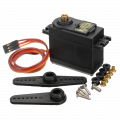
The Arduino knows this type of servo motors. There are many types. No relays.

There are sizes from micro to big monsters.
Many only do about 1/2 turn with a hard stop at the end of trave. Often use to steer a remote car.
Many have optional arms.
Some will do 1 turn, and some do up to 6 turns. (sailboat) Usually comes with a wench.
The above versions use the number 0 to 180 to tell the motor what angle to turn to.
There is one kind that has no stop. Used for car wheels. The instruction from the Arduino is used for speed and direction. 0 is full speed forwards. 90 is stop. 180 is full reverse.

The price depends on size, plastic/metal gears, how many are made of this type.
I see these in robots and moving art. (drones) They may be better for "artist who ...... create kinetic works. "

1736823670425.png
 

jiggermole

Joined Jul 29, 2016
185
There are display motors that are heavily geared down and are intended to run all the time under little load.
Amazon link to display motor
something like that is meant to plug in and leave running.
Like Cab said, that little hobby motor is just not meant to run for extended periods of time. It will run and it will function, just don't expect to get days of runtime out of it.
 

Thread Starter

natpenn

Joined Jan 13, 2025
5
Ah okay, thanks so much for all of this info! Unfortunately, I need to deliver this work on Monday, and it has this motor already, I'm not sure I have time (amidst work) to start looking at other options.
I have used these motors for all my works in the past through a relay (from the instructions of someone at Jaycar) and Arduino to set it off through the motion sensor and they haven't burnt out, after running for hours most days for at least a month.

It's just slowly turning this very small object (See pictures), so there isn't much load at all. It's very small scale and DIY hobby scale use, as you can see. But from these responses, I suppose if I do persist with this, it is possible to run it straight through the power supply at a low voltage? I just run the risk of it burning out faster than if it were to at least turn off if no one is near the work? Is this correct?

Apologies I am super amateur and if there's a better forum for these purposes, please let me know, I don't want to be wasting anyone's time in a more advanced forum.

Thanks.
 

Attachments

LowQCab

Joined Nov 6, 2012
5,101
Where you're at is just fine, otherwise the Mods would simply move your Post for You.

Lower-Voltage, and/or, lighter physical-Load on a Brushed-Motor will definitely make it last longer.
.
.
.
 

Ya’akov

Joined Jan 27, 2019
10,226
Ah okay, thanks so much for all of this info! Unfortunately, I need to deliver this work on Monday, and it has this motor already, I'm not sure I have time (amidst work) to start looking at other options.
I have used these motors for all my works in the past through a relay (from the instructions of someone at Jaycar) and Arduino to set it off through the motion sensor and they haven't burnt out, after running for hours most days for at least a month.

It's just slowly turning this very small object (See pictures), so there isn't much load at all. It's very small scale and DIY hobby scale use, as you can see. But from these responses, I suppose if I do persist with this, it is possible to run it straight through the power supply at a low voltage? I just run the risk of it burning out faster than if it were to at least turn off if no one is near the work? Is this correct?

Apologies I am super amateur and if there's a better forum for these purposes, please let me know, I don't want to be wasting anyone's time in a more advanced forum.

Thanks.
This should work, but if it is a permanent installation you should plan to swap it out after more research.
 

Thread Starter

natpenn

Joined Jan 13, 2025
5
Thanks for all the help, that's great! Luckily this one is just on for a very short time, so I will cross my fingers this time around and definitely research better options for next time. Again, thanks so much for being so thorough and helpful.
 

MrSoftware

Joined Oct 29, 2013
2,273
Ah okay, thanks so much for all of this info! Unfortunately, I need to deliver this work on Monday, and it has this motor already, I'm not sure I have time (amidst work) to start looking at other options.
I have used these motors for all my works in the past through a relay (from the instructions of someone at Jaycar) and Arduino to set it off through the motion sensor and they haven't burnt out, after running for hours most days for at least a month.

It's just slowly turning this very small object (See pictures), so there isn't much load at all. It's very small scale and DIY hobby scale use, as you can see. But from these responses, I suppose if I do persist with this, it is possible to run it straight through the power supply at a low voltage? I just run the risk of it burning out faster than if it were to at least turn off if no one is near the work? Is this correct?

Apologies I am super amateur and if there's a better forum for these purposes, please let me know, I don't want to be wasting anyone's time in a more advanced forum.

Thanks.
To answer your question directly, there is no problem running the motor direct from the power supply. If you have it turning slow with not much load then it may last some time.

For the future, if you don't want to become expert in motors, just look for a top quality display type motor. Many even run on 120V or 240V AC, meaning you may not need a separate power supply, if you're happy with the speed they run.
 

Tonyr1084

Joined Sep 24, 2015
9,744
I was wondering if it's possible to just run the pictured 12VDC reversible gearhead motor directly through the pictured power supply if I wire them up through the banana plugs, without the Arduino etc. Or will this be a problem?
To answer your question directly, there is no problem running the motor direct from the power supply. If you have it turning slow with not much load then it may last some time.
Wish to second this statement. As for the question about banana plugs - sure, you can. They're just plugs. They introduce virtually nothing into consideration of the operation of the project. You can hard wire it or you can use many different types of plugs. The PS you showed - those jack posts likely are screw type and can be backed off and a wire inserted through a hole, then re-tighten the post. An electrical connection is an electrical connection.

HOWEVER: If you want to control the times when the motor runs and when it doesn't via an Arduino - a relay will be necessary as the Ard' can't provide sufficient voltage or current to run the motor directly.
 

MaxHeadRoom

Joined Jul 18, 2013
30,557
Actually some of the Cheap Chinese made motors last quite some time if ran at or just under their limits, The Chinese made Johnson brand are particularly well made, Their long lasting TM motors are a testament to that,
China also has the market on rare earth magnets !
 

Thread Starter

natpenn

Joined Jan 13, 2025
5
This should work, but if it is a permanent installation you should plan to swap it out after more research.
To answer your question directly, there is no problem running the motor direct from the power supply. If you have it turning slow with not much load then it may last some time.

For the future, if you don't want to become expert in motors, just look for a top quality display type motor. Many even run on 120V or 240V AC, meaning you may not need a separate power supply, if you're happy with the speed they run.
Thank you! I was running these through this power supply because I liked being able to manually adjust the voltage easily and these were the suggestions from someone the person working in Jaycar at the time, when I was first being introduced to motors. I'd definitely like to learn a bit more for next time and will look into different motors.
 

Thread Starter

natpenn

Joined Jan 13, 2025
5
Wish to second this statement. As for the question about banana plugs - sure, you can. They're just plugs. They introduce virtually nothing into consideration of the operation of the project. You can hard wire it or you can use many different types of plugs. The PS you showed - those jack posts likely are screw type and can be backed off and a wire inserted through a hole, then re-tighten the post. An electrical connection is an electrical connection.

HOWEVER: If you want to control the times when the motor runs and when it doesn't via an Arduino - a relay will be necessary as the Ard' can't provide sufficient voltage or current to run the motor directly.
Thank you, that's great. I have wired up the banana plugs, so it's good to know there aren't any concerns with this method.

Yeh I usually go through a relay and Arduino to control them, when I have several running, doing different things but wanted to simplify for this, as someone else is installing it. Thanks so much for your help!
 

wraujr

Joined Jun 28, 2022
259
To reiterate what others have said:
(1) You appear to have a
Powertech MP3800
Power Supply 240VAC to 0-24VDC 15A
(2) Your motor is 36RPM 12VDC Reversible Gearhead Motor spec'd at 12V and 1.38A (full load)
Your power supply can easily handle the 1.38A
Just keep your voltage at 12V or less (can monitor with meter)
You probably could get away with going over 12V but if 36 RPM is what you want, then why go over 12V.
The terminals on the Power Supply can accept the banana plugs.
Direction of rotation just depends on how you connect motor terminals to red(+)/black(-) terminals of power supply.
 

MisterBill2

Joined Jan 23, 2018
27,164
That is an entirely OK motor, and it should last quite a while if you are not driving a heavy load at high speed. While it is not in the $250 class, it should run for many hours. My one caution is that if you solder the power wires to the motor, do not apply heat so long that you melt the plastic insulation around the connection. THAT can cause problems.
 
Top