Plan for Circuit to Obtain 12vdc and 24vdc from 2 x 12vdc Batteries.

Thread Starter

Sean Moran

Joined Jun 24, 2025
3
Hello Forum, and thank you.

I stumbled upon this forum a month or so ago when I realised that a 24vdc inverter could output more watts than a 12vdc unit, although the current setup in my mobile home runs 12vdc.

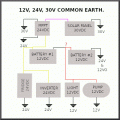
Below is a rough sketch of the (simplified) circuit I plan to build next month:
12v+ is red, 24v+ is yellow and 30v+ is pink.
common-122430.gif

Not wishing to confuse anyone with superficial details, there are 5 solar panels, 2 MPPT controllers, 2 12vdc inverters, 3 12vdc LED lights and 2 12vdc pumps, and the new 6000w 24vdc inverter is awaiting installation. The fridge and both MPPT controllers automatically adjust between 12 & 24vdc, but I don't think that the lights nor the pumps nor the 600 & 800w inverters are that flexible, so the plan is to run 24vdc for some things and 12vdc for the rest.

There are 2 12v batteries, and a question mark in the diagram at the single point of contention, between the batteries. Everything else has already proven to work, including the 30v solar panels and 12v appliances all sharing the common -ve earth through the steel frame of the vehicle.

However adding the 24v circuit is the new improvement, and I am fairly sure it will work having thought about it for a while now, but I joined here because I thought it wise to check with the experts first, and risk asking a silly question before I rush off and make yet another silly mistake.

Would anyone here care to let me know whether my planned 12vdc, 24vdc, 30vdc circuit with a common -ve earth will likely work or not, please?
 

WBahn

Joined Mar 31, 2012
32,702
Your charging arrangement isn't going to work the way you probably hope it will.

You have two batteries and they don't discharge at the same rate. Ignoring the power coming from the charging system for a moment, all of the 12 V appliances pull current from both batteries in series, resulting in them both discharging at about the same rate (assuming they are identical batteries, which is a poor assumption in the real world even if they are the same brand and model purchased at the same time). But all of the 12 V appliances draw only from Battery #2, which means that Battery #2 will (at least nominally) always be at a lower state of charge. However, your charging system can only charge both batteries in series. Because Battery #2 is always having more current drawn from it, over time, the end result is that, to maintain the 24 V that the charging system is shooting for, it will end up undercharging Battery #1 and overcharging Battery #2.

One possibility that might work would be to use one MPPT to charge Battery #2 to 12 V and another to charge Battery #1 to 24 V. I've never worked with MPPT controllers, so hopefully others can tell you if this is a viable set up or if there are hidden demons lying in wait. The one that might be an issue is that the charger for Battery #1 is still pushing it's charging current into Battery #2 as well. But if Battery #2's MPPT has topped it off, then that battery could get overcharged unless the MPPT is capable of sinking power from the battery if the voltage goes to high. I don't know if they are designed to do that or not.

The better way, it seems -- if the MPPT controllers support it -- would be to have the output ground of each MPPT tied to its assigned battery. But this requires that the input and output side grounds of the MPPT for Battery #1 must be able to be at different potentials. Again, I have no experience with these controllers, so hopefully others can tell you if controllers with this capability are available.

The bottom line, really, is that you need a way to do cell balancing (well, battery balancing) of series connected batteries. I would think that this is a problem with a pretty well-known solution since it is something that is done all the time in multi-cell LiPo and other battery packs. If the MPPT controller isn't capable of it, you might be able to add a battery management system to shunt excess power around a battery if it is fully charged.
 

Ian0

Joined Aug 7, 2020
13,097
I would suggest keeping the batteries in series and using a 24V/12V buck converter to produce the 12V output for the pump and the light, because they are small loads and the buck converter would be cheap. (However, it might be football stadium floodlights a fire engine pump, as you don't specify the power)
The DC/DC converter would be a small but constant drain on the battery.
The simplest solution would be to replace the light and pump by 24V versions.
 

Thread Starter

Sean Moran

Joined Jun 24, 2025
3
Thank you very much for enlightening me to the obvious error in my plan, WBahn. Also thanks for helping in such a short span of time, even less than an hour since I posted my question.

Also thank you for the two solutions, which I'll need to think about for a while before drawing another sketch to post. I never mentioned that the two MPPT controllers I happen to be using, (the solar project began in 2019 with a single 30A MPPT), are 30A and 50A, so it might make sense to charge the 24v pair with the 50A controller and Bat #2 with the 30A controller.

I reckon I could probably still work it so that all the components -ve earthed to the steel frame, but just a separate +ve cable from the second MPPT controller to Bat #2.

I did hope that the LiFePO4 batteries' BMSes would have the brains to balance the charge between the two, and I should mention also that the LED lights are very low current, and each of the water pumps are used once or twice a day for a few minutes for washing the dishes in the sink, and showering, so the 12v part is a relatively low current draw compared to the 24v usage, which will run a 3000w electric hot water system through the 6000w inverter, as well as the 700w microwave, 1500w air-fryer and 1200w induction cooker.

Still, there will be an imbalance between the batteries, and I think your solution with one MPPT for the 24v and another for the Bat #2 will rate as a work of electrical artwork.

Thank you again. I have a lot of thinking to do tonight. .
 

Thread Starter

Sean Moran

Joined Jun 24, 2025
3
Thanks very much for your reply, Ian0.

What fantastic lateral thinking! A 24v-12v converter. Hopefully I've clarified that the LED lights are very low current, and the 6lpm and 10lpm pumps are probably a lot less than 500w, but I've never bothered to check the specs. I'll have a look right now at what's available in the way of these converters.

One thing I am grateful for is that no one has pointed out that the circuit I've drawn up would cause any kind of massive burn out, so that's one less thing to worry about.
 

WBahn

Joined Mar 31, 2012
32,702
If your 12 V loads are all light, particularly at any one time, I would definitely consider having that circuit powered by a 24 V to 12 V DC-DC converter. That will have the two batteries purely in series and if they are nominally identical batteries, then any mismatch should result in a pretty slow buildup of the imbalance. You might check their individual voltages from time to time and if they start getting very far away from each other, connect a simple 12 V charger to the lower-voltage one. You could even run it from your 12 V converter provided the charger has an isolated output. Not the most efficient way to charge, perhaps, but it's something that you wouldn't do for long or that often, and it makes it so that you don't have to make changes to the system or find an external power source.
 

Ian0

Joined Aug 7, 2020
13,097
Thanks very much for your reply, Ian0.

What fantastic lateral thinking! A 24v-12v converter. Hopefully I've clarified that the LED lights are very low current, and the 6lpm and 10lpm pumps are probably a lot less than 500w, but I've never bothered to check the specs. I'll have a look right now at what's available in the way of these converters.

One thing I am grateful for is that no one has pointed out that the circuit I've drawn up would cause any kind of massive burn out, so that's one less thing to worry about.
A submersible pump that provides water to a caravan sink is about 30W to 40W, and they are readily available in both 12V and 24V Versions.
 

Ian0

Joined Aug 7, 2020
13,097
.The better way, it seems -- if the MPPT controllers support it -- would be to have the output ground of each MPPT tied to its assigned battery. But this requires that the input and output side grounds of the MPPT for Battery #1 must be able to be at different potentials. Again, I have no experience with these controllers, so hopefully others can tell you if controllers with this capability are available.
MPPTs are generally buck regulators (I.e. non-isolated) so I don’t need to tell you the limitation of the system . . . .
You also can’t put them in parallel as they will compete against each other because each is programmed to extract the maximum power from the source!
 

BobTPH

Joined Jun 5, 2013
11,463
A submersible pump that provides water to a caravan sink is about 30W to 40W, and they are readily available in both 12V and 24V Versions.
I am a big fan of KISS, so I would favor going with this all 24V solution. It might be a bit more expensive initially, but in the long run, I think it is the winner.
 

WBahn

Joined Mar 31, 2012
32,702
MPPTs are generally buck regulators (I.e. non-isolated) so I don’t need to tell you the limitation of the system . . . .
You also can’t put them in parallel as they will compete against each other because each is programmed to extract the maximum power from the source!
So, what about the balancing issues of treating two series batteries as a single power source? Is that a concern with lead acid batteries in practice?
 

Ian0

Joined Aug 7, 2020
13,097
So, what about the balancing issues of treating two series batteries as a single power source? Is that a concern with lead acid batteries in practice?
No. We regularly run 9 in series on float charge for years at a time for 108V AC/DC emergency lighting. Provided that they are a set of identical batteries of the same age when they have reached the float voltage for a day or so the voltages even out.
There are some companies who like to sell balancing devices to even them out more quickly.
Have you ever seen cell balancing on a fork-lift battery? That is 24 individual cells wired in series. If one cell fails it gets replaced by a new cell, and then the 23-old-cell-plus-one-new-one battery just keeps going.
One thing you must never do (as previous stated) is put a load on just one battery.
 

nsaspook

Joined Aug 27, 2009
16,249
No. We regularly run 9 in series on float charge for years at a time for 108V AC/DC emergency lighting. Provided that they are a set of identical batteries of the same age when they have reached the float voltage for a day or so the voltages even out.
There are some companies who like to sell balancing devices to even them out more quickly.
Have you ever seen cell balancing on a fork-lift battery? That is 24 individual cells wired in series. If one cell fails it gets replaced by a new cell, and then the 23-old-cell-plus-one-new-one battery just keeps going.
One thing you must never do (as previous stated) is put a load on just one battery.
You just need to run an equalization charge one in a long while with RE energy banks (that cycle daily) with FLA batteries. Fork-lift charger always run in 'equalization' mode because the massive plates in those types can take the heat of high energy Redox electrochemistry.
 
Last edited:
Top