I'm currently working on a project involving a gyrator circuit using op-amps

Thread Starter

Evergreen23

Joined Apr 19, 2025
1
Hello everyone,


I'm currently working on a project involving a gyrator circuit using op-amps to simulate an inductor, and I came across this very helpful thread and schematic sourced from IEEE paper 10.1109/TCS.1976.1084186.


I’m really interested in building this circuit myself, but I want to make sure I use the correct and finalized version of it. There were some great troubleshooting tips shared here about missing wires, bypass capacitors, resistor values, and op-amp power supply references.


Can anyone please share a verified and corrected version of this circuit that works well on a breadboard or, preferably, on a PCB? I’d also appreciate any suggestions for suitable op-amps and the correct layout to minimize parasitics and improve stability.


Looking forward to learning from your experience!


Thanks and best regards,
Evergreen23
 

MrAl

Joined Jun 17, 2014
13,667
Hello everyone,


I'm currently working on a project involving a gyrator circuit using op-amps to simulate an inductor, and I came across this very helpful thread and schematic sourced from IEEE paper 10.1109/TCS.1976.1084186.


I’m really interested in building this circuit myself, but I want to make sure I use the correct and finalized version of it. There were some great troubleshooting tips shared here about missing wires, bypass capacitors, resistor values, and op-amp power supply references.


Can anyone please share a verified and corrected version of this circuit that works well on a breadboard or, preferably, on a PCB? I’d also appreciate any suggestions for suitable op-amps and the correct layout to minimize parasitics and improve stability.


Looking forward to learning from your experience!


Thanks and best regards,
Evergreen23
I see you quoting a thread and article, but I do not see any links.

Post a schematic that will be the best.

The definition for an inductor is the same as a capacitor if you swap the current and voltage. The basic gyrator can convert a current into a voltage (or a voltage into a current) and that way we can use a capacitor to mimic an inductor with series resistance. If you have a particular circuit to do this though we would have to see that in order to help with this.
 

MisterBill2

Joined Jan 23, 2018
27,164
Welcome to AAC! And that is certainly an appropriate question to post here!
CERTAINLY MrAl is right! show us a circuit , and label the parts : R1, R2, so that we can all know which part somebody is referencing. The gyrator claims to be a simple thing, but that is not what I have observed, So I avoid using them. I use an actual inductance instead.
 

LowQCab

Joined Nov 6, 2012
5,101
I'm currently working on a project involving a gyrator circuit using op-amps to simulate an inductor, and I came across this very helpful thread and schematic sourced from IEEE paper 10.1109/TCS.1976.1084186.
Thanks and best regards,
Evergreen23
.
.
How about giving us a detailed description of the device You are wanting to build ????
.
.
.
 
Last edited:

MrAl

Joined Jun 17, 2014
13,667
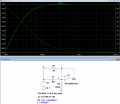
Below is the LTspice sim of a basic gyrator circuit:

View attachment 347458
Hi there,

Since Zin is not exactly R1+j*w*R1*R2*C1 but would be slightly in error due to C1 and R2, there would have to be constraints placed on the values for C1 and R2. I have not looked into this yet in detail though.
I would be nice though to see an equivalent RL circuit alongside of this one so we know what Vout represents. It's not immediately apparent.
It might also be nice to see plots of the input impedance of this circuit versus the input impedance of a real RL circuit side by side for quick comparison.

Many years ago they used to use a big inductor for the crossover network. It would go on the OUTPUT of the power amplifier so it had to be a real inductor. It ended up being pretty big (ha ha). I'm sure you've seen this too.
 
Top