Op Amp, trying to approach it again.

BobTPH

Joined Jun 5, 2013
11,558
I admit that my post was blunt and a bit harsh.

Engineering is a field that is not appropriate for all but a small percentage of the population. I believe there is an inherent ability, a way of thinking that is rare and necessary to be an engineer. I have seen many examples of people who laboriously worked their way through a degree only to find that they could not function as a working engineer and end up in marketing or management. If this is where you would like to go, then fine, an engineering degree will probably get you in.

You are clearly intelligent and hard working. I am sure you are way better than me in some different set of skills, whether it be legal reasoning, business sense, fine arts or manipulating a ball with only your feet. All I am saying is that maybe you would be better off pursuing something you are naturally good at.

My first serious idea for a career was as an architect (the kind that design buildings.). But I could not draw for anything, a skill that comes naturally to many others. So I abandoned that choice. My second choice was theoretical physics. I breezed through the early courses. But, as they got more advanced, I could still do the math, but it became meaningless to me. I graduated with honors but felt that I did not have the understanding to make a career of it. I ended up in computer science, where I finally found the skill that others were stymied by and was simple for me, programming. I have never regretted those moves.
 

Thread Starter

Xenon02

Joined Feb 24, 2021
504
You are clearly intelligent and hard working. I am sure you are way better than me in some different set of skills, whether it be legal reasoning, business sense, fine arts or manipulating a ball with only your feet. All I am saying is that maybe you would be better off pursuing something you are naturally good at.
The thing is I don't know what I am good at. Most of the time I was learning electronics.


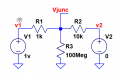
In this circuit, what the voltage and polarity of V2 will have to be to make Vjunc = 0V and Why.?

E
EG57_ 58.png
Good question.
R3 is like an open circuit (high resistance) So I could ignore it I guess ?

So there is voltage divider. For V1 it is 90 mV for R1 and 910 mV for R2.

Or maybe different approach ...
R1 has to have 1V so the current must be 1mA, R2 also has to have 1 mA so he needs 10V.

How do I get this ? If 1V is already in R1 via V1. I could say that V2 has to be -10V.

Why ? well good question I could use superposition. But to explain more like why I don't really know :D
 

ericgibbs

Joined Jan 29, 2010
21,463
Hi X02,
OK.:)
What will be the currents flowing in the 1K and 10k have to be that would make the Vjunc measure zero volts.
[ ignore the 100meg]

E
 

Thread Starter

Xenon02

Joined Feb 24, 2021
504
Hi X02,
What will be the currents flowing in the 1K and 10k have to be that would make the Vjunc measure zero volts.
[ ignore the 100meg]
I believe that 1mA.
Of course I can say that the same current flows through 1k and 10k because they are in series. But this is a specific circuit where I want to achieve 0V in the "middle".
Basically I want 1 mA that needs to flows through 1k and 10k. Why ? Because I want 1V from V1 to be "fully" taken by 1k, so that on one done he will have 1V and on the other 0V.
 

ericgibbs

Joined Jan 29, 2010
21,463
Of course I can say that the same current flows through 1k and 10k because they are in series. But this is a specific circuit where I want to achieve 0V in the "middle".
hi,
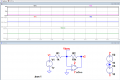
Consider that R1 and R2 are the Rin and Rfeedback resistor of an OPA, is that the 'virtual zero' exactly what you want in order to make the circuit to work correctly?


E


Added the OPA to show the expected result.
EG57_ 59.png
 
Last edited:

Thread Starter

Xenon02

Joined Feb 24, 2021
504
hi,
Consider that R1 and R2 are the Rin and Rfeedback resistor of an OPA, is that the 'virtual zero' exactly what you want in order to make the circuit to work correctly?
Yea.

But what I said about this 0V in the "middle" was pretty interesting.

Like from basics we know that current flows through R1 and R2 :).

So to achieve 0V in the middle I have to make R1 to "take" the whole voltage from V1 or something like that :D

About the negative feedback now I can see that it must be "stable".
I would even use the analogy from WBahn. That increasing now Vin (considering that Vout hasn't changed yet). Will increase the Vn/(-) input, but Vp/(+) is still the same. So Vout will decrease and so it will try to get the stability.
 

ericgibbs

Joined Jan 29, 2010
21,463
hi,
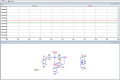
Now consider this case where the Non Inverting Input is +1V, note how the Vjunc also becomes +1v, so effectively both inputs are the same voltage.
Ignore the minute offset, due to the OPA model]

E

EG57_ 60.png
 

Thread Starter

Xenon02

Joined Feb 24, 2021
504
hi,
Now consider this case where the Non Inverting Input is +1V, note how the Vjunc also becomes +1v, so effectively both inputs are the same voltage.
Okej, yea these inputs are the same.

What do you think about this part ? :


I would even use the analogy from WBahn. That increasing now Vin (considering that Vout hasn't changed yet). Will increase the Vn/(-) input, but Vp/(+) is still the same. So Vout will decrease and so it will try to get the stability.
Stability means that both inputs are the same :D
 

BobTPH

Joined Jun 5, 2013
11,558
Stability means that both inputs are the same
[/QUOTE]
Please re-think this. Is there another requirement for stability?
 

ericgibbs

Joined Jan 29, 2010
21,463
Okey so what now ?
Hi X02,
So I assume you have understood the concept of the virtual ground condition on the Inputs of the OPA.?

What are the two equations for the Voltage Gain of an Inverting and Non inverting OPA.?
E
 

Thread Starter

Xenon02

Joined Feb 24, 2021
504
Please re-think this. Is there another requirement for stability?
Hmmm
Maybe that for Op Amp I didn't hid the saturation ?


Hi X02,
So I assume you have understood the concept of the virtual ground condition on the Inputs of the OPA.?

What are the two equations for the Voltage Gain of an Inverting and Non inverting OPA.?
Well because on of the inputs in constant 0V (grounded). Then the only option that the input can change for inverting OPA is the Vn. So Vout has to be at the voltage where Vn will be also 0V.
So giving a Vin will cause the Vn to have also a certain value (not equal to 0V), so the Vout will decrease, and so the Vn will also decrease. It will decrease to the moment where Vn is equal 0V.

Giving this intuition I can say that for Inverting the equation for voltage gain is Vout/Vin= -R2/R1 (according to the circuit you have provided).

For not inverting it would be : Vout/Vin = 1 + R2/R1.

For non inverting Op Amp the gain is "fully" positive for the inverting Op Amp the gain is "fully" negative.
What do I mean by that ? Increasing the Vin in inverting will cause the decrease of Vout, Because Vin is multiplied by negative value. For non inverting it is oposite , Vin is multiplied by (1) it is positive and multiplied by (+ R2/R1) which is also positive, so Vout will increase.
 

ericgibbs

Joined Jan 29, 2010
21,463
Vin is multiplied by (1) it is positive and multiplied by (+ R2/R1) which is also positive, so Vout will increase.
hi X,
That statement is ambiguous.

Consider:
Vout/Vin= 1+R2/R1,, Vout =Vin(1+(R2/R1))

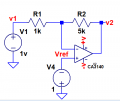
Let R1=1k and R2 =5k, what is the Gain for the Inverting and Non Inverting.?

E
 

Thread Starter

Xenon02

Joined Feb 24, 2021
504
hi X,
That statement is ambiguous.
Probably yes.
I wanted to approach as well understanding of "positive" and "negative" gain.


Consider:
Vout/Vin= 1+R2/R1,, Vout =Vin(1+(R2/R1))

Let R1=1k and R2 =5k, what is the Gain for the Inverting and Non Inverting.?
For non inverting the gain would be : Vout/Vin = -5
For inverting the gain would be : Vout/Vin = 1+5 = 6.
 

Thread Starter

Xenon02

Joined Feb 24, 2021
504
hi X,
You are making progress.

Look at this, note the -1V on the NON inverting, what is the Vout, V2.?
Okey.

So V- or Vn. Will be equal -1V.
So I_R1 =2mA Because it is not now the virtual ground so 2V for R1 as far as I know
V_R2 = 10V so Vout = -1V - 10V = -6V
 

ericgibbs

Joined Jan 29, 2010
21,463
Hi X,
Nope.:oops:
Forget the virtual ground focus on the two equations.
Remember that the Non Inv input voltage is Negative ie: -1v

E

Remember: virtual ground does not mean 0V!,

@Xenon02

Non Inverting means the polarity of the output voltage is the same as the input polarity of the NInv pin
 
Last edited:

WBahn

Joined Mar 31, 2012
32,933
Okey.

So V- or Vn. Will be equal -1V.
So I_R1 =2mA Because it is not now the virtual ground so 2V for R1 as far as I know
V_R2 = 10V so Vout = -1V - 10V = -6V
Your work, and reasoning, above is spot on, right up to the last part where you forgot how to do arithmetic.

What is (-1 V) - (10 V) ?

The better way to think about the condition at the inputs of the opamp is not that it is a "virtual ground", because that only applies if one of the inputs is tied to ground, but rather that there is a "virtual short" between the two since they are held at the same voltage, like a real short would, but no current flows between them, and hence it is only virtual, not real.
 
Top