Need Help: All Red LEDs Burned Out – Trying to Understand Why

Thread Starter

muhammadanas25

Joined Jun 21, 2023
20
Hi everyone, I’m facing a strange issue with my LED setup and would appreciate some guidance.

Setup:

LED Driver: 22–56V, 250 mA (constant current)

LEDs: 10mm Red LEDs

Configuration:

12 LEDs in series per string (~24V per string)

12 such strings in parallel

Each string has a 100Ω resistor and a diode (1N5119)

Problem:All my red LEDs suddenly burned out at the same time, and all the resistors were also found burned.

Confusing Part:I tried a similar setup with green LEDs, and surprisingly they are working fine without any resistor or diode.

My Questions:

Why did all the red LEDs fail simultaneously?

Why did the resistors burn out as well?

Why does the green LED setup seem to work fine under similar conditions?

Is the issue related to forward voltage differences or something else in the driver behavior?

I’d really appreciate if someone could explain what’s going wrong here and suggest a proper way to design this safely.

Thanks in advance!
 

WBahn

Joined Mar 31, 2012
32,702
Hi everyone, I’m facing a strange issue with my LED setup and would appreciate some guidance.

Setup:

LED Driver: 22–56V, 250 mA (constant current)

LEDs: 10mm Red LEDs

Configuration:

12 LEDs in series per string (~24V per string)

12 such strings in parallel

Each string has a 100Ω resistor and a diode (1N5119)

Problem:All my red LEDs suddenly burned out at the same time, and all the resistors were also found burned.

Confusing Part:I tried a similar setup with green LEDs, and surprisingly they are working fine without any resistor or diode.

My Questions:

Why did all the red LEDs fail simultaneously?

Why did the resistors burn out as well?

Why does the green LED setup seem to work fine under similar conditions?

Is the issue related to forward voltage differences or something else in the driver behavior?

I’d really appreciate if someone could explain what’s going wrong here and suggest a proper way to design this safely.

Thanks in advance!
What current were the red LEDs rates for?

How do you know that the LEDs themselves all failed, as opposed to just the series resistors failing?

What power were the resistors rated for?
 

Thread Starter

muhammadanas25

Joined Jun 21, 2023
20
What current were the red LEDs rates for?

How do you know that the LEDs themselves all failed, as opposed to just the series resistors failing?

What power were the resistors rated for?


Thanks for your response!

Here are the details:

  • The red LEDs are standard 10mm LEDs, rated around 20 mA typical forward current.
  • I confirmed that both LEDs and resistors failed:
    • The resistors are visibly burned.
    • The LEDs no longer emit light even when tested individually with a low-current supply.
  • The resistors used were 100Ω, 1/4 watt.
 

WBahn

Joined Mar 31, 2012
32,702
Are you sure the LEDs were rated for 20 mA of TYPICAL forward current? 20 mA is a very common rating for ABSOLUTE maximum current.

To exceed 250 mW in a 100 Ω resistor, the current would need to exceed 50 mA, requiring a voltage drop across it of just 5 V, so a 250 mA current source capable of putting out 56 V is certainly more than capable of letting their magic smoke out.

Let's come at it from another angle. It appears that the minimum output voltage of the supply is 22 V. So what would the Vf of the diodes need to be to get 50 mA of current them at that output voltage? With 5 V across the resistor, that puts 17 V across the 12 LEDs, making the average Vf 1.4 V. The Vf for red LEDs bottoms around 1.8 V, that that doesn't seem likely.

Now, what happens if a single string fails for some reason?

The current has to shift to the other strings, which would take the average per-string current from 20.8 mA to 22.7 mA. Half the strings would need to fail to get them up to an average of 50 mA.

Another thing to consider is whether you are using these 250 mW resistors in such a way that they can actually dissipate a quarter watt. How are they mounted? Are they in a small enclosure? Is there any airflow around them?

When you say that they suddenly failed at the same time, does that mean that you were watching them and they were all glowing at a normal intensity and then, poof, they all just went out together and instantly? Or did they fail progressively, one string at a time? Or something else?
 

BobTPH

Joined Jun 5, 2013
11,463
A constant current driver is designed to run a single string of LEDs at their rated current or less. If you use a device in a way it it’s not intended, do not expect good results.

For parallel strings with resistors, a constant voltage supply is the correct solution and is likely to be cheaper and more reliable.
 

ronsimpson

Joined Oct 7, 2019
4,645
For parallel strings with resistors, a constant voltage supply is the correct solution
I have used parallel strings with some resistance on constant current supplies. Because we get LEDs by the millions, we use LEDs with the same date code to "match them".

Is the supply working now? It might have failed and was putting out too much current.
 

ronsimpson

Joined Oct 7, 2019
4,645
What advantage does it have over a constant voltage supply?
LED's voltage is dependent on temperature and changes from lot to lot. A CC supply does not care that the voltage drop is. A CC system does not have power loss in the resistor. The current is more accurate under CC, and does not change with temp.

You are correct that a parallel system is vulnerable to one LED being open. That will push more current into the other strings. Parallel strings also are vulnerable to one LED being shorted or backwards.
 

crutschow

Joined Mar 14, 2008
38,314
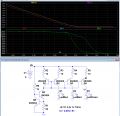
Below is the LTspice sim of an interesting current-mirror circuit that can drive multiple LED strings from a voltage source, each string with a constant-current, which can operate down to a supply voltage near the highest voltage string for good efficiency:
The value of R1 determines the constant-current value.

The current is shown for a varying Vb input voltage (horizontal scale), and the LED currents are quite constant (likely no noticeable change in the visual brightness) until the supply dropout voltage is reached (here at a Vb of about 2.5V, which is close to the green LED's forward voltage drop of ≈2.3V).

The strings can have more than one LED in series of course, as long as the supply voltage is above the sum of the total forward voltage drops of the highest voltage string.
The number of strings can be increased by the addition of another transistor and emitter resistor for each string.

1773855487473.png
 
Last edited:

ronsimpson

Joined Oct 7, 2019
4,645
It does if you put resistors in series with the load!
Many people put 30 to 50% of the power into resistors. Look at almost any LED circuit on the internet.
I can't remember now but I only used enough resistant to balance out the strings. I think we loss 1% to 5% in the resistors.
 

Thread Starter

muhammadanas25

Joined Jun 21, 2023
20
I am working on an LED project (O/HLS light with arrow and cross), and I am facing an issue with my red LEDs getting damaged after some time. I am a beginner, so I would really appreciate guidance from experts.

Here are my details:

  • I am using a constant current LED driver rated 22–42V (as per datasheet)
  • When I measure the driver with no load, it gives around 56V
  • For the red cross, I have:
    • 144 red LEDs
    • Arranged as 12 strings
    • Each string has 12 LEDs in series
  • Each red LED has ~2.0V forward voltage, so one string consumes about 24V
To balance the strings, I added:

  • A 150Ω resistor
  • An 1N5819 diode
    in series with each string
When I measured current, each string was taking around 17mA

However, after some days:

  • Some strings randomly stop working
  • In some cases, all LEDs suddenly turn off
  • I found that resistors are burned and LEDs are also damaged
Important note:

  • For the green LEDs, I did NOT use any resistor or diode
  • I directly connected strings to the same driver
  • Green LEDs are working perfectly without any issue
  • I only turn ON one (red or green) at a time, not both together
My understanding (please correct me if I am wrong):
  • Red LEDs have lower forward voltage than green LEDs
  • That’s why I added resistors and diodes to control current
  • But still, the circuit is failing
My confusion:
  1. Why are my resistors burning even though current measured is only ~17mA?
  2. Why are LEDs getting damaged after some time, not immediately?
  3. Why does green work fine without resistors, but red fails even with protection?
  4. Is my driver incompatible with this configuration?
What I need help with:
  • Correct way to design multiple LED strings with a constant current driver
  • Whether I should:
    • Use separate drivers per string
    • Or use a constant voltage supply instead
  • Proper method to balance current across strings
  • How to safely run 144 LEDs without burning components
Goal:
I want a reliable design where:

  • No LEDs burn
  • No resistors overheat
  • Both red and green patterns work properly with the same system
Any guidance, corrections, or suggestions would be highly appreciated.
Thank you!
 

BobTPH

Joined Jun 5, 2013
11,463
Many people put 30 to 50% of the power into resistors. Look at almost any LED circuit on the internet.
I can't remember now but I only used enough resistant to balance out the strings. I think we loss 1% to 5% in the resistors.
Sure, if you want to compare using way too much in the first case and way too little in the second.
 

ronsimpson

Joined Oct 7, 2019
4,645
I am working on an LED project
Now I see why the 150 ohms + diode.
Red LEDs have a voltage of 2.0V. Twelve LEDs = 24V + 2.55V for the resistors + 0.7V for the diode = 27.25V
Because the LED driver works from 22 to 42 volts you could remove the resistors and diodes.
Not all Red LEDs have a 2.0V drop. Your next batch might be different. That is why we CC.
Normally I would add one more LED to the string to get 26V. Because the 24V is getting close to the minimum of 22V for the driver.

Green LEDs have a voltage of (I don't see where you said but I think 2.27V) 12x2.27=27.25V.

Using CC you need to get the LED voltage to the 22 to 42 range. You do not need to get it to exactly some voltage. I see no reason to have the diodes or the resistors.

When I make something for production I must plan on buying millions of LED over years. (I pick a Red LED data sheet at random because I don't know your part number.) The data sheet said the voltage could be 1.5 min 2.2 typ 2.7 max. I cannot design for 2.2V because next year the voltage might be 2.6V or 1.7V. I get the LEDs with the same date code so most likely they all have the same voltage. If you are only going to make 100 then you can use the "2.0V". I must make the string have a length so 1.5V x number_of _LEDs = more than 22V and 2.7V x number_of _LEDs = less than 42V. It is very likely the voltages will be close to 2.2V and then I try to get the voltage to near the center of 22V to 42V. For your case 24V to 40V is probably safe.

Again, you do not need to add a diode just to increase the voltage by 0.7V. I think you do not need to have the resistor.

Are the Red LEDs from the same date code? Parallel strings of LEDs with different voltage drop, is not good. I might have used 50 ohms or 75 ohm trying for 0.5V or 1V to help just in case one string is not the same as the others.
 
Top