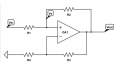
Op Amp, trying to approach it again.

Thread Starter

Xenon02

Joined Feb 24, 2021
504
No I didn't. I found what the input must be in order to make V+ equal to V- for a given Vout. That is VERY different than finding what Vout is for a given Vin.
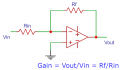
?

1664116144541.png

The same you did with positive feedback.


You mean you haven't been taught derivatives yet, or don't know how to apply them to a circuit?
More like applying to the circuit. But nevermind about that.


I think it's a great quote.
Great quote ?
It says that the input connected to positive input can't result in negative gain.

you even said it here that Vin it self doesn't define Vout :


Once again you are trying to draw simplistic conclusions that aren't the case in general. Just because Vin connects to Vp via a resistor does NOT mean that the output will always be the same polarity as the input. The output is a function of the entire circuit, not just a single connection
But the author of the quote said that Vin connected to Vp via resistor define the Vout and it's polarity.


Again, this is ONLY the case if the opamp is operating in its linear region.

What if V+ = 3 V, V- = 1 V, and Aol = 1,000,000? That equation says that the output would be two million volts! Do you believe that? Of course not. The output will simply be as positive as it can be, which will be somewhere close to its positive supply voltage.
I can believe that output cannot be 2 milion volts.

The closed loop gain of this is NOT negative! The closed loop gain doesn't exist! Any number you come up with for it by throwing stuff at an equation is meaningless!
I used this example to calculate the gain but for positive feedback. Same steps like for negative in this one.


Because the circuit isn't stable! It will not operate at a point where V+ = V- because the positive feedback (if it is net positive in case both types are present) will immediately drive the output away from that point.
But there must be a reason why it immediately drives out of stability point. If not V- =V+ or not gain then what makes this positive feedback to drive out of stability ?
 

BobTPH

Joined Jun 5, 2013
11,555
[QUOTE="Xenon02, post: 1765895, member:
But there must be a reason why it immediately drives out of stability point. If not V- =V+ or not gain then what makes this positive feedback to drive out of stability ?
[/QUOTE]
Because as the output moves, it increases the the input differential, that is what positive feedback means.
 

MrChips

Joined Oct 2, 2009
34,879
Positive feedback is inherently unstable.
There is always noise in the system. The slightest amount of noise will tip the system over and the output will be driven to one of the supply rails.

That is a fact of life and you just have to accept it.
 

WBahn

Joined Mar 31, 2012
32,929
?

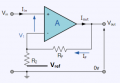
View attachment 276997

The same you did with positive feedback.
This circuit is a linear amplifier. It has a well-defined closed loop gain. That gain is -Rf/Rin (and NOT the Rf/Rin that you indicate).

What does gain mean? It means you take the input signal, multiply it by the gain, and you have the output signal.

Note that this discussion is limited to linear systems, so we make no distinction between large-signal and small-signal gain.

If you build a circuit in which you cannot take the input signal and multiply it by a gain to get the output signal, then that circuit does not have a gain.

What is the gain of a logic inverter? What is the gain of a NAND gate? What is the gain of a multiplexer?

We don't talk about the gain of any of these because such a concept just doesn't apply to them (at least in normal operation).

When you swap the inputs to the opamp in that circuit, you no longer have a linear amplifier. You have Schmitt Trigger comparator, which is a HIGHLY non-linear circuit and the notion of gain just doesn't apply. It does not matter what you can crank some math and come up with a number -- that number is meaningless for that circuit.

Great quote ?
It says that the input connected to positive input can't result in negative gain.
So if I say that the car in my garage is gold colored, are you going to quote me and say that I am claiming that all cars are gold colored?

Read the quote again. It states, very explicitly, "Basically, this circuit has both positive feedback and negative feedback. It is stable only if the negative feedback is dominant, resulting in net negative feedback."

THAT circuit is not stable for negative gain, because any value of resistors you choose that would nominally result in a negative gain ALSO result in THAT circuit having net positive feedback and being unstable.

I can believe that output cannot be 2 milion volts.
Then you must also believe that

Vout = Aol * (Vp - Vn)

doesn't always apply to the circuit.

I used this example to calculate the gain but for positive feedback. Same steps like for negative in this one.
For the umpteenth time, that circuit does not have a gain (in terms of Vout/Vin). Follow the same steps all day long and that does not change -- you are just wasting time coming up with a meaningless number that has no meaning at all for that circuit.

But there must be a reason why it immediately drives out of stability point. If not V- =V+ or not gain then what makes this positive feedback to drive out of stability ?
I have gone through that multiple times. For the last time, if you were to somehow manage to get the circuit a point where V+ = V-, any tiny deviation, even due to the thermal noise that is always present, that causes Vout to change will result in the differential input voltage changing in such a way that the new Vout will be even further away from that "stability point" (and it's not a stability point, it is an equilibrium point -- these are not the same concept). That's what positive feedback does. It positively reinforces any changes in the circuit so that small changes become large changes and then large changes become even larger changes.
 

Thread Starter

Xenon02

Joined Feb 24, 2021
504
So if I say that the car in my garage is gold colored, are you going to quote me and say that I am claiming that all cars are gold colored?
The quote stated this :
" OK - with corrected resistor values the calculated gain is Acl=-11/9 (as given by you). Question: Can this be a realistic value? Answer: No - because the input signal acts on the non-inverting input and the gain cannot be negative. This explanation is sufficient. This is also clear because we can see that there is much more positive feedback (factor Hr+=0.5) than negative feedback (factor Hr-=-1/11)"

The issue I had with this quote is that the author of this quote said that the input which is Vin defines the gain, and so the gain defines the Vout am I right ?

And you mentioned that not only Vin defines the Vout but also other components such as resistors.

I just don't know why the author said that Vin defines the gain and that gain also defines the Vout so it's like Vin defines the Vout. Also it was mentioned (I don't remember where) that polarity also matters. Can't Vin with positive polarity connected to VP via resistor result in negative Vout ?


For the umpteenth time, that circuit does not have a gain (in terms of Vout/Vin). Follow the same steps all day long and that does not change -- you are just wasting time coming up with a meaningless number that has no meaning at all for that circuit.
So why when I check some sites or check here that it is possible.
I can understand that the gain doesn't apply for positive feedback.


I have gone through that multiple times. For the last time, if you were to somehow manage to get the circuit a point where V+ = V-, any tiny deviation, even due to the thermal noise that is always present, that causes Vout to change will result in the differential input voltage changing in such a way that the new Vout will be even further away from that "stability point" (and it's not a stability point, it is an equilibrium point -- these are not the same concept). That's what positive feedback does. It positively reinforces any changes in the circuit so that small changes become large changes and then large changes become even larger changes.
Is it possible that you can show me some example ?
Like how it is going into unstability for positive and going into stability for the negative. Like adding noise to the op amp and see what will happen.


Read the quote again. It states, very explicitly, "Basically, this circuit has both positive feedback and negative feedback. It is stable only if the negative feedback is dominant, resulting in net negative feedback."

THAT circuit is not stable for negative gain, because any value of resistors you choose that would nominally result in a negative gain ALSO result in THAT circuit having net positive feedback and being unstable.
"stronger feedback".
Of course I don't look at V- and V+. Because this is meaningless.
But what does it mean ? That even if there is negative feedback then it goes unstable ? What does it mean that it is stronger ?

Also about that circuit. The negative gain and it resulted in positive feedback which was stronger, but what if the same circuit had negative feedback and was stable ? Which it means that the negative feedback was stronger.
Would it be possible ?

By the way stronger feedback means what ? That Vout starts at specific polarity ?
 

WBahn

Joined Mar 31, 2012
32,929
The quote stated this :
" OK - with corrected resistor values the calculated gain is Acl=-11/9 (as given by you). Question: Can this be a realistic value? Answer: No - because the input signal acts on the non-inverting input and the gain cannot be negative. This explanation is sufficient. This is also clear because we can see that there is much more positive feedback (factor Hr+=0.5) than negative feedback (factor Hr-=-1/11)"

The issue I had with this quote is that the author of this quote said that the input which is Vin defines the gain, and so the gain defines the Vout am I right ?
Why must I defend some quote made by someone else?

The author of the quote is simply rationalizing that, in their view, it doesn't make sense for that circuit to be able to have a negative gain because the an increase in the input signal (i.e., adding a positive voltage to it to make it either more positive or less negative) will act to increase the voltage at the non-inverting input, which will make the output go more positive than whatever it already is. Thus, in their view, any value of gain for that circuit doesn't make sense. In addition, they are saying that, for the example resistors that supposedly resulted in a negative gain, the was more positive feedback than negative feedback. What was not said, at least in the quoted material, is that this means that the circuit is unstable and therefore any gain that is calculated is meaningless.

And you mentioned that not only Vin defines the Vout but also other components such as resistors.
The context of that statement was that, for a circuit having a legitimate gain, if you tell me what Vin is, I can tell you what Vout is (and vice versa). In a circuit with positive feedback, that is not the case in general. For the circuits you've shown, there is a whole range of values for Vin for which I can't tell you what Vout is (due to the hysteresis of the circuit). Plus, if you tell me what Vout is, I can't tell you what Vin is because it could be any value within a wide range of possible input values.

I just don't know why the author said that Vin defines the gain and that gain also defines the Vout so it's like Vin defines the Vout. Also it was mentioned (I don't remember where) that polarity also matters.
Go ask the author.

Can't Vin with positive polarity connected to VP via resistor result in negative Vout ?
Sure. There are all kinds of ways to make that happen.

Consider the classic non-inverting opamp circuit that has been modified to refer the feedback voltage divider to a positive voltage, such as the positive supply rail. Now, for some range of positive input voltages, the output voltage must be negative in order to get the right voltage at the inverting input.

So why when I check some sites or check here that it is possible.
I can understand that the gain doesn't apply for positive feedback.
Don't believe everything you read on every website.

Is it possible that you can show me some example ?
Like how it is going into unstability for positive and going into stability for the negative. Like adding noise to the op amp and see what will happen.
I've walked through several examples already. No reason to think that doing yet another one will make a difference.

"stronger feedback".
Of course I don't look at V- and V+. Because this is meaningless.
But what does it mean ? That even if there is negative feedback then it goes unstable ? What does it mean that it is stronger ?
Again, THAT circuit has BOTH positive and negative feedback. Whether the circuit, as a whole, exhibits positive or negative feedback depends on which of the two is dominant over the other.

Also about that circuit. The negative gain and it resulted in positive feedback which was stronger, but what if the same circuit had negative feedback and was stable ? Which it means that the negative feedback was stronger.
Would it be possible ?
I already showed what is required for that circuit to have negative feedback:

https://forum.allaboutcircuits.com/threads/op-amp-trying-to-approach-it-again.189334/post-1765382

R2·R4 > R1·R3

But that same constraint also results in a positive value for the gain (for THAT circuit).

By the way stronger feedback means what ? That Vout starts at specific polarity ?
It has NOTHING to do with the polarity of Vout!

It's simply whether the two combined influences have net-positive or net-negative feedback.
 

Thread Starter

Xenon02

Joined Feb 24, 2021
504
Why must I defend some quote made by someone else?
This quote made me think alot about it.


The author of the quote is simply rationalizing that, in their view, it doesn't make sense for that circuit to be able to have a negative gain because the an increase in the input signal (i.e., adding a positive voltage to it to make it either more positive or less negative) will act to increase the voltage at the non-inverting input, which will make the output go more positive than whatever it already is. Thus, in their view, any value of gain for that circuit doesn't make sense. In addition, they are saying that, for the example resistors that supposedly resulted in a negative gain, the was more positive feedback than negative feedback. What was not said, at least in the quoted material, is that this means that the circuit is unstable and therefore any gain that is calculated is meaningless.
Do you think the author was correct ?
Because let's suppose that this gain can exist(I know for positive feedback it is incorrect). Now to think about it why it doesn't work.
Simply saying that let's increase the Vin (input signal) with resistor connected to Vp. We know that Vin doesn't define what will be the output Vout. So increasing Vin that is connected to Vp can result in positive or negative Vout.
So if I want say that this gain doesn't have any sense because this is what I want to do and let's say that i don't know which feedback is dominant because the only thing I did was calculating gain, so this gain cannot say that increasing Vin must result in increasing Vout? I know that connecting Vin to VP doesn't define the polarity of Vout (whether it is positive or negative), but does it define if increasing Vin in Vp will increase the Vout ? Even if there is resistor between Vp and Vin ?

Something like that ?


Sure. There are all kinds of ways to make that happen.

Consider the classic non-inverting opamp circuit that has been modified to refer the feedback voltage divider to a positive voltage, such as the positive supply rail. Now, for some range of positive input voltages, the output voltage must be negative in order to get the right voltage at the inverting input.
Modifying this :

1664149354511.png


Even if Vin will be positive I can have negative Vout ? Increasing Vin can result in decreasing Vout ?


Don't believe everything you read on every website.
but it's hard to find what is legit and what is not legit.


I've walked through several examples already. No reason to think that doing yet another one will make a difference.
I mean only to show that a random noise will increase the Vout to infinity, and a example where a random noise will be stable at a certain time.


Again, THAT circuit has BOTH positive and negative feedback. Whether the circuit, as a whole, exhibits positive or negative feedback depends on which of the two is dominant over the other.
As a whole, okey.
So I should look at V- = V+ but rather if it as a whole work aas a negative feedback or not.


It has NOTHING to do with the polarity of Vout!

It's simply whether the two combined influences have net-positive or net-negative feedback.
I just said about polaryties because I read it from here :


And if you look at the voltage polarities you will see that it is not possible for the circuit with positive feedback to be stable with the output at other than one of the rail voltages

But probably I understood it wrongly.
 
Last edited:

WBahn

Joined Mar 31, 2012
32,929
Do you think the author was correct ?
Within the context of THAT circuit, their reasoning was reasonable.

So if I want say that this gain doesn't have any sense because this is what I want to do and let's say that i don't know which feedback is dominant because the only thing I did was calculating gain, so this gain cannot say that increasing Vin must result in increasing Vout? I know that connecting Vin to VP doesn't define the polarity of Vout (whether it is positive or negative), but does it define if increasing Vin in Vp will increase the Vout ? Even if there is resistor between Vp and Vin ?
If the only thing you are calculating is a gain based on an assumption that the circuit behaves as an amplifier, then you aren't doing your job properly.

You are also constantly mixing up two concepts. At times you talk about a positive Vin resulting in a negative Vout, and at other times you talk about an increasing Vin resulting in an increasing Vout. These are two completely different things. One is talking about the actual input and output voltage levels and the other is talking about their slope.

Modifying this :

View attachment 277030


Even if Vin will be positive I can have negative Vout ? Increasing Vin can result in decreasing Vout ?
This is the unmodified circuit. Make the mod I suggested and refer the voltage divider to some other voltage:

1664174865829.png

Now the output voltage is given by

Vout = Vin * (1 + Rf/R2) - Vref * (Rf/R2)

If you make Vref positive, you get a negative output voltage for at least some range of positive Vin.

But note that increasing Vin always results in Vout increasing, regardless of their respective polarities.

As a whole, okey.
So I should look at V- = V+ but rather if it as a whole work aas a negative feedback or not.
Of course! That's what we've been trying to tell you repeatedly. You can't just look at one tiny aspect. An opamp is only useful because we can use the external components to determine the behavior of the overall circuit, so it shouldn't be surprising that you have to look at the overall circuit to determine the behavior of an opamp-based circuit.
 

Thread Starter

Xenon02

Joined Feb 24, 2021
504
Within the context of THAT circuit, their reasoning was reasonable.
Reasonable hmm.

I mean saying that Vin connected to Vp must result in positive gain and not with negative gain ?


If the only thing you are calculating is a gain based on an assumption that the circuit behaves as an amplifier, then you aren't doing your job properly.

You are also constantly mixing up two concepts. At times you talk about a positive Vin resulting in a negative Vout, and at other times you talk about an increasing Vin resulting in an increasing Vout. These are two completely different things. One is talking about the actual input and output voltage levels and the other is talking about their slope.
Hmm okey so basically. Gain doesn't tell me everything I have to assure that it works in negative feedback.
So argument that Vin connected to VP must result in specific gain or must result in specific polarity of Vout is incorrect.

But I've got a question.
If I have Vin connected to Vp via resistor. The increasing Vin will increase Vout ? Even though Vin is not connected directly to Vp ?
It cannot work that increasing Vin (that is connected to Vp via resistor) will decrease Vout ?


Of course! That's what we've been trying to tell you repeatedly. You can't just look at one tiny aspect. An opamp is only useful because we can use the external components to determine the behavior of the overall circuit, so it shouldn't be surprising that you have to look at the overall circuit to determine the behavior of an opamp-based circuit.
It takes me a while to understand new stuff, sorry for annoying here everybody.
Of course V+ = V- is essential, but I have to assure that it is negative feedback (or if it's domiant). Other wise it will go into saturation.


Altough looking at those schematics from Jony :

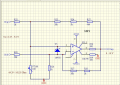
1664195495565.png

Analysing it looks like a nightmare ...
So many elements with specific value that I don't understand or wierdly connected elements.

From those basic knowlage I am supposed to be able to analize it? Or create a practical circuit ?
 

WBahn

Joined Mar 31, 2012
32,929
To analyze that circuit, you can combine the two strings of series resistors to make it a easier. I'm not sure why the feedback resistors are split out -- possibly for tweaking purposes. It's interesting that R57 is 464 Ω and not 470 Ω, given that the 6 Ω difference represents just 0.03% of the value of R23. That leads me to think that the values shown are "as tuned".

I'm not sure what the intended purpose of the zener diode is. I can't even find a datasheet for that part, so I don't know what the voltage is. But if the opamp is operating in its active region, the voltage across the diode should be essentially zero, meaning that you should be able to ignore it for that part of the analysis. My guess is that it's there to clamp the max differential voltage into the opamp when it is driven out of linear operation.

The 200 Ω resistor on the output of the opamp can probably also be ignored, at least for the first cut analysis. It adds to the opamp's intrinsic output impedance and may be there to deal with capacitive loads. But, in any event, it is effectively the voltage U_wy that is being fed back.

So now you have two feedback paths. Find V+ and V- in terms of the components along each path, set them equal, and solve for U_wy.

To find the region of stability, you can determine the gain along each path and require the negative feedback gain to be more than the positive feedback gain, or you can find the differential voltage in terms of U_wy and take the derivative and find where it is negative.
 

Thread Starter

Xenon02

Joined Feb 24, 2021
504
I'm not sure what the intended purpose of the zener diode is. I can't even find a datasheet for that part, so I don't know what the voltage is. But if the opamp is operating in its active region, the voltage across the diode should be essentially zero, meaning that you should be able to ignore it for that part of the analysis. My guess is that it's there to clamp the max differential voltage into the opamp when it is driven out of linear operation.
I mean this diod was really wierd :D
Dunno why it was even added. But clamp max differential voltage ? I don't get it but ok.


So now you have two feedback paths. Find V+ and V- in terms of the components along each path, set them equal, and solve for U_wy.

To find the region of stability, you can determine the gain along each path and require the negative feedback gain to be more than the positive feedback gain, or you can find the differential voltage in terms of U_wy and take the derivative and find where it is negative.
The problem is that we have two inputs and both inputs are connected to V- and V+ but in different moment.
Calculating for every value of Vin 1 and Vin 2 also calculating for every combination of the PT100.

But wait a second wasn't Pt100 a termal resistor ?

And also why would author of this circuit did connect Vin1 and Vin2 in wierd way.

Also what about this ? :


Hmm okey so basically. Gain doesn't tell me everything I have to assure that it works in negative feedback.
So argument that Vin connected to VP must result in specific gain or must result in specific polarity of Vout is incorrect.

But I've got a question.
If I have Vin connected to Vp via resistor. The increasing Vin will increase Vout ? Even though Vin is not connected directly to Vp ?
It cannot work that increasing Vin (that is connected to Vp via resistor) will decrease Vout ?
 

crutschow

Joined Mar 14, 2008
38,538
Why the problem with your understanding the basic operation of an op amp?
If the (+) input is more positive than the (-) input, than that output goes towards the positive.
If the (+) input is more negative than the (-) input than the output goes towards the negative.
So you calculate the voltage at the two inputs and that will tell you what the output is doing.

For positive feedback the output change will tend to increase the voltage difference at the input, so the output will keep going until it hits a rail voltage.
So it will have two stable states, either with the output at the plus rail or at the minus rail.

For negative feedback the output will tend to decrease the voltage difference at the input until the difference is near zero.
Thus it is stable at whatever output voltage can generate a zero input difference (assume that occurs before the output saturates).

That's the basics.
If you can't understand those, than I see no further point in this discussion.
 

Thread Starter

Xenon02

Joined Feb 24, 2021
504
Why the problem with your understanding the basic operation of an op amp?
If the (+) input is more positive than the (-) input, than that output goes towards the positive.
If the (+) input is more negative than the (-) input than the output goes towards the negative.
So you calculate the voltage at the two inputs and that will tell you what the output is doing.

That's the basics.
If you can't understand those, than I see no further point in this discussion.
If the (+) input is more positive.
But there is Vin connected to (+) input via resistor, and further is a feedback. So how can we say the I've increased (+) input ?

Also I was just thinking about the quote :

" OK - with corrected resistor values the calculated gain is Acl=-11/9 (as given by you). Question: Can this be a realistic value? Answer: No - because the input signal acts on the non-inverting input and the gain cannot be negative. This explanation is sufficient. This is also clear because we can see that there is much more positive feedback (factor Hr+=0.5) than negative feedback (factor Hr-=-1/11)"

This quote made me just think a little bit.
Because Vin doesn't define the Vout itself.
But the author concluded that because the Vin is connected to (+) input then the gain cannot be negative. Why ?
 

crutschow

Joined Mar 14, 2008
38,538
But there is Vin connected to (+) input via resistor, and further is a feedback. So how can we say the I've increased (+) input ?
I assume you know Ohm's law and how voltage division by resistors work.
So use that to calculate to the voltage at the (+) and (-) inputs (or is that beyond your math abilities?)
 

Thread Starter

Xenon02

Joined Feb 24, 2021
504
I assume you know Ohm's law and how voltage division by resistors work.
So use that to calculate to the voltage at the (+) and (-) inputs (or is that beyond your math abilities?)
Hmmm.
So as I know. if we have negative feedback then (+) input = (-) input.

Or I shouldn't assume any feedback ?
Because depending on the Vout, the value on the (+) input might be any value.

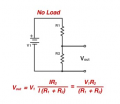
Typical voltage division equation
1664209249200.png
So first node of Vout would be (+) input. the other node should be for Vout. But R2 is a negative feedback which is not connected to Vin. So it is a bit different ? Sorry If I'm wrong.
 

crutschow

Joined Mar 14, 2008
38,538
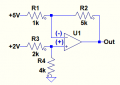
Since I'm never sure what circuit you are referring to, below is a simple op amp circuit (with ideal op amp, so the op amp gain is assumed to be essentially infinite).
Calculate the Out voltage for the circuit.
Hint: For an ideal opamp, that occurs when the (-) op amp input voltage equals the (+) input voltage (no voltage difference between the inputs).

1664212396973.png
 

Thread Starter

Xenon02

Joined Feb 24, 2021
504
Since I'm never sure what circuit you are referring to, below is a simple op amp circuit (with ideal op amp, so the op amp gain is assumed to be essentially infinite).
Calculate the Out voltage for the circuit.
Hint: For an ideal opamp, that occurs when the (-) op amp input voltage equals the (+) input voltage (no voltage difference between the inputs).

1664212396973.png
So input (+) is equal 1,3333V can I assume that it is 1,3V ? If yes then :

input (-) must be also 1,3V. So current in R1 is 3,7mA so Vout is equal -17.2V?

So what did you mean by increasing (+) input while they are always equal (for negative feedback).
 

Thread Starter

Xenon02

Joined Feb 24, 2021
504
No, the value is 1⅓V
Why would you round off the voltage?
If you use the exact value, then the output will be -17V, not -17.2V
Okey sorry.


That's a garbled statement.
What are you referring to?
Why the problem with your understanding the basic operation of an op amp?
If the (+) input is more positive than the (-) input, than that output goes towards the positive.
If the (+) input is more negative than the (-) input than the output goes towards the negative.
So you calculate the voltage at the two inputs and that will tell you what the output is doing.
Increasing the (+) input. But here they are equal.

or here :

1664214351917.png

Increasing Vin should increase VP ? Also increasing Vin should increase the Vout ? Because Vin is connected to (+) input via resistor.
 
Top