The are equal when the output settles to the final value.
It you want to calculate the relative value of the (+) and (-) inputs for other values of the output you can, but you will see that the only output value the leads to a steady-state value is when the (+) and (-) voltages equal each other.
That circuit has both positive and negative feedback, so the output depends upon the relative resistor values to see whether the predominate feedback is positive or negative.
Thus you have to put in some actual resistor values, before we can determine what the output is doing.
The are equal when the output settles to the final value.
It you want to calculate the relative value of the (+) and (-) inputs for other values of the output you can, but you will see that the only output value the leads to a steady-state value is when the (+) and (-) voltages equal each other.
Okej.
I mean I know that they will be equal (+) and (-). I just didn't understand the fact that increasing (+) will increase the Vout. When I have a stable state in Op Amp so there (+) input will not increase although Vout is changing.
That circuit has both positive and negative feedback, so the output depends upon the relative resistor values to see whether the predominate feedback is positive or negative.
Thus you have to put in some actual resistor values, before we can determine what the output is doing.
So increasing Vin while Vin is connected to (+) input with resistor like in the image with both feedback, cannot tell me if the Vout is increasing ? Because I don't know whether I am increasing (+) input ?
Because in the quote as I mentioned the author said that increasing Vin while is it connected to (+) input must result in positive gain, but it was negative gain (although the Vin is connected to (+) with resistor and there are other resistors as well). So I didn't really get it.
Let's try this again, but a slightly different way.
Let's assume, for the moment, that the resistor values have been chosen such that the circuit operates with net negative feedback and is stable. We've shown, several times, that this requires
R2·R4 > R1·R3
Now, let's assume that the circuit is sitting there with some Vin and the corresponding Vout and it nice and happy.
What is the chain of events that happens if Vin is increased?
If Vin goes up, and Vout hasn't had time to change yet (there is a delay through the opamp, afterall), the voltage at Vp will increase.
This increase at Vp will cause the voltage at Vout to increase.
However, the increase in Vout will ALSO cause Vp to increase, which will want to cause Vout to increase even further.
This is the effect of the positive feedback.
But, at the same time, when Vout increases, that ALSO causes the voltage at Vn to increase, which will tend to make Vout go down (or at least not increase as much).
This is the effect of negative feedback.
So the question is: Which effect wins in the end?
If the change in Vp caused by the increase in Vout is more than the increase in Vn, the positive feedback will win and the output will keep increasing until it hits the rail. But if Vn increases more than Vp, the negative feedback will win and the voltage at Vn will catch up to the voltage increase at Vp (caused by the increase in Vin) and the output voltage will stop increasing and hold at a new stable value.
Okej.
I mean I know that they will be equal (+) and (-). I just didn't understand the fact that increasing (+) will increase the Vout. When I have a stable state in Op Amp so there (+) input will not increase although Vout is changing.
If Vout is changing, then both Vp and Vn will be changing. Look at the circuit. If Vout goes up, then BOTH Vp and Vn will go up as a result. But which one will go up more?
Both sides are voltage dividers. Using superposition to focus the effect due just to an increase in Vout (let's call the change in Vout dVout), the increase in Vp (let's call that dVp) will be
dVp = dVout · R1/(R1+R2)
Similarly, the change in Vn (let's call it dVn) will be
dVn = dVout · R4/(R3+R4)
If dVp > dVn, the positive feedback wins and the amplifier rails.
But if dVn > dVp, the negative feedback wins and the amplifier will settle to a new value of Vout consistent with the new value of Vin and with Vp = Vn.
So, in order to be stable, we need
dVn > dVp
dVout · R4/(R3+R4) > dVout · R1/(R1+R2)
R4/(R3+R4) > R1/(R1+R2)
R4(R1+R2) > R1(R3+R4)
R4·R1 + R4·R2 > R1·R3 + R1·R4
R4·R2 > R1·R3
Looks familiar, doesn't it?
So increasing Vin while Vin is connected to (+) input with resistor like in the image with both feedback, cannot tell me if the Vout is increasing ? Because I don't know whether I am increasing (+) input ?
No. We can see quite clearly that increasing Vin will cause Vout to increase. What we can't tell until we know whether or not the constraint shown above is whether Vout will go up a bit and then stop, or whether it will keep going until it saturates at the positive rail.
Because in the quote as I mentioned the author said that increasing Vin while is it connected to (+) input must result in positive gain, but it was negative gain (although the Vin is connected to (+) with resistor and there are other resistors as well). So I didn't really get it.
The case that that author should that supposedly had negative gain cannot happen. That's what the author was talking about -- if THAT circuit is stable, then increasing Vin will result in an increase in Vout, meaning that the gain must be positive for THAT circuit. So any time you calculate a negative gain for THAT circuit, something must be wrong. The something that is wrong is that any time THAT circuit appears to have a negative gain, in actuality the circuit is unstable and therefore any gain that you calculate is meaningless.
Now, let's assume that the circuit is sitting there with some Vin and the corresponding Vout and it nice and happy.
What is the chain of events that happens if Vin is increased?
If Vin goes up, and Vout hasn't had time to change yet (there is a delay through the opamp, afterall), the voltage at Vp will increase.
This increase at Vp will cause the voltage at Vout to increase.
However, the increase in Vout will ALSO cause Vp to increase, which will want to cause Vout to increase even further.
This is the effect of the positive feedback.
But, at the same time, when Vout increases, that ALSO causes the voltage at Vn to increase, which will tend to make Vout go down (or at least not increase as much).
This is the effect of negative feedback.
So the question is: Which effect wins in the end?
If the change in Vp caused by the increase in Vout is more than the increase in Vn, the positive feedback will win and the output will keep increasing until it hits the rail. But if Vn increases more than Vp, the negative feedback will win and the voltage at Vn will catch up to the voltage increase at Vp (caused by the increase in Vin) and the output voltage will stop increasing and hold at a new stable value.
No. We can see quite clearly that increasing Vin will cause Vout to increase. What we can't tell until we know whether or not the constraint shown above is whether Vout will go up a bit and then stop, or whether it will keep going until it saturates at the positive rail.
The case that that author should that supposedly had negative gain cannot happen. That's what the author was talking about -- if THAT circuit is stable, then increasing Vin will result in an increase in Vout, meaning that the gain must be positive for THAT circuit. So any time you calculate a negative gain for THAT circuit, something must be wrong. The something that is wrong is that any time THAT circuit appears to have a negative gain, in actuality the circuit is unstable and therefore any gain that you calculate is meaningless.
So increasing Vin while Vin is connected to (+) input with resistor like in the image with both feedback, cannot tell me if the Vout is increasing ? Because I don't know whether I am increasing (+) input ?
Why the problem with your understanding the basic operation of an op amp?
If the (+) input is more positive than the (-) input, than that output goes towards the positive.
So increasing Vin was comming with increasing Vout. But you mentioned about increasing Vout by increasing (+) input.
But (+) and (-) are the same and doesn't change when I increase Vin so I was a bit confused.
Due to negative feedback the only stable state is when the (+) and (-) voltages are the same (or a very small difference as determined by the op amp open-loop gain).
So if you change Vin, Vout changes until the (+) and (-) voltages are again equal.
If there were not equal then Vout is forced to changed (by the (+) and (-) voltage difference) until they are the same.
Due to negative feedback the only stable state is when the (+) and (-) voltages are the same (or a very small difference as determined by the op amp open-loop gain).
So if you change Vin, Vout changes until the (+) and (-) voltages are again equal.
If there were not equal then Vout is forced to changed (by the (+) and (-) voltage difference) until they are the same.
Okey so when we have stable state (+) nad (-) are equal, changing Vin (increasing) will change (+) input and (-) input, then Vout changes due to changes in input (+) and (-).
In both feedback I did something like this is it correct conclusion ? :
If by both, you mean positive and negative feedback, that's true for negative feedback
For positive feedback, any difference in the (+) and (-) voltages will cause the output to go in the direction such as to increase the difference, not reduce it.
That's why the output ends up at one of the output rails.
If by both, you mean positive and negative feedback, that's true for negative feedback
For positive feedback, any difference in the (+) and (-) voltages will cause the output to go in the direction such as to increase the difference, not reduce it.
That's why the output ends up at one of the output rails.
I meant there the simulation, when I said about the conclusion
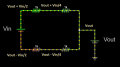
There were 4 resistors. 2 on top represents negative feedback and 2 down there positive feedback. Like how will the feedback works when the Vout will increase or when it starts with Vout = 0V. And I showed the instability 1,25V for (+) input and -1,25V for (-) input
But saying that (for the circuit with both feedbacks) if I calculate the negative gain, saying that it is impossible because the input acts on the non-inverting input. Because I've seen the examples that even if I had input signal on the non-inverting input I could have negative gain. It's just that this conclusion didn't make much sense.
This makes no sense. First, you don't define where V+ and V- are in that circuit, and it has nothing to do with opamps or stability. The solution is obvious by inspection:
Why can we tell that Vout will be increasing ? Just because Vin is connected to Vp ? But this is not a direct connection like here :
It is connected to Vp via a voltage divider from Vin to Vout. What happens to the voltage at the center of a voltage divider if the voltage at one in goes up and the other stays the same?
I mean the author said that gain cannot be negative because the Vin is connected to Vp. And that doesn't make sense.
For THAT circuit.... if Vin is increased, then Vp has to increase, which means that Vout has to move up. That is inconsistent with the gain being negative, therefore the gain can't be negative.
So increasing Vin was comming with increasing Vout. But you mentioned about increasing Vout by increasing (+) input.
But (+) and (-) are the same and doesn't change when I increase Vin so I was a bit confused.
You are once again confusing the absolute voltage with a change in voltage.
Let's say that Vp = Vn = 2 V.
Now we increase Vin so that Vp = 3 V. If the circuit is stable, then Vout will increase until Vn = 3 V. Both Vp and Vn increased, but the differential voltage, (Vp-Vn), has not and is still zero.
In a real opamp with large, but finite, gain, there WOULD be an increase in the differential voltage since Vp would have to increase just slightly more than Vn in order for Vout to settle at a higher voltage. But we are talking microvolt-level increases.
I meant there the simulation, when I said about the conclusion
There were 4 resistors. 2 on top represents negative feedback and 2 down there positive feedback. Like how will the feedback works when the Vout will increase or when it starts with Vout = 0V. And I showed the instability 1,25V for (+) input and -1,25V for (-) input
That circuit you posted is rubbish in that it has NO connection, in any way, with feedback in an opamp circuit.
But saying that (for the circuit with both feedbacks) if I calculate the negative gain, saying that it is impossible because the input acts on the non-inverting input. Because I've seen the examples that even if I had input signal on the non-inverting input I could have negative gain. It's just that this conclusion didn't make much sense.
Once again, you are insisting on taking a chain of reasoning that is specific to a particular circuit and brute force applying it to every circuit that can ever be. Your "other examples" have ZERO relevance to a chain of reasoning that applies to THAT specific circuit unless those other examples are THAT specific circuit.
Plus, you are once again confusing a situation in which a positive voltage at the input can produce a negative voltage at the output with a circuit having a negative gain. The circuit that I showed you still has a positive gain, it's just that the output had a negative offset voltage added to it because of where the reference voltage was set.
I've reluctantly come to the conclusion that you have picked the wrong field to study, since you seem to be having great difficulty in understanding even the basics.
I've reluctantly come to the conclusion that you have picked the wrong field to study, since you seem to be having great difficulty in understanding even the basics.
I came to the same conclusion about five threads ago. In each thread he insists on generalizing a principle that applies in a specific case to other situations where it does not, then clings to this incorrect understanding. In the first thread, he was applying Ohm’s law to a capacitor and it took many posts before he finally dropped that notion.
It is connected to Vp via a voltage divider from Vin to Vout. What happens to the voltage at the center of a voltage divider if the voltage at one in goes up and the other stays the same?
Okey,
Also Vn is also increasing. Not looking at the final voltage value but at the changes as you said. I've increased Vin, so Vp also increases, Vout stays the same (for a moment), so Vn also changes and it increases.
For THAT circuit.... if Vin is increased, then Vp has to increase, which means that Vout has to move up. That is inconsistent with the gain being negative, therefore the gain can't be negative.
Aha so because Vin is increasing therefore Vp is increasing if the gain was negative then it would say that Vout is decreasing.
I think I get it.
But isn't Vn also increasing when Vin is increasing ?
Plus, you are once again confusing a situation in which a positive voltage at the input can produce a negative voltage at the output with a circuit having a negative gain. The circuit that I showed you still has a positive gain, it's just that the output had a negative offset voltage added to it because of where the reference voltage was set.
I've reluctantly come to the conclusion that you have picked the wrong field to study, since you seem to be having great difficulty in understanding even the basics.
I came to the same conclusion about five threads ago. In each thread he insists on generalizing a principle that applies in a specific case to other situations where it does not, then clings to this incorrect understanding. In the first thread, he was applying Ohm’s law to a capacitor and it took many posts before he finally dropped that notion.
I'm very sorry, maybe I'm not that bright. But could you please stop talking about my decisions in life ?
I'm struggeling because I'm trying to learn new thigns basing on what I have.
I clinge to the incorrect understanding because I belive there is some connection or rather a question in my mind "why one works this way and the other doesn't", trying to use same basics.
I'm already struggeling with my self-esteem, because there are many more complex circuits I'm trying to understand by myself.
The only stuff I know was Op amp with one feedback, they didn't teach my how both works. They didn't even tell me why this feedback works this way and why positive feedback was saturating, no intuition.
By the way I was considering changingmy field of study, but there is a problem (after 1st year of electronics), I don't have anything else to do, no vision of future.
Hi X02,
Electronics Engineering is simply the manipulation of Electrons in order to give a desired end result.
Unfortunately, the little beggars are not directly visible to the human eye.
You have to develop a visual sense of what is actually happening in a circuit, before applying the maths.
If you don't understand a particular problem, at this point in your studies, you have a number of options, you can either keep dogging away at it in frustration or go around it and place it in the pending tray.
As you become more proficient in your studies, you will get the 'duh' moment and the answer that alluded you will be so obvious you will kick yourself.
So don't give up studying, just get organized in your thinking.
You have to develop a visual sense of what is actually happening in a circuit, before applying the maths.
If you don't understand a particular problem, at this point in your studies, you have a number of options, you can either keep dogging away at it in frustration or go around it and place it in the pending tray.
I'm trying really hard.
I usually get information to stop studying and change it. But this field is really interesting but very complex.
When I learn new stuff I want to try it. Maybe it is to early I don't know. I even tried to learn by myself how transistors work but it's pretty hard (hard in the moment when I have 2 or more transistors connected to each other).
I want to also understand the circuits many people does here.
But when I get comments to give up I just don't know what to do ...
As you become more proficient in your studies, you will get the 'duh' moment and the answer that alluded you will be so obvious you will kick yourself.

 Facebook
 Google
 GitHub
 Linkedin