I'm looking for a circuit to make a noise after being triggered by either impact or a magnet.

Thread Starter

weezy721

Joined Jul 30, 2024
6
Hi all,

Not sure this is the right place but Im looking for some expertise/help in understanding design of a simple circuit.

Im looking to make something that would make a noise after being triggered by either impact or a magnet.

Looking for this to be very very small also. Smaller than a tennis ball.

Im thinking I'd need (at the minimum):
-power source (battery)
-sound maker (P-Buzzer)
-trigger (?)
-something that would stop the buzzer after being triggered (hoping to buzzer can go for 2-4)

Some newb thoughts I had were:
-Could a capacitor make the buzzer beep for 3 min until its depleted
-What could I use to trigger the buzzer via impact
-Could any of this be triggered on or off using a magnet (or impact on and off)

Really appreciate anyones help as I go down my first journey of building an electrcial circuit with a purpose.

Thanks


Mod Note:
The original Title "Circuit Newbie Help" had been modified.
 

MrChips

Joined Oct 2, 2009
34,627
Welcome to AAC!

Everyone is or was a newbie at sometime in their life. It would help others to post a thread title that reflects the nature of the topic. For example, "Compact triggered sound machine" is better that "Circuit Newbie Help".

"General Electronics Chat" forum is a catch-all for most electronics design discussion.

Though not required, age, schooling, and electronics experience would give us an idea of how to present our responses.

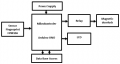
For any design effort such as this one, a good starting point is to draw a block diagram of what you think are the major building blocks. Omit any details, part numbers, etc.

Here is a random sample block diagram taken off the internet. Notice that arrows tend to flow from left to right.

1722363729262.png
 

dl324

Joined Mar 30, 2015
18,218
Welcome to AAC!
-sound maker (P-Buzzer)
-trigger (?)
-something that would stop the buzzer after being triggered (hoping to buzzer can go for 2-4)
Make sure you get a buzzer that doesn't need an oscillator to drive it.

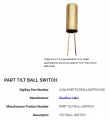
Use a tilt switch for a trigger.
1722364071418.png
Note that the DigiKey part has a $15 shipping charge on a $2 part. You can likely find them elsewhere for less.

Use a CMOS 555 timer.
1722364198568.png

Power the thing with an 18500 Li-ion battery. If you want something smaller more like golf ball sized, use a 16340.
 

Thread Starter

weezy721

Joined Jul 30, 2024
6
thanks for the advice Dennis!

I assume usage of a timer would require me to build this on a board to incorporate a chip.

Any options if:
a) i want it to be very small
b) and not need a board?

I've seen kids/dog toys that light up after being thrown and landing...i'm probably over-simplifying, but looking to replicate but use a buzzer/sound vs an LED light.

Regarding the tilt ball switch...would that trigger anytime the switch is moved vs triggered on impact?

Thanks again.
 

dl324

Joined Mar 30, 2015
18,218
a) i want it to be very small
You said you wanted smaller than tennis ball size. That would allow a board, battery, and buzzer.
b) and not need a board?
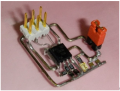
Only limited by your imagination and skill:
1722365616816.png
To get an idea of scale, the pin spacing on the white connecter is 0.1".
Regarding the tilt ball switch...would that trigger anytime the switch is moved vs triggered on impact?
It would trigger whenever the contacts were closed (or opened).
 

MrChips

Joined Oct 2, 2009
34,627
Answers to some of your questions:

1) A capacitor will not hold enough charge to power your circuit. Use a coin battery.
2) Relatively speaking, the volume of a tennis ball is huge for this simple project.
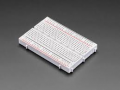
3) Yes, eventually it is better to use a circuit board. For now, put that aside until you have prototyped the circuit. You will use a solderless circuit board at the prototyping stage.

You can get a half-sized protoboard such as this one.

1722368972133.png

This is an example of a project under construction:
1722369042527.png
 

Thread Starter

weezy721

Joined Jul 30, 2024
6
Hi all, thank you for the feedback.

At second thought. I probably overstated my size requirement of a tennis ball. I realized the circuit needs to be much smaller.

Maybe the size of a quarter (i know, im way off from a tennis ball :( lol )

Im sure this complicates the matter but sny input on general component requirements would help me understand feasibility.

The idea i had was a simple circuit similar to one that would light up a toy when thrown and turn off on its on. But instead of light i want some type of sound or beep.

Thanks!
 

MrChips

Joined Oct 2, 2009
34,627
Hi all, thank you for the feedback.

At second thought. I probably overstated my size requirement of a tennis ball. I realized the circuit needs to be much smaller.

Maybe the size of a quarter (i know, im way off from a tennis ball :( lol )

Im sure this complicates the matter but sny input on general component requirements would help me understand feasibility.

The idea i had was a simple circuit similar to one that would light up a toy when thrown and turn off on its on. But instead of light i want some type of sound or beep.

Thanks!
Size is still not a problem. The final size can be less that the size of a standard postage stamp, if anyone still uses them.
Ignore any thoughts on the size for now. Get a design tested and working on a breadboard for now.

We're still waiting to see a block diagram. After that, the next step will be to write down the specifications and behaviour of the circuit. Leave design details out for now until we complete the important specifications stage.
 

AnalogKid

Joined Aug 1, 2013
12,043
Is activation with a magnet still an option? If yes, then will the magnet be against the device continuously, or just long enough to trigger it, or something in between. The issue is whether the device still is being triggered when the time period ends.

And just to clarity, "2-4" seconds, minutes, fortnights - ?

ak
 

MrChips

Joined Oct 2, 2009
34,627
Let us imagine a reality consultation session.

You walk into an electronics custom design company and you present your goal:
"I would like you to design a gadget that will make a noise after being triggered."

The electronics designer replies:
"Welcome to the XYZ Engineering Design Company. You've come to the right place. Come into my office and have a seat. Do you care for some coffee?"

The engineer, after pleasant introductions, pulls out a paper pad. Now, you are asked the following questions:

1. Let us begin with the trigger source. What kinds of motion or action will trigger this device?
a) Light
b) Sound
c) Tilt
d) Impact
e) Motion
f) Proximity to another object
g) Motion of an external object

2. What kind of noise would you like this gadget to make?
a) Tone or beep
b) Buzz
c) Smartphone ring tone
d) Music
e) Voice announcement

3. What is the duration of the sound? In other words, how long does it have to last?

4. How loud is the sound? Audible from 1 metre, 2m, 5m, 10m, 25m?

5. What is supposed to happen if the gadget is triggered while still emitting sound?

6. Does the gadget need to have an ON/OFF switch or is it powered continuously?

7. How many hours, days, months or years do you expect the battery to last on one charge?

As you can see, there are a lot of questions to be answered even before there is any discussion on technology, size, or battery type.

We specify the behaviour of the product first. The technology is secondary. This is the proper engineering design approach.
 

Thread Starter

weezy721

Joined Jul 30, 2024
6
Is activation with a magnet still an option? If yes, then will the magnet be against the device continuously, or just long enough to trigger it, or something in between. The issue is whether the device still is being triggered when the time period ends.

And just to clarity, "2-4" seconds, minutes, fortnights - ?

ak
Magnet activation can still be an option. In this case id prefer an opposite sequence vs what i mentioned earlier.

For magnet, I'd like the magnet to trigger (applied then removed) a timer...of 1 min. After the 1 min the sound would emit for 5 min unless the magnet is triggered to stop it.
 

Thread Starter

weezy721

Joined Jul 30, 2024
6
Let us imagine a reality consultation session.

You walk into an electronics custom design company and you present your goal:
"I would like you to design a gadget that will make a noise after being triggered."

The electronics designer replies:
"Welcome to the XYZ Engineering Design Company. You've come to the right place. Come into my office and have a seat. Do you care for some coffee?"

The engineer, after pleasant introductions, pulls out a paper pad. Now, you are asked the following questions:

1. Let us begin with the trigger source. What kinds of motion or action will trigger this device?
a) Light
b) Sound
c) Tilt
d) Impact
e) Motion
f) Proximity to another object
g) Motion of an external object

2. What kind of noise would you like this gadget to make?
a) Tone or beep
b) Buzz
c) Smartphone ring tone
d) Music
e) Voice announcement

3. What is the duration of the sound? In other words, how long does it have to last?

4. How loud is the sound? Audible from 1 metre, 2m, 5m, 10m, 25m?

5. What is supposed to happen if the gadget is triggered while still emitting sound?

6. Does the gadget need to have an ON/OFF switch or is it powered continuously?

7. How many hours, days, months or years do you expect the battery to last on one charge?

As you can see, there are a lot of questions to be answered even before there is any discussion on technology, size, or battery type.

We specify the behaviour of the product first. The technology is secondary. This is the proper engineering design approach.
Yes to the coffee :)

I really appreciate the detail above. It does help me as a newbie understand the mindset many of you experts work through.

Not sure if it was a rhetorical breakdown, but if not heres my thoughts.

1. Impact
2. Tone or beep, repeated for 2-4 minutes
3. 2-4 min
4. Audible within 10 ft
5. If retriggered, repeat 1-3 above
6. Would love a switch
7. Last as long as possible
 

MrChips

Joined Oct 2, 2009
34,627
Ok, we are making progress. Hopefully, you can see that without these questions answered we would be playing the 101 Q&A game.

1. Impact, meaning that something strikes the gadget. The sensor that comes to mind is a piezoelectric transducer, i.e. a piezoelectric beeper used as a microphone. Depending on the force of the impact, you may or may not need an amplifier.

2. Tone. Easy to generate with a piezoelectric transducer. With clever design, one transducer can serve as both sensor and tone output. You can have a continuous tone or a pulsed tone lasting 2-4 minutes. State which you prefer. State exactly how long the sound should last, not 2-4 minutes.

3. See 2.

4. Doable

5. Possible with separate transducer. Not possible with one transducer.

6. Done. See 7.

7. This is not an engineering specification. If the switch is OFF, the battery will last for 10 years. If the switch is ON, we need to know in order to size the battery.

There are two design paths to take, technology wise, (a) LMC555 timer circuit, (b) 8-pin MCU (microcontroller).

Is this a security alarm of some kind? Stating exactly the purpose of this gadget will put it into its proper perspective. Otherwise we're still playing the 101 Q&A game.
 

MisterBill2

Joined Jan 23, 2018
27,160
To do a trigger on impact, a piezodisc with a small mas soldered to it. One bump and it generates a voltage spike that can be amplified enough to trigger either a CMOS one-shot or maybe a 556 timer, with the other half being a sound generating oscillator. Another piezo did as the sound transducer. If it has to be louder, either a CMOS booster or anLM386 amplifier. Except for the battery it can be about a cubic inch.
 

AnalogKid

Joined Aug 1, 2013
12,043
After the 1 min the sound would emit for 5 min unless the magnet is triggered to stop it.
We're getting closer, but what does this mean? Having the sound stop when the magnet is re-applied can happen for two reasons -

1. The system is restarts the 1 minute wait period before another 5 minute sound period.

2. The system is off until another magnet event starts the 1 minute timer.

???

ak
 
Top