Looking for a circuit where a LED comes on when power is cut.

Thread Starter

Rathen

Joined Sep 19, 2025
3
Hello,

I am wanting a circuit where when the 9v DC power is cut, an LED turns on for ~2 minutes. When the power is reconnected, the light goes back off. Can someone help me with this? In the early 90's I took 4 years of electronics and I am finding out that I don't remember a lot of stuff and I am now relearning.
 

panic mode

Joined Oct 10, 2011
4,864
Does battery stay there and just load is disconnected? Because details matter so If you just reword it slightly, same 9V battery could be used.
If that is not an option, you need to use either second battery, or use capacitor large enough to work as backup power.
 

dl324

Joined Mar 30, 2015
18,218
wanting a circuit where when the 9v DC power is cut, an LED turns on for ~2 minutes. When the power is reconnected, the light goes back off
What does it mean when "power is cut" and reconnected?
In the early 90's I took 4 years of electronics and I am finding out that I don't remember a lot of stuff and I am now relearning.
I studied electronics in the mid-70's and early 80's. Even though I spent most of my career doing software, I still remember a significant amount of what I learned.
 

drjohsmith

Joined Dec 13, 2021
1,549
a relay , held off by the "power "
capacitor charged through diode from power source
led connects to capacitor when power cut,
size capacitor and led current to give the time on you want.

crude but away,
 

sghioto

Joined Dec 31, 2017
8,633
I am wanting a circuit where when the 9v DC power is cut, an LED turns on for ~2 minutes. When the power is reconnected, the light goes back off.
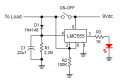
Making the assumption that the 9 volt power source is on continuously and power to the load is cut through a switch.
Version #1 suggestion.
1758572771700.png
 
Last edited:

WBahn

Joined Mar 31, 2012
32,702
a relay , held off by the "power "
capacitor charged through diode from power source
led connects to capacitor when power cut,
size capacitor and led current to give the time on you want.

crude but away,
Even an LED that only draws 1 mA is going to need over 0.1 C of charge for two minutes. Even assuming that you can draw from the cap at a constant 1 mA total current and that the cap can drop from 9 V to 3 V while still functioning, that's still going to be a 20,000 µF cap -- and those two assumptions are on pretty shaky ground. And then there's the leakage current associated with large capacitors. Aluminum electrolytics are typically in the 5 mA to 50 mA per coulomb range, so you are looking to at least double the needed capacitance, if not increase it by a full order of magnitude.

Given this, it's probably worth taking a harder look at just exactly what the problem is that the TS is actually trying to solve -- why do they want an LED to stay lit for two minutes after power is removed? What is it that is actually being accomplished and are there other alternatives?
 

schmitt trigger

Joined Jul 12, 2010
2,027
To the TS:
If you’re willing to employ an auxiliary battery to power up the LED, it can be done.
It can be as simple as a single alkaline cell powering a Joule thief.
 

WBahn

Joined Mar 31, 2012
32,702
If a power source isn't already available when the 9 V is removed (it would sure be nice if the TS would clarify their actual situation), another option would be to use a rechargeable battery. While providing 0.1 C of charge is a significant ask for a capacitor, it's nothing for a battery. A one milliamp draw for two minutes is 120 mA·s, or 0.033 mAh. I would imagine that a couple of 3.2 V LiFePO4 cells could form the basis of a very simple circuit the could work well.
 

drjohsmith

Joined Dec 13, 2021
1,549
A
Even an LED that only draws 1 mA is going to need over 0.1 C of charge for two minutes. Even assuming that you can draw from the cap at a constant 1 mA total current and that the cap can drop from 9 V to 3 V while still functioning, that's still going to be a 20,000 µF cap -- and those two assumptions are on pretty shaky ground. And then there's the leakage current associated with large capacitors. Aluminum electrolytics are typically in the 5 mA to 50 mA per coulomb range, so you are looking to at least double the needed capacitance, if not increase it by a full order of magnitude.

Given this, it's probably worth taking a harder look at just exactly what the problem is that the TS is actually trying to solve -- why do they want an LED to stay lit for two minutes after power is removed? What is it that is actually being accomplished and are there other alternatives?
All good points
More than anything , the ts was as you imply vague in the definition , but did say they had a basic background.
It was aimed at getting them , and it seems others, thinking of what they actually want .
To me the first question is what is going to power the led / timer circuit after power is removed .
 

MrChips

Joined Oct 2, 2009
34,628
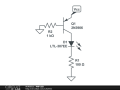
Use a 3V coin cell to power the LED via a PNP transistor as a switch and a series resistor. If the voltage on the base of the transistor is higher than 2.5 V the LED will be off.

Sorry, I am not in a position to draw a circuit diagram.

The circuit looks like this. Vcc is the voltage from the coin battery.
R2 is connected to your power to be monitored, instead of the GND connection shown. You may need to add another resistor (10k Ω) from the base to GND.

1758618031831.png
 

eetech00

Joined Jun 8, 2013
4,704
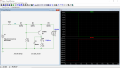
This is untested but might work.
It uses a CR2032 non-rechargeable coin battery and Hi-Efficiency LED.
All diodes are shottky type.

1758653925630.png
 

WBahn

Joined Mar 31, 2012
32,702
It all comes down to what the actual problem is that the TS is actually trying to solve. As is often the case, an acceptable solution needs to take into account details that aren't obvious with a superficial description of the problem, let alone when all we have is a superficial description of their envisioned solution to the problem.

For instance, why do they want an LED to light up when power goes off, as opposed to just having an LED that is lit when power is on? After all, if it isn't lit, there's your indication that power is off.

Why two minutes? What issues are driving that particular time frame? Why isn't a minute sufficiently long? What should happen after two minutes? Is the two minutes a minimum? Is the purpose, perhaps, to let someone know not only that power was removed, but that it was removed less than two minutes ago? Perhaps the action to be taken is different if power was removed within less than two minutes compared to if it's been off for longer?

What is the power budget for this circuit when power is on? If it is something that is being powered by a 9 V battery, then it might not be able to sustain much quiescent draw. But if it's powered by a sizeable source, such as a wall-wart, then quiescent draw might be a non-factor. In that case, using an optocoupler to detect power loss and activate a completely separate (and separately powered) indicator circuit offers a lot of advantages.

There are dozens of directions and rabbit holes this could go down, and most of them don't actually move the TS any closer to solving their actual problem, and we can't do much about that unless we can coax the TS into telling us a lot more about what their problem actually is.
 

Thread Starter

Rathen

Joined Sep 19, 2025
3
Thanks for all the replies. I am going to check out those circuits further. After my electronics schooling, I went on to work on computer networks and servers, which is what I have done for the last 30 years. I wish I could remember more from my electronics days, but I don't.
 
Top