Ground triggered Latching Circuit using transistors

cmartinez

Joined Jan 17, 2007
8,768
Hmm. What neither my sim nor yours explicitly shows are the power connections to the IC. Do you have a decoupling cap (100nF) between pins 7 (GND) and pin 14 (V+), very close to the pins?
I've built I circuits in the past for driving relays, and sometimes the electric pulse generated by its activation affects its operation.
I've had to add strong decoupling caps (in the order of 4.7 uF and up) along with the standard 100 nF for the circuit to stabilize.
 

Thread Starter

stillgrowingup

Joined Jul 15, 2015
219
Hmm. What neither my sim nor yours explicitly shows are the power connections to the IC. Do you have a decoupling cap (100nF) between pins 7 (GND) and pin 14 (V+), very close to the pins?
I did not have a 100nf cap between the 12v and GND. :( I will try that tonight. ... Is there another possibility?
Thank you,

TONY
 

Thread Starter

stillgrowingup

Joined Jul 15, 2015
219
I've built I circuits in the past for driving relays, and sometimes the electric pulse generated by its activation affects its operation.
I've had to add strong decoupling caps (in the order of 4.7 uF and up) along with the standard 100 nF for the circuit to stabilize.
Hi cmartinez,

At this point, I only was using an LED on the 4013 output for feedback, not the the complete circuit with relay and 3W bulb. Where would you put the 4.7uF (Electro Cap?) in the circuit?

TONY
 

Alec_t

Joined Sep 17, 2013
15,119
Breadboards are notorious for making poor contact with inserted wires. Are you sure you have good connections from the notQ outputs to the respective D inputs of the IC?
 

Thread Starter

stillgrowingup

Joined Jul 15, 2015
219
Breadboards are notorious for making poor contact with inserted wires. Are you sure you have good connections from the notQ outputs to the respective D inputs of the IC?
I thought the same, so I did go over all the connections with a Volt meter to confirm contact. All appeared to be connected.
I will try again tonight.

TONY
 

Thread Starter

stillgrowingup

Joined Jul 15, 2015
219
Hi all

I retried the circuit again, adding the 100nF cap between the 14 (+) and 7 (-) 4013 pins. And it did latch a couple of times. I had to very very very quickly close the PB to get it to latch.

I then tried a electro cap 1uF 50V (it is what I had) WITH the 100nF cap in parallel. Again, I had to very very very quickly close the PB to get it to latch. It did seem to latch more often with 2 caps in parallel.

I then moved all the components on the breadboard to different areas, just in case there was a ... not so good connection. Same results.

Currently, I am using a small 12VDC 300mA wall plug transformer. Is it possible that this power supply is insufficient and causing these problems? I do have a desktop 12VDC 7A power supply I was going to try again tonight.

Thank you guys for your continuing efforts in helping me create this. :)

TONY
 

Alec_t

Joined Sep 17, 2013
15,119
When you say 'latch', do you mean just maintain its output state, or do you mean toggle from one state to the opposite state?
At this point, I only was using an LED on the 4013 output
Hopefully you have a current-limiting resistor in series with the LED; otherwise the high LED current could be pulling the output voltage up/down and affecting the toggle action. Loads should be driven by the Q output; not the Q-bar output.
Is it possible that this power supply is insufficient and causing these problems?
Not if you have only a LED as the output load.
If you're still having problems, post a sharp close-up pic of the breadboard, in case we can spot the cause.
 

Thread Starter

stillgrowingup

Joined Jul 15, 2015
219
When you say 'latch', do you mean just maintain its output state, or do you mean toggle from one state to the opposite state?
Yes, Maintain its output state through the Q output.

Hopefully you have a current-limiting resistor in series with the LED; otherwise the high LED current could be pulling the output voltage up/down and affecting the toggle action.
No I do not have I resistor with LED. Didn't think it was necessary for testing with such a small power supply. :oops: I didn't think about how it could affect the circuit has a whole. My Bad.

Not if you have only a LED as the output load.
If you're still having problems, post a sharp close-up pic of the breadboard, in case we can spot the cause.
Will do. :)

Tony
 

cmartinez

Joined Jan 17, 2007
8,768
No I do not have I resistor with LED. Didn't think it was necessary for testing with such a small power supply. :oops: I didn't think about how it could affect the circuit has a whole. My Bad.
I'm a bit surprised that your LED hasn't blown up already... if you're using 12V, I'd suggest a 1.2k resistor in series with it.
 

Thread Starter

stillgrowingup

Joined Jul 15, 2015
219
If it's rated for 12V then it includes a resistor, or some other current limiter. But a CD4013 is supposed to sink/source only a few mA; not the 20mA or so that a '12V LED' might try to draw.
They do? Cool! They do not look different.

That explains why when I use the recommended 1k resistor with the LEDs, they do NOT light up. They do not even light up with a 500 ohm resistor. I do use a 320 ohm.

TONY
 

cmartinez

Joined Jan 17, 2007
8,768
They do? Cool! They do not look different.

That explains why when I use the recommended 1k resistor with the LEDs, they do NOT light up. They do not even light up with a 500 ohm resistor. I do use a 320 ohm.

TONY
Why don't you just get an ordinary vanilla red LED and use a 1.2k resistor in series with it, replacing your actual LED.... see what happens...
 

Thread Starter

stillgrowingup

Joined Jul 15, 2015
219
Why don't you just get an ordinary vanilla red LED and use a 1.2k resistor in series with it, replacing your actual LED.... see what happens...
I never heard of a vanilla red LED.
------
Last night. I put tried a 1k, 1.5k and 3k resistor in line with LED. I than used my 7A power supply. Still did not toggle the output. only pulsed when ground was applied. :(

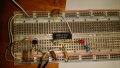
I have attached pictures of my breadboard. As well as the caps I'm using. I was told these were 100nF when I bought them. Can you confirm?

Thanks

TONY
 

Attachments

cmartinez

Joined Jan 17, 2007
8,768
I never heard of a vanilla red LED.
------
Last night. I put tried a 1k, 1.5k and 3k resistor in line with LED. I than used my 7A power supply. Still did not toggle the output. only pulsed when ground was applied. :(

I have attached pictures of my breadboard. As well as the caps I'm using. I was told these were 100nF when I bought them. Can you confirm?

Thanks

TONY
The only way to make sure if they're actually 100nF is to get a multimeter with that function and test them. A multimeter would also come in handy to help you measure every node in your circuit and see how it's behaving.

I never heard of a vanilla red LED.
my bad.... red LED's are strawberry... yellow ones are vanilla :D
(I used the word "vanilla" as a slang to refer to something that is extremely common and widely available, btw)
 

Thread Starter

stillgrowingup

Joined Jul 15, 2015
219
The only way to make sure if they're actually 100nF is to get a multimeter with that function and test them. A multimeter would also come in handy to help you measure every node in your circuit and see how it's behaving.
I have a FLUKE 73 series voltmeter. There is no cap test on it :( ... It only has up to 10A load testing, diode testing and the standard Ac/Dc measuring.

my bad.... red LED's are strawberry... yellow ones are vanilla :D
(I used the word "vanilla" as a slang to refer to something that is extremely common and widely available, btw)
Good info to know. I presume the Vanilla LED would be a 5V?

TONY
 

cmartinez

Joined Jan 17, 2007
8,768
I have a FLUKE 73 series voltmeter. There is no cap test on it :( ... It only has up to 10A load testing, diode testing and the standard Ac/Dc measuring.

Good info to know. I presume the Vanilla LED would be a 5V?

TONY
LEDs are not voltage driven, but rather current driven devices. In theory, it doesn't matter what voltage you apply to it, as long as the current does not exceed its capabilities. That's why a current limiting resistor is normally used.

Of course all doides, including LEDs, have a property called voltage drop. You have to apply at least that amount of voltage for it to start conducting current...

I can't remember off hand what the voltage drop for an ordinary red LED is, but I think it's in the order of 1.2V or something like that.
 
Top