As I said, there is no such thing as a "5 volt LED" (unless you're talking about a module) but rather a 10 mA LED, for instance.
And yes, as long as you use a resistor rated for that amount of current you should be alright. Just follow Ohm's law:
V=I×R, so R=V/I, and since we want 10mA and you are working with 12V,
R=12/0.010 = 1,200 ohms.
In reality a bit less of current will flow through that arrangement since I didn't include the diode's voltage drop in my calculation. But that's ok, your LED will shine anyways, and will be better protected.
EDIT: I've just taken a look at the pics you posted, and yes, you're using a standard, ordinary red LED with a 1K resistor in series with it (that is brown-black-red stripes). So you should be ok.
I'll take a closer look at your wiring later on, see if I can find an anomaly.
The cap pictured is marked ".01", so I guess it's a rather old one and that its value is 0.01uF, = 10nF (whereas you want 100nF). That might account for erratic triggering, but doesn't explain why you need to keep the button pressed for the circuit to latch.
Two observations on the breadboard:
1) Unused input pins of a CMOS IC must not be left floating, or the IC can behave oddly. That's the most likely reason you're getting weird results. So, connect pins 8,9,10,11 to ground.
2) The 'decoupling' capacitor(s) on the power rails should be connected as physically close to pins 7 and 14 as possible.
An ordinary red LED has a Vf of about 1.8V. If you are running your circuit fom 12V and the resistor in series with the LED is 1k the LED current will be ~(12-1.8)/1k = ~ 10.2mA (actually a bit less, because of the internal resistance of the IC). The 4013 will be struggling to manage that.
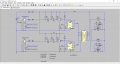
Ok, just a preliminary assessment here, but the unused inputs of your IC have to go somewhere, and should not be left floating. I'll model your circuit the way it's shown in your pictures, and not in your diagram, and then let you know how it went.
Unused input pins of a CMOS IC must not be left floating, or the IC can behave oddly. That's the most likely reason you're getting weird results. So, connect pins 8,9,10,11 to ground.
The cap pictured is marked ".01", so I guess it's a rather old one and that its value is 0.01uF, = 10nF (whereas you want 100nF). That might account for erratic triggering, but doesn't explain why you need to keep the button pressed for the circuit to latch.
1) Unused input pins of a CMOS IC must not be left floating, or the IC can behave oddly. That's the most likely reason you're getting weird results. So, connect pins 8,9,10,11 to ground
An ordinary red LED has a Vf of about 1.8V. If you are running your circuit fom 12V and the resistor in series with the LED is 1k the LED current will be ~(12-1.8)/1k = ~ 10.2mA (actually a bit less, because of the internal resistance of the IC). The 4013 will be struggling to manage that.
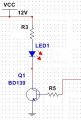
I did add a NPN, to the 4013 output. See attached.
I put a 1.5K in series with the LED.
But it wasn't till I started playing with the resistance from the 4013 output that it started to latch. See my chart below.
Using a 2n2222 NPN:
100 ohm resistor from 4013 Output. LED stayed ON, but turned OFF when PB was pressed. Never toggled.
42.5 ohm resistor from 4013 Output. LED stayed off, but came on when PB was pressed. Never toggled.
55 ohm resistor from 4013 Output. LED stayed ON, but turned OFF when PB was pressed. Never toggled.
48 ohms resistor from 4013 Output. LED toggled seldomly. Not reliable.
Using a BD139 NPN:
No resistor from 4013 Output. LED stayed off, but came on when PB was pressed. Never toggled.
48 ohms resistor from 4013 Output. LED stayed off, but came on when PB was pressed. Never toggled.
82 ohms resistor from 4013 Output. LED stayed ON, but turned OFF when PB was pressed. Never toggled.
68 ohms resistor from 4013 Output. LED stayed off, but came on when PB was pressed. Never toggled.
72 ohms resistor from 4013 Output. LED toggled seldomly. Not reliable.
I have no idea whats this means. But at least it toggled. How to get it stable now?
Those resistor values are far too low. Even with 100Ω you are asking the poor old 4013 to source over 100mA! Try R5= something like 10k from the Q output to the transistor base, then use the LED + R3=1.5k as the collector load.
Those resistor values are far too low. Even with 100Ω you are asking the poor old 4013 to source over 100mA! Try R5= something like 10k from the Q output to the transistor base, then use the LED + R3=1.5k as the collector load.
Those resistor values are far too low. Even with 100Ω you are asking the poor old 4013 to source over 100mA! Try R5= something like 10k from the Q output to the transistor base, then use the LED + R3=1.5k as the collector load.
Current capability isn't an issue; total load is around 300mA. My point was that there are 7 darlingtons in that package and 5 will be unused. OP is having a problem with latching, so this suggestion will not help.
Current capability isn't an issue; total load is around 300mA. My point was that there are 7 darlingtons in that package and 5 will be unused. OP is having a problem with latching, so this suggestion will not help.
Correct. Right now. I can NOT seem to get this 4013 to toggle. ... which is very frustrating to me. This is not a new idea. It's old and proven to work, with similar circuit designs for many years. ... why it doesn't work for me is mind boggling to me.
The cost of the uln2004 is low and comparable with a couple BDXXX transistors.
IF I can get this 4013 circuit to work. I may want to add an additional 4013 and utilizing the remaining uln2004 outputs.

 Facebook
 Google
 GitHub
 Linkedin



 ... you beat me to it by one minute