MOSFET - Ground Question

Thread Starter

rs123456

Joined Mar 3, 2026
1
Hi all,
I'm having trouble conceptiualising how to deal with the "moved" ground when switching power with a mosfet.

Suppose you have a working circuit in kicad, that uses regular GND symbols, now you add a low-side switch with an NMOS.
now the circuit doesn't go from +VDD to GND but Load+ to Load- as the NMOS's source no connects to the actual ground.

All previous GND symbols are now useless.

can anyone explain it like I'm 5? :D
 

crutschow

Joined Mar 14, 2008
38,316
Don't understand your problem as the circuit you described, would not make the GND symbols "useless".
Show a schematic.
 

WBahn

Joined Mar 31, 2012
32,703
In Kicad, there are several GND signal types, the most common is View attachment 364157 which simply defines a power supplu common path.
Most simulators, and I doubt Kicad is any different, use the GND symbol simply to identify which node in the circuit will be called node "0", which is the node to which all other node voltages are referenced to. That we commonly (no pun intended) use it as the negative node of a power supply is mere conventional coincidence.
 

WBahn

Joined Mar 31, 2012
32,703
I thought that was pretty much what I indicated, albeit, not as clearly ! :p
Perhaps that is what you meant, but (to me) it read like it has some specific relation to the power supply and, in particular, some 'path' associated with it. But we are free to associate the ground symbol with any node in the circuit, whether it is in the path of the current from a supply or not.
 

MaxHeadRoom

Joined Jul 18, 2013
30,557
circuit doesn't go from +VDD to GND but Load+ to Load- as the NMOS's source no connects to the actual ground.

All previous GND symbols are now useless.

can anyone explain it like I'm 5? :D
BTW, what is the symbol you are using for GND, the one in post #3 or there are a few others , including the one for earth,

1772587759160.png
 

panic mode

Joined Oct 10, 2011
4,864
as WBahn and others suggested, you can indeed use KiCad to draw anything, and design PCB without ever using ANY kind of ground symbol.
btw. it is only there to tell to the world what YOU consider a reference point, should you ever choose to share your design. circuit (or KiCad) do not care...!

what you are most likely confused about is how to use transistor (MOSFET or whatever) as a high side or low side switch.

before you get to that i suggest to try to figure out what the voltages in circuit are if you choose different point as a reference.

lets start with simple things...

lets say you have 9V battery (this is power source) and 100 Ohm resistor (this is your load).
you can connect them directly of course but then load is always on.

so you decide to use a switch....

there are two places where you can open circuit and wire that switch.
either you are placing switch between Batt+ and resistor OR between Batt- and resistor.

but switch is not polarized device. you can swap the sides of the switch and all is fine. circuit will work and you can use it to produce a bit of heat.

great but you want to use transistor as a switch. transistor is polarized device so if you choose connections arbitrarily, it may not work the way you think.

so lets pick some NMOS... it has 3 terminals G,S,D.
you need to use S and D as "switch" and you need to connect it in either of the two previously mentioned places - close to Batt+ OR close to Batt-. the only condition is that whichever side is more positive will need to go to D (drain) since this is a NMOS.

so....

if you want this MOSFET as a "low side switch", then Batt- connects to S (source), D (drain connects to resistor, and the other side of resistor goes to Batt+.
and
if you want this MOSFET as a "high side switch", then Batt- connects to resistor. the other side of resistor connects to S (source), D (drain) connects to Batt+

both of those two cases are correct. to turn the load on, you need to make G (gate) positive... bit it need to be positive relative to S (source).... and ... this can be a problem if you are trying to use only ONE battery (or whatever power source).

in first case (low side switch) this is easy because Batt+ is 9V and this is potential that is sufficiently higher than S (connected to Batt-).
but if you try to use the second case ("high side switch") this does not work. at least it is not as simple... you need SOME way to get the higher voltage to turn the transistor on. this means it needs to be higher than S. the simplest solution is to use another battery, but there are also so called bootstrap circuits that can replace it.

so if you want to use high side switch with an NMOS... this is not so simple.

but, you can change the mosfet to a different one. if you choose PMOS, you just solved the problem. because everything that works for NMOS also works for PMOS but it is mirrored (they are complementary).
that means:
a) D and S are still the "switch"
b) S need to be connected to more positive potential than D.
c) G need to be negative with respect to S

voila...

and this will work for most of the circuits. but.... there are other things.
while PMOS and NMOS are opposite polarity, the fact is that NMOS wins when it comes to extremes...(high current, high voltage, high power dissipation, faster switching etc.)

in those cases PMOS simply cannot hold the candle to NMOS so for such circuits we want to use NMOS everywhere - both as high side switch and as low side switch.
so you get the better of both world but the price you have to pay is higher complexity of the circuits (need second power source or boot strapping for example).
 

dl324

Joined Mar 30, 2015
18,219
Suppose you have a working circuit in kicad, that uses regular GND symbols, now you add a low-side switch with an NMOS.
now the circuit doesn't go from +VDD to GND but Load+ to Load- as the NMOS's source no connects to the actual ground.
Who says the load actually needs to be connected to ground?

The N channel MOSFET is being used as a switch. Its resistance to ground should be negligible and the drain can be considered to be essentially the same as ground.
All previous GND symbols are now useless.
They're still ground, so what's the problem?
 
Last edited:

MaxHeadRoom

Joined Jul 18, 2013
30,557
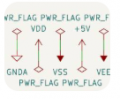
A power flag (PWR_FLAG) in KiCad is used to tell the Electrical Rules checker (ERC) that a specific net is powered preventing the common Input power not driven by any output power pin" error.
. It acts as a "source" definition for inputs like connectors or passive components, satisfying KiCad's requirement that power lines originate from an active source

1772634643099.png
 
Top