DC voltage shorted to earth ground!

Thread Starter

ulms

Joined Mar 19, 2024
179
Hi

The schematic attached is from my garage door opener manual. If you look at connector pins 15 and 16 (lower right) My up-and-down limit switches short 8 volts DC to the chassis Earth ground. I just thought DC was always kept separate from AC with respect to circuit boards and controls. What can you tell me about this.
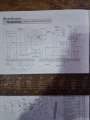
20260314_105335.jpg
 

crutschow

Joined Mar 14, 2008
38,314
Why do you think they should be kept separate?
That's the safety ground from the AC plug which is connected to earth.
It's not an AC or DC ground, it's just ground.
There's no particular reason to have that separate from the DC ground/common, and there are safety reasons to have them be the same.
 
Last edited:

B-JoJo-S

Joined Jan 3, 2026
208
Grounding pin 15 will open the door.
Grounding pin 16 will close the door.
Those two pins are connected to the control board. They're left at some floating voltage. When the signal goes to ground that takes the voltage away from those pins and drives the door in the desired direction.
Also, the ground symbol is a "Chassis Ground".
 

AnalogKid

Joined Aug 1, 2013
12,042
My very old opener has an internal power transformer with a 28 Vac secondary. All of the control stuff runs on that. There are at least two relays with AC coil currents of 0.7 A each.

One side of the transformer secondary is tied to the chassis.

ak
 

WBahn

Joined Mar 31, 2012
32,702
Hi

The schematic attached is from my garage door opener manual. If you look at connector pins 15 and 16 (lower right) My up-and-down limit switches short 8 volts DC to the chassis Earth ground. I just thought DC was always kept separate from AC with respect to circuit boards and controls. What can you tell me about this.

View attachment 364621
Consider the following fault if the output circuit that is powered by the transformer were floating: The transformer fails such that the hot side of the primary gets shorted to the secondary winding. With the output floating, the circuit will continue to work fine -- but is just waiting for someone to get tangled up with it and receive a potentially lethal shock. With the output circuit referenced to ground, this fault will cause an immediate high current that will trip the breaker.
 

B-JoJo-S

Joined Jan 3, 2026
208
True, but they have also used the same symbol on earth conductor in the AC supply cord, Possible symbol error?
There are many people who misuse the ground symbols. However, I don't think there is an error in this case. Ground - whatever you call it - is connected to the chassis. Hence, the chassis is earth grounded at the plug. The chassis is merely another part of the system that is grounded. Bonded to earth for safety of anyone operating that equipment. They could have used earth ground on the AC in line but then that could cause some confusion.

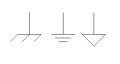
I think you know this Max, but I'll share it for anyone who might not understand: There are three common ground symbols, each is a different purpose. The image below shows a chassis ground (left side) earth ground (middle) and common ground (right side). Earth ground is the most basic ground symbol indicating that is a part of an AC circuit whose source is mains voltage, whether 120 or 240 VAC. It tells me that if I contact the housing I'm not likely to receive an electric shock. If the earth ground is faulty then there's a potential of live voltage on the chassis; such as a washing machine. In my house the washing machine is plugged into one outlet while the dryer (gas) is plugged into a different outlet. If either machine has a faulty ground and I touch both machines at the same time while one is not grounded there's a potential of an electrical shock.

Chassis ground is akin to earth ground in that it CAN be grounded to earth ground, likely at the plug socket through the electrical panel. However, it doesn't mean always an AC circuit. Our cars have electronics that are chassis grounded in that the body of the car acts as a return pathway for any given circuit

Common ground more of a common point, is a reference to a common point in a circuit. You can even have different common reference points in a circuit. Common A might be the zero point between a positive and negative voltage source such as a center tapped transformer. Usually found in things like an amplifier circuit. But Common B could be part of an oscillating circuit where a common point of reference is required. It won't necessarily be the zero point voltage. A DC offset could raise an AC waveform to purely on the positive side for some purpose I'm not educated enough to make an example.

- - - - - - - - CHASSIS GND - - - - EARTH GND - - - - COMMON GND
Screenshot 2026-03-15 at 7.42.42 AM.png
 
Last edited:

MaxHeadRoom

Joined Jul 18, 2013
30,557
There are many people who misuse the ground symbols.
My pet peeve is the fact that the symbol indicating Earth GND is extensively miss-used, essentially making it meaningless, for ex, the much refered to publication, "The Art of Electronics" shows the earth GND symbol throughout the book for each and every circuit example, where IMO the common GND one would have sufficed .
The result is that those that learn from publications such as this, tend to use the Earth symbol, indiscriminately . :rolleyes:
 

AnalogKid

Joined Aug 1, 2013
12,042
for ex, the much refered to publication, "The Art of Electronics"
That's because the author is old.

Way back, I was raised on two GND symbols. Post #11-left for earth ground, and post #11-center for everything else. You didn't need separate GND symbols for power and signals because of course they had to have a common connection or nothing would work. In terms of documentation, the thing that needed clarity,, especially in 60's audio gear, was whether or not the signal GND was tied to the chassis because the chassis was almost always tied to earth GND somehow (even if only through a capacitor).

Through all of this:

SAMS Photofacts (love 'em or hate 'em, they ruled)
Popular Electronics et al
Factory service manuals, everything from TV's to DEC and DG minicomputers
Broadcast audio and video gear - Ampex and RCA hated each other, but they agreed on this.
All EE textbooks (1969 - 1975)
Decades of EDN, ED et al
w.h.a.t.e.v.e.r

I never saw the downward triangle back then. I think it started creeping into the magazines in the 2000's. Analog Devices used it in their datasheets before that, so I blame them.

Even farther off-topic: Which is the "correct" symbol for a connection to a +5 V or +12 V source (leaving out Vcc, Vdd, etc.) - An upward triangle with the voltage above it, or a capital T shape with the voltage above it?

ak
 
Last edited:

B-JoJo-S

Joined Jan 3, 2026
208
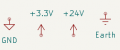
For a supply voltage I've seen this one in a number of places, though I can't point to a specific event:

Screenshot 2026-03-15 at 10.20.26 AM.png
Voltage sitting above the flat top. Far as I recall it's always been a DC source. Far as I recall, that is.
 

B-JoJo-S

Joined Jan 3, 2026
208
Following the black wire from the power cord it connects to the PRIMARY SEQUENCER (PS), pin 10. A jumper between 10 and 9 takes another black wire to the motor thought THERMAL PROTECTION. On the right side of the motor is the MOTOR CAPACITOR. On either side an ORANGE or YELLOW wire traces back to the PS pins 1 & 2 for opening and closing the door. What I don't see in the entire schematic is any SAFETY BEAMS. This is an old machine. It's possible the TERMINAL STRIP (pins 1 through 4) may be a part of the safety beams (pins 3 & 4) but I'm unsure what STB SYSTEM is. At first glance I'd call it a "StandBy System. But I don't know that.

If you look at connector pins 15 and 16 (lower right) My up-and-down limit switches short 8 volts DC to the chassis Earth ground.
The TS calls these two switches "Limit Switches". They appear to be Normally Open. So when the garage reaches the end of travel the corresponding switch closes and the PS stops driving the motor any further. The TRANSFORMER (voltage unknown) primary is powered at all times.

What is the voltage on pins 1 & 2 of the SEQUENCER HOUSING? {not that it would answer any questions}. The TS wants to understand why pins 15 and 16 are driven to ground through either switch.
 

Thread Starter

ulms

Joined Mar 19, 2024
179
Following the black wire from the power cord it connects to the PRIMARY SEQUENCER (PS), pin 10. A jumper between 10 and 9 takes another black wire to the motor thought THERMAL PROTECTION. On the right side of the motor is the MOTOR CAPACITOR. On either side an ORANGE or YELLOW wire traces back to the PS pins 1 & 2 for opening and closing the door. What I don't see in the entire schematic is any SAFETY BEAMS. This is an old machine. It's possible the TERMINAL STRIP (pins 1 through 4) may be a part of the safety beams (pins 3 & 4) but I'm unsure what STB SYSTEM is. At first glance I'd call it a "StandBy System. But I don't know that.


The TS calls these two switches "Limit Switches". They appear to be Normally Open. So when the garage reaches the end of travel the corresponding switch closes and the PS stops driving the motor any further. The TRANSFORMER (voltage unknown) primary is powered at all times.

What is the voltage on pins 1 & 2 of the SEQUENCER HOUSING? {not that it would answer any questions}. The TS wants to understand why pins 15 and 16 are driven to ground through either switch.
Yes they are end of travel motor stops. STB = Safety Beam. This all started because I wanted to use these existing switches as inputs for a project. Thanks to all.
 

Thread Starter

ulms

Joined Mar 19, 2024
179
For a project ? ? ? So you're not looking to fix the GDO? You want to "RE"-use those switches? Then why the concern about grounding?
The switches will be left in the circuit doing there function as per the factory operation.I was going to hook into them in parallel , and I didn't want to mess up the garage door opener
 

B-JoJo-S

Joined Jan 3, 2026
208
So what's the project? How are you going to use those switches? What kind of load will they control? Can you be confident the load won't act like a closed switch?
 
Top