Electromagnetic brake

Irving

Joined Jan 30, 2016
5,121
Thank you. Are you concerned with introducing 12 volts from this unit into A1+A2 that has 10 volts ?
No, because the diode inside the opto-isolator plus the external diode will give roughly the same 10v. Thefact you measured 10v tells me with some certainty that there is an opto-isolator inside the PWM controller. As I said, its probable that a low-current relay could be used directly but doing it this way covers any doubt.
 

MisterBill2

Joined Jan 23, 2018
27,522
If the motor is speed controlled by a separate speed control, then what seems reasonable is to power the brake release from the power feed prior to the speed control electronics. It is possible that I missed someone else's making that suggestion in the previous 60 posts. One caution is that spring-applied brakes do eventually wear to the point of being less effective. I have discovered that with a brake-motor that I use .
 
Last edited:

Thread Starter

rgsawmill

Joined Apr 13, 2025
103
If the motor is speed controlled by a separate speed control, then what seems reasonable is to power the brake release from the power feed prior to the speed control electronics. It is possible that I missed someone else's making that suggestion in the previous 60 posts. One caution is that spring-applied brakes do eventually wear to the point of being less effective. I have discovered that with a brake-motor that I use .
Good morning sir.
Yes, I have thought about the wear on the brake . It is a concern however I do have an other motor with brake . The brake can be easily replaced.
Do you have any idea on how many cycle times./hours of use or any estimate on how long the brake lasts. Also I hope to find a source for parts.
Tks Bob G
 

Thread Starter

rgsawmill

Joined Apr 13, 2025
103
No, because the diode inside the opto-isolator plus the external diode will give roughly the same 10v. Thefact you measured 10v tells me with some certainty that there is an opto-isolator inside the PWM controller. As I said, its probable that a low-current relay could be used directly but doing it this way covers any doubt.
Thank you sir.
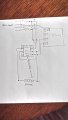
Last night I looked up the operation of the relay module with opto-isolator and found it interesting. I understand now. (Enough) I scratched out a schematic of how you suggested it be wired for your approval.
Also is there a preference of diod type. I see you mentioned a steer diod, and I have blocking diods. I did read up on them but I don't know. Am I looking to just allow current to flow in one direction or am I looking to do more. Also the diods I have are 60amp. I'm guessing a 5-10 amp would be plenty on the ground side of the ckt. Am I correct?
Thank you much. Bob G.
 

Thread Starter

rgsawmill

Joined Apr 13, 2025
103
No, because the diode inside the opto-isolator plus the external diode will give roughly the same 10v. Thefact you measured 10v tells me with some certainty that there is an opto-isolator inside the PWM controller. As I said, its probable that a low-current relay could be used directly but doing it this way covers any doubt.
Thank you sir.
Last night I looked up the operation of the relay module with opto-isolator and found it interesting. I understand now. (Enough) I scratched out a schematic of how you suggested it be wired for your approval.
Also is there a preference of diod type. I see you mentioned a steer diod, and I have blocking diods. I did read up on them but I don't know. Am I looking to just allow current to flow in one direction or am I looking to do more. Also the diods I have are 60amp. I'm guessing a 5-10 amp would be plenty on the ground side of the ckt. Am I correct?
Thank you much. Bob G17456730672133023738920992636837.jpg
 

Thread Starter

rgsawmill

Joined Apr 13, 2025
103
Thank you sir.
Last night I looked up the operation of the relay module with opto-isolator and found it interesting. I understand now. (Enough) I scratched out a schematic of how you suggested it be wired for your approval.
Also is there a preference of diod type. I see you mentioned a steer diod, and I have blocking diods. I did read up on them but I don't know. Am I looking to just allow current to flow in one direction or am I looking to do more. Also the diods I have are 60amp. I'm guessing a 5-10 amp would be plenty on the ground side of the ckt. Am I correct?
Thank you much. Bob GView attachment 347923
All I can say is from reading the information on how these components function, someone probably went crazy out in there barn designing these components.
 

Irving

Joined Jan 30, 2016
5,121
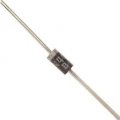
So a diode just allows current flow in one direction - traditionally that's from + to - in the direction of the arrow. The only difference between diodes (for this purpose) is how much current they can carry, continuously and peak, and what voltage they can withstand when blocking. Clearly a 60A rated diode is overkill for this, and physically probably too large. For this purpose a 1A diode rated at 50v would be more than enough. A typical diode (see pic below) would be type 1N400x where x = 1 for 50v to x = 7 for 1000v so x can be anything you can find cheaply; you can usually pick up a pack of 5 for a 2 or 3 bucks online. The bar on its symbol is the white line on the case.
1745674908168.jpeg
Your wiring diagram is correct, other than you missed the links from A1 and A2 to the PWM controller. You should use at least 18 - 20awg stranded for the brake coil circuit, but 20 - 24awg stranded is fine for everything else. The diode leads are 20awg (0.8mm/0.032" dia) so push-fit or screw terminal blocks sized for 20awg will allow you to hook this all up easily (you won't get 2 diode leads into the 'IN' terminal).
 

Thread Starter

rgsawmill

Joined Apr 13, 2025
103
So a diode just allows current flow in one direction - traditionally that's from + to - in the direction of the arrow. The only difference between diodes (for this purpose) is how much current they can carry, continuously and peak, and what voltage they can withstand when blocking. Clearly a 60A rated diode is overkill for this, and physically probably too large. For this purpose a 1A diode rated at 50v would be more than enough. A typical diode (see pic below) would be type 1N400x where x = 1 for 50v to x = 7 for 1000v so x can be anything you can find cheaply; you can usually pick up a pack of 5 for a 2 or 3 bucks online. The bar on its symbol is the white line on the case.
View attachment 347931
Your wiring diagram is correct, other than you missed the links from A1 and A2 to the PWM controller. You should use at least 18 - 20awg stranded for the brake coil circuit, but 20 - 24awg stranded is fine for everything else. The diode leads are 20awg (0.8mm/0.032" dia) so push-fit or screw terminal blocks sized for 20awg will allow you to hook this all up easily (you won't get 2 diode leads into the 'IN' terminal).
Yes sir I figured it would be more reasonable to get the properly rated diods. I do understand the basic principle of a diod however when you get reading it seems like they go off on a wild tangent and my understanding gets blurry. I have learned a lot in the past but never had a chance to brake down every component and understand their operation.
Thank you and all who have helped and not just said go buy a new gear motor. It seemed doable and you have thought me how to accomplish it. Learning something is rewarding.
Tks Bob G
 

Irving

Joined Jan 30, 2016
5,121
You're welcome, always happy to help.

If you find the back-drive becomes problematic, you might consider trying a more powerful motor from a better class of wheelchair. The best motors are worm-geared and cannot be back-driven; the lower powered ones fitted to low-end chairs are often just bevel-geared and so much more reliant on the brakes, which of course wear quicker - though I've done over 3000 miles in nearly 6y on my road-legal chair and never worn a brake out yet!
 

Thread Starter

rgsawmill

Joined Apr 13, 2025
103
Good morning sir.
Yes, I have thought about the wear on the brake . It is a concern however I do have an other motor with brake . The brake can be easily replaced.
Do you have any idea on how many cycle times./hours of use or any estimate on how long the brake lasts. Also I hope to find a source for parts.
Tks Bob G
You're welcome, always happy to help.

If you find the back-drive becomes problematic, you might consider trying a more powerful motor from a better class of wheelchair. The best motors are worm-geared and cannot be back-driven; the lower powered ones fitted to low-end chairs are often just bevel-geared and so much more reliant on the brakes, which of course wear quicker - though I've done over 3000 miles in nearly 6y on my road-legal chair and never worn a brake out yet!
Understood. I haven't opened up the gearbox but I was under the impression it was a worm gear unit.
Thank you.
 

Attachments

MisterBill2

Joined Jan 23, 2018
27,522
As far as how long spring applied brakes last, that depends at least partly on the load inertia and how much energy the brake must absorb. But always it is in the many thousands of operations when used within the ratings.
If you are able to gain enough access to see the brake pad material that will be valuable. Most of those brakes will start to make a noise when they are worn out, so that should be a handy warning.
 

Thread Starter

rgsawmill

Joined Apr 13, 2025
103
As far as how long spring applied brakes last, that depends at least partly on the load inertia and how much energy the brake must absorb. But always it is in the many thousands of operations when used within the ratings.
If you are able to gain enough access to see the brake pad material that will be valuable. Most of those brakes will start to make a noise when they are worn out, so that should be a handy warning.
Agreed, the downward movement is where the momentum will occur. I do plan on looking further into the friction material in the brake. I don't know if it is replaceable or not. I do have an other motor with brake assembly.
I have just received my 1A diods and relay so I will be trying to find a terminal strip, wire , fuse holder and cable glands to match the wire coming to and out of the box.
Tks Bob G.
All the electrical suppliers that had rows of stuff in stock have closed up around here so it's hard to use your imagination when you can't see what's available.
 

Irving

Joined Jan 30, 2016
5,121
All the electrical suppliers that had rows of stuff in stock have closed up around here so it's hard to use your imagination when you can't see what's available.
Sadly Bob, that seems to be true the world over. The small retailers just can't compete with Amazon etc on price or delivery, and rents are punishing. We had a new hardware store open nearby within walking distance but they weren't competitive on price or range of products and they closed within 18 months.

Having said that, Amazon and, to some extent eBay and AliExpress, makes it pretty easy. For example:

Terminal block, 12way, 5A: https://www.amazon.com/YXQ-Position-Terminal-Plastic-X3-0512/dp/B071WSDD2J
20awg wire, silicone sheath 7 colours: https://www.amazon.com/Silicone-Electrical-electronics-stranded-Flexible/dp/B07TGJGJGD
Wago-style lever connector kit: https://www.amazon.com/Splicing-Connector-Lever-Nut-Assortment-Pocket/dp/B07NKSHVF6/
10awg wire, silicone sheath, black/red: https://www.amazon.com/TUOFENG-Silicone-Black-Gauge-Stranded/dp/B075L2CRWV
10awg x 6mm terminals black/red: https://www.amazon.com/InstallGear-Tinned-Copper-Terminals-Connectors/dp/B07MK5BSSX
 

Thread Starter

rgsawmill

Joined Apr 13, 2025
103
Sadly Bob, that seems to be true the world over. The small retailers just can't compete with Amazon etc on price or delivery, and rents are punishing. We had a new hardware store open nearby within walking distance but they weren't competitive on price or range of products and they closed within 18 months.

Having said that, Amazon and, to some extent eBay and AliExpress, makes it pretty easy. For example:

Terminal block, 12way, 5A: https://www.amazon.com/YXQ-Position-Terminal-Plastic-X3-0512/dp/B071WSDD2J
20awg wire, silicone sheath 7 colours: https://www.amazon.com/Silicone-Electrical-electronics-stranded-Flexible/dp/B07TGJGJGD
Wago-style lever connector kit: https://www.amazon.com/Splicing-Connector-Lever-Nut-Assortment-Pocket/dp/B07NKSHVF6/
10awg wire, silicone sheath, black/red: https://www.amazon.com/TUOFENG-Silicone-Black-Gauge-Stranded/dp/B075L2CRWV
10awg x 6mm terminals black/red: https://www.amazon.com/InstallGear-Tinned-Copper-Terminals-Connectors/dp/B07MK5BSSX
Good afternoon.
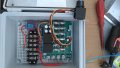
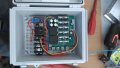
It ain't pretty but I think I have my enclosure wired. Now I have to get nice flexible wire to run from the cabinet to the mill controller and motor . I'm not sure what gauge wire I need for the wheelchair motor. The wire on it isn't very big, 10-8 gauge maybe. I have not tested the amperage when activating the motor. The distance from cabinet to motor will be between 8'-10'.. the largest wires that I will need are from battery to cabinet (PWM) and from PWM to motor. Then a two conductor wire for the brake and a 3-4 conductor wire for the relay board in the mill controller to tell the PWM when to activate and in what direction.
Oh ya then I have to get wire glands to seal the wires when passing through the cabinet. I sure miss radio shack and cables+connectors.
 

Attachments

Irving

Joined Jan 30, 2016
5,121
Wheelchair motors are typically wired with 12 or 10awg stranded to minimise power loss in the cable. I use exclusively 10awg on my chairs as peak current is 120A. 10awg is 1.1ohms/1000ft (12awg = 1.7ohms/100ft). So 10awg = 3.3mOhm for a 3ft run (typical length for a chair) x 2 (there & back) = 6.6mOhm or a 0.8v drop @ 120A (1.2v for 12awg). While that doesn't sound much, it can cause the chair's motor controller to misbehave if battery is close to depletion; a problem if you're on soft terrain or need to move in a hurry! I'd recommend 10awg minimum for those long runs from PWM controller to the motor and for battery to PWM controller.

For the low voltage/current stuff 20awg is fine; you can get 4-core 'control cable' for the relay stuff (though you only need 3-cores as two are common to A). Since its cheaper in bulk, I'd get a longer length of 3-core and use it for both. The voltage drop for the brake coil on 20awg at 3A with a 10ft run is around 3v which may have negative impact on brake function. It's designed to work on 24v so at 12v is already compromised and 3v off that is potentially as little as 9v. Now my experience is that brake-off function on wheelchairs is OK down to about 6v; below that they don't reliably disengage. So you *should* be ok with 20awg but I'd suggest 18awg to be safe and the price differential is minor, around 60cents/foot. Alternatively, if the battery and motor are colocated, put the relay near the motor, then 20awg works for all.
 

Thread Starter

rgsawmill

Joined Apr 13, 2025
103
Wheelchair motors are typically wired with 12 or 10awg stranded to minimise power loss in the cable. I use exclusively 10awg on my chairs as peak current is 120A. 10awg is 1.1ohms/1000ft (12awg = 1.7ohms/100ft). So 10awg = 3.3mOhm for a 3ft run (typical length for a chair) x 2 (there & back) = 6.6mOhm or a 0.8v drop @ 120A (1.2v for 12awg). While that doesn't sound much, it can cause the chair's motor controller to misbehave if battery is close to depletion; a problem if you're on soft terrain or need to move in a hurry! I'd recommend 10awg minimum for those long runs from PWM controller to the motor and for battery to PWM controller.

For the low voltage/current stuff 20awg is fine; you can get 4-core 'control cable' for the relay stuff (though you only need 3-cores as two are common to A). Since its cheaper in bulk, I'd get a longer length of 3-core and use it for both. The voltage drop for the brake coil on 20awg at 3A with a 10ft run is around 3v which may have negative impact on brake function. It's designed to work on 24v so at 12v is already compromised and 3v off that is potentially as little as 9v. Now my experience is that brake-off function on wheelchairs is OK down to about 6v; below that they don't reliably disengage. So you *should* be ok with 20awg but I'd suggest 18awg to be safe and the price differential is minor, around 60cents/foot. Alternatively, if the battery and motor are colocated, put the relay near the motor, then 20awg works for all.
Thank you sir.
It does appear that 12 ga. Wire is used at the motor. I was concerned with the extended distance from the PWM cabinet to the motor. I will get some 10/2 , 18/3 wire and try to find a source of the glands to match the cable. I want to make sure I keep the cabinet water tight.
When not in use or in bad weather I keep the saw head covered but moisture is a killer.
Thank you again for sticking with me on this project.
Bob G.
 

Thread Starter

rgsawmill

Joined Apr 13, 2025
103
Thank you. In the past I have used rubber hose and silicone but that was at work trying to get a crane to finish a job on the road.
Good afternoon sir.
I temporarily wired up the sawmill to the cabinet we have been building to test it's performance.
All went well and performed flawlessly until I started the engine to top off the battery charg . That's when the brake would stay released. I noticed the red light was on dimly on the brake relay and power was being supplied to the brake. Also if the PWM is powered off it looks like there is 3 volts on the in terminal and the red light is illuminated . With the PWM on the in terminal has 11 volts and the red light is off. When running the engine and charging the red light never goes off completely but dose dim and power is being fed to the brake releasing it.
Any thoughts would be greatly appreciated.
Thank you Bob G.
 

Irving

Joined Jan 30, 2016
5,121
if the PWM is powered off it looks like there is 3 volts on the in terminal and the red light is illuminated . With the PWM on the in terminal has 11 volts and the red light is off.
That's an easy one I think. You need to power the relay module from the same 12v supply as the PWM controller, so that when the PWM is powered down so is the relay module.

When running the engine and charging the red light never goes off completely but dose dim and power is being fed to the brake releasing it.
Hmmm, ok, this is a little trickier but I suspect I know what the issue is. When the battery is charging what is the battery voltage and what is the voltage at the 'in' terminal?
 
Top