dual supply from rectifier circuit

Ylli

Joined Nov 13, 2015
1,092
That's A solution that comes with serious shortcomings, particularly current capacity. If it works for you, fine.
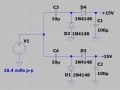
Thanks. I was trying to provide something that was simple and used a minimum of readily available components. Yes, it is very current capacity limited. But if it is enough, it is enough. :)
 

MisterBill2

Joined Jan 23, 2018
27,551
First question is "WHAT are you trying to achieve?" The question was a power supply question, so where does the function generator enter the discussion. All that I have seen is a bunch of guesses.
Either the TS wants to get +15 volts and -15 volts from one power supply, or the TS wants to get a waveform that is 30 volts peak to peak from a function generator. Post #12 tells us that the TS wants a power supply, not an amplifier.
Of course a circuit drawing of whatever has that output of 20 volts peak to peak would allow for some applicable answers, wouldn't it?
If it is just a single transformer winding with no tap, then two half-wave voltage doubles would work and allow for using power-tab voltage regulators. Half wave doublers allow one side of the supply to be commoned and so it could provide positive and negative voltages.
BUT until more information is provided we are all just guessing.
 

Ylli

Joined Nov 13, 2015
1,092
The TS wanted to get +/- 15 volt outputs using a signal/function generator as the source. the maximum output of the signal/function generator is 20 volts p-p.
 

BR-549

Joined Sep 22, 2013
4,931
If I understand this, the TS has two problems. He needs a dual polarity power supply. That's easy to fix. An old desktop computer supply will work.

The second problem is generating a test signal containing a high component and a low component, in which, his test circuit will separate or filter.

For that, he needs a dual channel function generator and a scope.

IF I understand this.
 

Thread Starter

Zeeus

Joined Apr 17, 2019
616
Hiii...Please someone assist

I want to get +-15 with close to 1A.....I learned diode and capacitors recently and want to solder up a rectifier circuit (AC to DC), something useful for 1st time which is not school work..

Input is 60hz "class two transformer" (mine is bad: Anyway to revive it? or have to buy new one)
\
I am making a mistake but dunno : look at 2nd image

for +17....Low pass sets f3db around 7hz...I did not add collector resistor because I want A to be able to get to 1A

for -17...when nothing is connected to the emitter, the voltage drop across both LED's is about 4v... When I add emitter Resistor(Re) so to determine the current through the zener, the voltage drop across LEDs goes down to 0.5 (I changed the 100k but no much difference to voltage across LEDs)


Again...I am a beginner..All I want is to solder up something useful (+-15 with possible 1A) so to use for other things...

Please post your solutions : going to get new transformer
 

Attachments

BR-549

Joined Sep 22, 2013
4,931
Zeeus......I can not understand what you are saying. First you say something about + and - 15. Then you mention 17.

I have no idea of what you are saying.

YOU can not use a function generator for a power supply.

Do you understand that?
 

Thread Starter

Zeeus

Joined Apr 17, 2019
616
YOU can not use a function generator for a power supply.

Do you understand that?[/QUOTE]

because it can not give 1A?

my fault..+17 is from generator then diode drop etc....the number not really relevant... 3 (5.6v) zeners
 

wayneh

Joined Sep 9, 2010
18,106
Input is 60hz "class two transformer" (mine is bad: Anyway to revive it? or have to buy new one)
It's unlikely you can repair the transformer in a way that is worth your time and effort. How do you know it is bad?

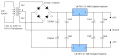
The circuit posted by @bertus above is the traditional way to get a regulated dual supply from a single supply (such as the rectified DC from a bridge + filter cap). You will need at least about 33V off the bridge to achieve regulation at ±15V.

Another approach is to use two similar transformers and bridges, and attach the DC outputs in series. That center connection becomes "ground" and the other two ends are the ± poles. You can do the same with two 9V or 12V batteries.
 

Thread Starter

Zeeus

Joined Apr 17, 2019
616
It's unlikely you can repair the transformer in a way that is worth your time and effort. How do you know it is bad?

The circuit posted by @bertus above is the traditional way to get a regulated dual supply from a single supply (such as the rectified DC from a bridge + filter cap). You will need at least about 33V off the bridge to achieve regulation at ±15V.

Thanks..Will just use 2 12v
 

BR-549

Joined Sep 22, 2013
4,931
Ok.....then you know what a desktop computer is. An ATX supply is a desktop computer power supply.

Check this out. https://www.electronics-tutorials.ws/blog/convert-atx-psu-to-bench-supply.html

If you want to experiment, you need equipment, like power supplies.

Brand new...these supplies are cheap. You might find some old used ones at a computer repair shop. Or possibly and old desktop that isn't viable these days.

A function generator is a function generator and a power supply is a power supply.

Is it possible to make a small power supply from a function generator?...........yes, but only if zombies are at the door.

One step at a time. Power supplies first........then circuits and filters.

Roanoke VA....67 years.
 

Thread Starter

Zeeus

Joined Apr 17, 2019
616
Is it possible to make a small power supply from a function generator?...........yes, but only if zombies are at the door.

One step at a time. Power supplies first........then circuits and filters.

Roanoke VA....67 years.[/QUOTE]

hehe..thanks

yh, wanted to get a power supply...question : Should I expect my light bill to triple with a function generator, oscilloscope and power supply? Assume 6hrs/day
 
Top