Remote dual battery power supply

Thread Starter

striplin

Joined Aug 20, 2025
5
I wish to construct a dual battery power supply to power a 12v security camera. I wish it to deplete 1 battery to 10.5 volts and then automatically switch to the 2nd battery. I have found some automatic battery switches, but the ones I have found all switch with loss of voltage and not at a specific voltage point. they also say they lose power for less than 1 second, but I need near instant switching. Anybody know of anything available that may work, or how to build something like this? I really need very low power consumption as well. considering 7ah sla's or d batts in series.
 

Ya’akov

Joined Jan 27, 2019
10,226
Welcome to AAC.

Is there a reason that you don't just wire the two batteries in parallel? It seems you may have hidden requirements, would you explain what problem this is a solution to?
 

Thread Starter

striplin

Joined Aug 20, 2025
5
This is a located in a place that I visit very infrequently and a 4 hour drive away. If 2 batteries in parallel will last approximately 60 days, and I visit the site at say 45 days, then I will have to discard all the batteries even though they still have 15 days of use in them. Where as having them deplete 1 battery bank before using the 2nd bank then I can fully use 1 bank and still have 15 days left in the 2nd bank therefore reducing waste. I should also be able to swap out the used bank of batteries with out losing power to the cell camera and having to go through the whole setup process again.
 

Thread Starter

striplin

Joined Aug 20, 2025
5
What's the maximum current draw you can tolerate?
at .5 mah unless my math is wrong, would dissipate a 7ah battery in about 60 days. Not counting the amp draw of the cell camera. Also, I do not think The battery switch will be fast enough to not let the camera shut down and they are iffy on a restart without going through the set up. I am just gonna have to stay with what I have.
 

MrChips

Joined Oct 2, 2009
34,628
at .5 mah unless my math is wrong, would dissipate a 7ah battery in about 60 days. Not counting the amp draw of the cell camera. Also, I do not think The battery switch will be fast enough to not let the camera shut down and they are iffy on a restart without going through the set up. I am just gonna have to stay with what I have.
If the device draws 5 mA,
that is 5 mA x 24 h = 120 mAh per day = 7200 mAh per 60 days

If the device is drawing 0.5 mA, then the 7 Ah battery would last for about 600 days.
 

Thread Starter

striplin

Joined Aug 20, 2025
5
If the device draws 5 mA,
that is 5 mA x 24 h = 120 mAh per day = 7200 mAh per 60 days

If the device is drawing 0.5 mA, then the 7 Ah battery would last for about 600 days.
Yup, I stand corrected. but what relay or switching device draws less than 1 ma? I really would like to hear some ideas on how you would do it.
 

crutschow

Joined Mar 14, 2008
38,317
Yup, I stand corrected. but what relay or switching device draws less than 1 ma? I really would like to hear some ideas on how you would do it.
I'm working on a low-power circuit using MOSFETs, but am away from home temporarily, so probably won't be able to finish it until Saturday.
 

BobTPH

Joined Jun 5, 2013
11,463
Yup, I stand corrected. but what relay or switching device draws less than 1 ma? I really would like to hear some ideas on how you would do it.
The switching circuit should take far less than the camera. If done without relays, it should be negligible. What does the camera take?
 

crutschow

Joined Mar 14, 2008
38,317
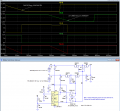
Okay, below is the LTspice sim of a circuit that should do what you want:
It uses a dual micropower comparator IC with built-in 400mV reference voltage, to trigger a CMOS NAND-gate latch, which controls MOSFET switches.
The total power draw is <50µA.

The comparator triggers the latch (low output voltage sets the latch) to connect the fresh battery, when the discharged battery drops below the comparator trip voltage.
The latch then keeps that battery connected until it drops below 10.5V, even after the other battery is changed to a fresh one.

The switches are two P-MOSFETs connected back-to-back to block current in either direction when off (since the output voltage could be above or below the unconnected battery voltage).
That works since MOSFETs conduct equally well in either direction when on.
The MOSFETs are on when their gate voltages (E1, E2) are low, and off when high.

The trip voltage occurs when the comparator input voltage from the two resistor dividers (R5/R6 & R7/R8) drops below the 400mV Ref voltage, here giving a trip voltage of slightly below 10.5V.
The trip voltage can be changed, of course, by modifying the value of R6 and R8.

The sim shows how the output voltage (red trace) drops with each battery to below 10.5V, and then goes back to 12.6V from the fresh battery.

The switching is fast (<10µs), and C2 should prevent any switching glitches from affecting your equipment.

The MOSFETs can be just about any P-MOSFET with a voltage rating of at least 20V.

Look feasible to you?

1755970906155.png
 
Last edited:
Top