Title of thread says it all. Basically my understanding of Negative or Positive revolves around current flow. What am I missing?
Thanks for your expertise!
Why do you need to discuss current flow?
Why do you need to discuss AC in a dual rail power supply?
A dual rail power supply means that you have two supply voltages with a common reference voltage. Commonly, the reference voltage is halfway between the two supply voltages.
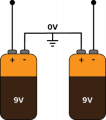
It is common to create a dual rail power supply using two identical batteries or voltage sources as in this circuit diagram:
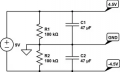
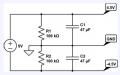
You can also create a split supply using a single voltage source by creating a common reference point that is halfway of the supply voltage.
So... what happens to the voltage of the negative rail if a load that should nominally draw 50 µA from a 4.5 V supply is placed between the 4.5 V rail and GND?
I don't consider that to be a dual power supply, but rather a means of establishing a high-impedance reference voltage midway between the supplies. It can only serve as a reference for circuits that operate directly between the actual rails, not as two split supplies. An example would be putting an opamp operated between the two rails and using the "GND" only as a reference to the high impedance input of the opamp. Many of the classic opamp configurations, including the basic non-inverting amplifier, won't work well from these power rails.
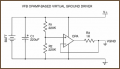
This can be remedied by removing this ground reference and putting a unity-gain voltage follower at that node and declaring its output to be "GND", though some care needs to be given regarding capacitive loads and stability.
So... what happens to the voltage of the negative rail if a load that should nominally draw 50 µA from a 4.5 V supply is placed between the 4.5 V rail and GND?
I don't consider that to be a dual power supply, but rather a means of establishing a high-impedance reference voltage midway between the supplies. It can only serve as a reference for circuits that operate directly between the actual rails, not as two split supplies. An example would be putting an opamp operated between the two rails and using the "GND" only as a reference to the high impedance input of the opamp. Many of the classic opamp configurations, including the basic non-inverting amplifier, won't work well from these power rails.
This can be remedied by removing this ground reference and putting a unity-gain voltage follower at that node and declaring its output to be "GND", though some care needs to be given regarding capacitive loads and stability.
Sorry, I just pulled that circuit diagram off the internet.
You are correct. R1 and R2 at both 100 kΩ each is too high for many applications.
There are other ways of improving on this. For example, we can make R1 and R2 1 kΩ each if that makes you any happier.
Title of thread says it all. Basically my understanding of Negative or Positive revolves around current flow. What am I missing?
Thanks for your expertise!
To put it simply, dual supplies are needed because signals which need to be amplified often oscillate between a "zero point" reference. An audible sound for example corresponds to a pressure of zero, positive, or negative. Amplifying that signal then generally requires that the amplifier itself bounce in correspondance between zero, positive, and negative as well. Hence the need for a "negative rail".
But of course not *all* signals (non-oscillating ones for instance) require such a feature and in those cases a "single supply" (SS) configuration (Vcc/Gnd connection) may be suffient (besides some other relatively minor biasing considerations). Additionally, even a fluctuating audio signal could theoretically be biased above the zero point and then fed into an SS amplifier, although the usefulness of such a setup would likely be rather limited.
In most cases, an oscillating signal is going to need a dual rail.
To put it simply, dual supplies are needed because signals which need to be amplified often oscillate between a "zero point" reference. An audible sound for example corresponds to a pressure of zero, positive, or negative. Amplifying that signal then generally requires that the amplifier itself bounce in correspondance between zero, positive, and negative as well. Hence the need for a "negative rail".
But of course not *all* signals (non-oscillating ones for instance) require such a feature and in those cases a "single supply" (SS) configuration (Vcc/Gnd connection) may be suffient (besides some other relatively minor biasing considerations). Additionally, even a fluctuating audio signal could theoretically be biased above the zero point and then fed into an SS amplifier, although the usefulness of such a setup would likely be rather limited.
In most cases, an oscillating signal is going to need a dual rail.
This is not exactly correct and needs clarification.
There are millions (no, billions) of "audible" devices that run on a single voltage supply and do not need to generate negative voltages. In fact, whether the voltage is negative or positive is irrelevant.
Sorry, I just pulled that circuit diagram off the internet.
You are correct. R1 and R2 at both 100 kΩ each is too high for many applications.
There are other ways of improving on this. For example, we can make R1 and R2 1 kΩ each if that makes you any happier.
It might be good enough. Heck, the 100 kΩ might be good enough for some applications. But that circuit has the same classic problem as most beginner-level zener voltage regulator circuits -- in order to work well, the regulator circuit needs to dissipate many times (like ten times) the amount of power that the load will draw under maximum intended operation.
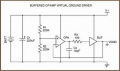
WBahn and I understand each other and what we are saying. For those who are curious about how at create a low impedance reference point or "virtual ground" using an op amp, here are some example circuit diagrams:
So the zero voltage is actually 9 volts if a meter is placed at the zero and one of the nines outer terminals, and the voltage across both batteries is 18 volts.
Old 12 volt car batteries spit half the battery with a terminal in the center to use some 6 volt accessories which looks like the exact same set up.
While generating A/C, current goes one way and then the other, How elts can you get 'negative voltage'?
With A/C geration, the nuetral splits the coils creating half of the voltage between the two 'hots'. It does not have 'zero' voltage. Dual Power supply definitions don't make any sense with these reguards.
To put it simply, dual supplies are needed because signals which need to be amplified often oscillate between a "zero point" reference. An audible sound for example corresponds to a pressure of zero, positive, or negative.
It was a bit of a hand-wavey description, granted, but I figured you would get the gist. To be more precise, "zero" corresponds to pressure forces on the sensor being in equilibrium. An imbalance in either "direction" would thus be positive/negative depending on the convention being used by the sensor itself.
A voltage is a measurement of electrical potential between two points.
Imagine a battery-operated device that has no connection to earth potential, for example, a device powered by a 9 V battery or a 12 V car battery. There is no negative voltage or positive voltage even if the battery clearly has + and - signs written on it. The signs indicate which terminal is more positive than the other. A voltage and its positiveness or negativeness is a relative measure.
We can choose any node in the circuit and give it a label such as COMMON, or 0 V, or GND. The voltage at all other nodes are measured with respect to this reverence point. Voltages are still relative to this reference point.
The "classic" dual-rail power setup was for the earlier OP-AMPS. Those devices, working on zero to +/-ten volt (peak) signals needed a dual 15 volt supply, with the best dual supplies had "tracking" regulators, meaning that if one side varied the other also varied, so the +/-15 might drop to +/- 14.2 if there was a disturbance. That was handy for the systems that operated off of an inverter in mobile systems. The symetrical drop in the supply voltages kept those disturbances out of the data. Mostly.
i guess you need to first understand why would one need dual supply... after all, many circuits can be done using single supply.
well... there is a problem...
suppose you have something running from 9V source and this 9V source is really really 9.000V.
and then you need to process some signal... the problem is that your circuit can NEVER get to 0.000V or 9.000V - no matter what you do or how hard you try. even if your circuit has some transistor in saturation (so Vce is low), you can only get as far as 0.100V or 8.900V. you try using mosfets with low Rds on resistance and that will get you closer but NEVER to the extreme. and even if gets you close, there is no linearity, you get distortions.
so one option is to use additional supply... then if you connect it correctly, you avoid one of the two limits.
now you get same problem but it is a little different... suppose you wire the two supplies to get 0
v in the middle and rails are +/-9V. and suppose you are still fighting with mentioned Vce or 0.1V. well this power configuration will allow you use range from -8.9V to +8.9V and nonlinearity will be close to those points. but... you got something nice in return. 0V is no longer the limit - it is in the middle. so your circuit can get to true 0V ... or slightly higher... or slightly lower.
same thing is when you plan to build garage. you are not going to make it as long, as high and as wide as car you drive. you would never be able to get it in and out of the garage. and even if you did somehow manage to get the car in (and without a scratch), you would not be able to open the door. those limits that you are imagining now around your car, are not different from limits that power rail represent for signals.
in fact many Operational amplifiers have problem that their inputs or outputs cannot get close to rails... for some products that is not 0.1V but more like 2V. imagine chip powered by +/-9V whose output (or input) can only be between +/-7V.
nowadays there are also products that are advertised as "rail-to-rail". it means they can get REALLY close to rail voltages, so that for intended applications this should be "close enough". for example they may get to something like +/-8.992V (if powered from +/-9V). with only few mV off, it is almost there...
so isn't that supposed to be good enough for everything? hell no...
say you have a 16-bit ADC connected to MCU and everything is running on 3.3V.
2^16 = 65535 steps or counts that analog signal would be approximated to.
3.3V/65535 = 0.000050355 V or 0.05 mV. and that is quite a bit less than few mV that rail-to-rail OpAmp is able to get to.
so if you want to get to some point precisely, you need enough room to be able to get past it... but that is just 16-bit. there are ADCs that do better than that (24 or 32-bit).
and what is zero? that is whatever you want to call zero. it is a reference potential. if you have pair of 9V batteries connected in series, you get three terminals. you can choose to call any of them YOUR reference potential. depending which of them you call zero, voltages will be one of following:
+9V, 0V, -9V if the center point is used as reference (or zero point)
+18V, +9V, 0V if the negative terminal of the second battery is chosen to be reference point aka zero.
0V, -9V, -18V if the positive terminal of the first battery is chosen to be reference point.
since choice of reference point can be arbitrary, we can also use single power source (battery) and create some midpoint potential as a reference point. that is called virtual ground. if we consider that to be zero, then rails become +/-4.5V if the point is selected to be symmetrical. but it does not have to be.... you may as well split it any way you like, say +3/-6 or +1/-8...
for many devices (such as analog I/O in industrial automation) it is common that signals are 0-10V range. that is just one of several standard ranges. if you have 12 or 15V supply, getting output up to 10V is easy. but getting down to 0V is not - unless you have negative supply. the negative rail does not need to match the potential of the positive rail. it is enough that you have -1V or -5V as second rail and then your output can reach true zero.
Thank you all for the in depth replies.
As I don't have a simple circuit to reference besides batteries or a voltage divider; with a analog multimeter, if you connect the test leads backwards, the needle goes backwards. Negative voltage causes current to obviously reverse. With a radio transmitter, the current circles the antenna in the opposite direction (flux lines). It's not just a matter of assigning a name for a difference between two different numbers. If a lower current passes through the antenna, the result is just a weaker signal.
Thank you all for the in depth replies.
As I don't have a simple circuit to reference besides batteries or a voltage divider; with a analog multimeter, if you connect the test leads backwards, the needle goes backwards. Negative voltage causes current to obviously reverse. With a radio transmitter, the current circles the antenna in the opposite direction (flux lines). It's not just a matter of assigning a name for a difference between two different numbers. If a lower current passes through the antenna, the result is just a weaker signal.
The signal in an antenna is always AC, so it alternates back and forth in direction. That's how it sets up a propagating electromagnetic wave when it transmits, or the result of an electromagnetic wave impinging on it.
I over simplified it. Whatever is amplifying the signal is reversing the current. I'll try to find some simple transmitter circuits and see how it' being done.

 Facebook
 Google
 GitHub
 Linkedin