A better explanation for battery terminal voltage drop?

Thread Starter

xox

Joined Sep 8, 2017
936
I just had an interesting conversation with the neighbor who was doing some minor electrical work on his vehicle. He was wondering why a voltage reading at the positive terminal drops when a battery is connected to a (resistive) load. I told him that the battery is sort of like a large capacitor connected in series with a resistor, and thus the load forms a voltage-divider with the battery's "internal resistor". Makes sense, he said, but then he raised the point that a capacitor discharges linearly whereas the battery discharge curve is generally not so much. To that I could only say that it was basically due to the fact that the chemistry of the battery is such that the charge throughout it is roughly uniform. It was a rather hand-wavy explanation, I admit, but I honestly couldn't think of a better way to describe what is really going on there.

Is there a more concise way to explain that (and moreover, was my capacitor-resistor analogy somewhat reasonable)?
 

ronsimpson

Joined Oct 7, 2019
4,645
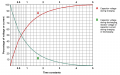
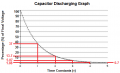
A capacitor is like an air tank. The pressure changes just like the voltage on a capacitor.
1764788193884.png
You are right a battery is a chemical reaction. In the case of a car battery, it makes 2 volts/cell. That voltage is (more or less) constant until the end.
1764788119926.png
 

Thread Starter

xox

Joined Sep 8, 2017
936
A capacitor is like an air tank. The pressure changes just like the voltage on a capacitor.
View attachment 359916
Ah yes, more of a 1/x curve than linear!

A battery does not behave like a capacitor. It is a chemical reactor that generates voltage based on the elements' electrode potential in the electrochemical series. The battery has internal resistance and that is why the voltage falls when a load is connected, as you have stated.
Right, I only compared it to a capacitor because they both store charges. But as you point they are obviously not strictly analogous.
 

wayneh

Joined Sep 9, 2010
18,085
Analogies to water are fraught with problems but this one is pretty good. A capacitor is like a tank that can be filled or emptied of water. The exit pressure (voltage) drops with the charge level. A battery is like that tank raised up on a platform. The voltage (pressure head) still drops with SoC but is more relatively constant until the water runs out. Stored chemical energy is what provides the lift.
 

MisterBill2

Joined Jan 23, 2018
27,159
The very simple correct explanation for the instant voltage drop when a battery delivers current is the internal resistance of the battery. The internal resistance is not separate, but rather intrinsic. It does vary with the battery chemistry, as well as the battery condition and the state of charge..
Note that the internal resistance drop is not the same as the discharge drop.
 

WBahn

Joined Mar 31, 2012
32,702
I just had an interesting conversation with the neighbor who was doing some minor electrical work on his vehicle. He was wondering why a voltage reading at the positive terminal drops when a battery is connected to a (resistive) load. I told him that the battery is sort of like a large capacitor connected in series with a resistor, and thus the load forms a voltage-divider with the battery's "internal resistor". Makes sense, he said, but then he raised the point that a capacitor discharges linearly whereas the battery discharge curve is generally not so much. To that I could only say that it was basically due to the fact that the chemistry of the battery is such that the charge throughout it is roughly uniform. It was a rather hand-wavy explanation, I admit, but I honestly couldn't think of a better way to describe what is really going on there.

Is there a more concise way to explain that (and moreover, was my capacitor-resistor analogy somewhat reasonable)?
I have a blog post that addresses the difference between a battery and a capacitor, but I don't know how readable it is given the travesty that the ZenForo blogs have become with regards to tex renderings.

https://forum.allaboutcircuits.com/ubs/a-battery-isnt-a-capacitor.588/

Here is a handwavy explanation for why the voltage drops as you draw current from a battery (i.e., where the internal resistance comes from).

When no current is being drawn, the internal battery chemistry reaches equilibrium after producing just enough charge separation to result in an electric potential across the plates that suppresses further chemical reaction.

When you draw charge off of the plates with an external load, the voltage HAS to drop in order for the potential across the plates to lessen such that the battery chemistry needed to produce more charge can pick up. The rate at which that happens is largely proportional to the difference between the potential that suppresses it completely and the actual difference under load. So, under load, a new equilibrium is reached in which the lower terminal voltage is sufficiently lower so as to allow the battery chemistry to just keep up with the production of charge to match the rate at which it is flowing out of the battery terminals.
 

Thread Starter

xox

Joined Sep 8, 2017
936
I have a blog post that addresses the difference between a battery and a capacitor, but I don't know how readable it is given the travesty that the ZenForo blogs have become with regards to tex renderings.

https://forum.allaboutcircuits.com/ubs/a-battery-isnt-a-capacitor.588/

Here is a handwavy explanation for why the voltage drops as you draw current from a battery (i.e., where the internal resistance comes from).

When no current is being drawn, the internal battery chemistry reaches equilibrium after producing just enough charge separation to result in an electric potential across the plates that suppresses further chemical reaction.

When you draw charge off of the plates with an external load, the voltage HAS to drop in order for the potential across the plates to lessen such that the battery chemistry needed to produce more charge can pick up. The rate at which that happens is largely proportional to the difference between the potential that suppresses it completely and the actual difference under load. So, under load, a new equilibrium is reached in which the lower terminal voltage is sufficiently lower so as to allow the battery chemistry to just keep up with the production of charge to match the rate at which it is flowing out of the battery terminals.
For being such a brief blog post, that was actually a pretty nice deep-dive into the topic. Several of the points raised were actually quite surprising too. (For example I had no idea that the capacitor equivalent to a battery would be so impractical!) Kudos.

On a side note, a lot of sites struggle with LaTex. I would recommend just converting the equations to images. Here are all 8 used in the article, in case you want to swap them out.

1.png

2.png

3.png

4.png

5.png

6.png

7.png

8.png

(BTW you have a minor typo in "fasted 74-series".)
 

crutschow

Joined Mar 14, 2008
38,316
The drop in battery voltage as it discharges would seem to be more than just an increase in internal resistance, since the drop with the state-of-charge occurs even for a high resistance load, such as the >1meg impedance of a typical digital multimeter.
This allows for an approximate estimate of the charge state of some types of batteries (lead-acid and alkaline for example) just from the open-circuit voltage.
 

rsjsouza

Joined Apr 21, 2014
424
The drop in battery voltage as it discharges would seem to be more than just an increase in internal resistance, since the drop with the state-of-charge occurs even for a high resistance load, such as the >1meg impedance of a typical digital multimeter.
This allows for an approximate estimate of the charge state of some types of batteries (lead-acid and alkaline for example) just from the open-circuit voltage.
In addition to the actual decrease in voltage of the core cell, there is a chemical effect that takes place at the junction between the cell at one of (or both) its leads, which creates a momentary potential barrier (similarly to a PN junction) that causes the voltage to drop even on smaller loads. This potential barrier recovers quite fast when a battery is new but it becomes thicker and slower to recover as the battery discharges over its lifetime. That is why in certain batteries you measure a momentary drop in voltage that slowly recovers if you leave the leads plugged.

A highly non-linear effect nonetheless, but such is the inherent characteristic of a portable chemical reactor. :)
 
Top