How do MELF resistors primarily dissipate heat? Are they better at dissipating heat than through-hole parts?

Thread Starter

ballsystemlord

Joined Nov 19, 2018
249
Hello,
I was wondering if MELF resistors primarily dissipate their heat into the PCB, the air, like through-hole parts do, or about 50% in both ways. I'm uncertain how hot they'd make my board compared to a through-hole or SMD part. It also occurred to me that they might be better at heat dissipation since the heat that they generated can be both conducted and convected away.

I tired looking this up, but multiple searches later, I'm still at a loss.

How do MELF resistors primarily dissipate heat? Are they better at dissipating heat than through-hole parts?

Thanks!
 

WBahn

Joined Mar 31, 2012
32,702
As with most things engineering, the best answer is, "It depends."

MELF resistors are generally considered comparable to equivalent through-hole components at dissipating heat, and both are considered better than chip resistors, all else being equal.

There is no way to give a reliable ratio, because the behavior is driven by a number of factors, including board layout, how much standoff a through-hole component is given, how much airflow over the board there is, etc.
 

Thread Starter

ballsystemlord

Joined Nov 19, 2018
249
<snip>
There is no way to give a reliable ratio, because the behavior is driven by a number of factors, including board layout, how much standoff a through-hole component is given, how much airflow over the board there is, etc.
Well, I'd be looking at either still air, which is a very normal scenario or a "standard airflow" scenario. But I'm uncertain if manufacturer's have such a thing. I got a lot of results for chip-SMD vs MELF resistors and I see one manufacturer uses ~25CFM for their "standard," which is conservative IMHO, but who knows what others use.

As for the stand-off of through-hole components from the board, normally they're either up tight against the board with about 2mm lead spacing on either side between the resistor and the pads, or they're 2-3mm above the board with a similarly increased length in lead spacing, or they're standing up, like vertically.

As for the board layout, yes, that's certainly very important, but again, for normal manufacturer testing, you use a recommended pad layout with 2oz copper on a 25mm^2 board from what I've read.

Granted, probably none of you are in the resistor manufacturing field for MELFs, but I'm trying to make life easy. I figure, if anyone knows of a white-paper, research article, blog post, or other spec, it's probably from a manufacturer.

Thanks!
 
Last edited:

drjohsmith

Joined Dec 13, 2021
1,549
I typically don't get answers when I try, but okay. I figured others would know, so I asked here.
lots depends upon how you make the board and mounting.
All manufactureses have info on thermal capabilities.
there are also standards, so that a given resistor type can be used from different manufactureres.

lots of info availible on line , esspecialy from tbe bigger manufactureres
 

Thread Starter

ballsystemlord

Joined Nov 19, 2018
249
As mentioned, I tried searching in a few different ways, but I could only find info on the thermal dissipation of SMD vs MELF resistors. So if you know where this info is, I'd appreciate a link.
 

ronsimpson

Joined Oct 7, 2019
4,645
I am looking at resistor data sheets. Not all but many show how they set the power rating. For example, they often say using this pad size on a single sided FR4 PCB with no other parts.
1774721443235.png
I found the resistor runs cooler with traces connected to the pads. And much cooler with wide traces. The resistor will run cooler with larger pads. Sometimes I make the solder mask opening the size required but make the copper area larger to get a little cooler resistor.

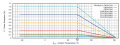
Often there is a graph like this. It shows you can use the part at 100% of its rating up to an air temp of 70C and then must be derated up to 150C. At 150C the part cannot take any more heat.
1774721573026.png
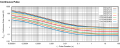
Here is another thing to think about. A 1W resistor can be take 10W for 2mS and 100W for 15uS.
1774721741205.png
If you want more information, we can talk for hours about little known thing in the data sheets.
 

Thread Starter

ballsystemlord

Joined Nov 19, 2018
249
So as not to repeate your search m which words did you Google on ??
"MELF vs. through-hole resistors"
And didn't get anything useful.

"MELF vs. SMD resistor thermal dissipation characteristics"
In an attempt to coax the search engine to show me how the MELF's dissipate heat. There was a lot of useful stuff but nothing about how the MELFs dissipate heat compared to the SMD resistors.
 

drjohsmith

Joined Dec 13, 2021
1,549
"MELF vs. through-hole resistors"
And didn't get anything useful.

"MELF vs. SMD resistor thermal dissipation characteristics"
In an attempt to coax the search engine to show me how the MELF's dissipate heat. There was a lot of useful stuff but nothing about how the MELFs dissipate heat compared to the SMD resistors.
try
melf datasheet
smd resistor datasheet
smd resistor layout guide
smd resistor power disipation
 

ronsimpson

Joined Oct 7, 2019
4,645
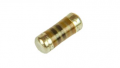
I don't see the big difference between a MELF resistor or a through hold pushed down on the PCB. Either way the heat must get into the air.
1774736870780.png
 

WBahn

Joined Mar 31, 2012
32,702
I don't see the big difference between a MELF resistor or a through hold pushed down on the PCB. Either way the heat must get into the air.
View attachment 365274
The MELF resistors have a stronger thermal path from the end cap to the circuit board pad, which makes it possible to suck heat into the PCB better, particular if the board is laid out with that intent. Through hole components have to feed heat through the thin lead, which limits how much heat you can pull out of the component that way, regardless of what is on the PCB.
 

Thread Starter

ballsystemlord

Joined Nov 19, 2018
249
try
melf datasheet
smd resistor datasheet
smd resistor layout guide
smd resistor power disipation
I'm assuming that you mean for me to read the datasheets and try and determine the thermal differences?
I already tried that. The ones I viewed showed a difference between the JA thermal resistance, but they didn't specify how the heat was transferred in terms of the amount to the PCB into the air. Hence my question of comparing them to through-hole parts, which, in opposition to SMD ones, transfer most of their heat into the air.
 

Thread Starter

ballsystemlord

Joined Nov 19, 2018
249
Hello,
Does this page and attached pdf help?
<snip link>
Bertus
Thanks Bertus, but that, like most other stuff I discovered, just goes over the advantages of MELF resistors over SMD resistors. I was interested in knowing how the majority of the heat is transferred. Like, into the PCB, like an SMB part, or into the air, like a through-hole part. I think that's an important property to know for designing PCBs using MELFs.
 

drjohsmith

Joined Dec 13, 2021
1,549
Thanks Bertus, but that, like most other stuff I discovered, just goes over the advantages of MELF resistors over SMD resistors. I was interested in knowing how the majority of the heat is transferred. Like, into the PCB, like an SMB part, or into the air, like a through-hole part. I think that's an important property to know for designing PCBs using MELFs.
The important property you ask
A. Always follow recommended manufacturers layout
B. Try not to dispute heat in resistors.
C. Always follow manufacturers power disipstion
D. If disipating power , over rate the resistor , so if you want to disipste 1w , use a 2 or 5 w resistor .

Generally , resistors are not used to disipate heat ,

Why do you want to use a resistor to dispate heat ?

You will note that resistors designed to disipate heat , say a 25w wire wound , has a metal case , and mounting lugs to connect to a heat sink.

The question your asking is strange in that people dont tend to use melfs to disipate heat.

What sort of value resistance and voltages are you looking at ?

Be aware also , resistors have a voltage limit ( in data sheets )
 

drjohsmith

Joined Dec 13, 2021
1,549
to be pedantic ..
these size resistors, be it smd or round things, can only disipate small amounts of heat, they are not power resistors.

1/8 or 1/4 watt resistors are what most resistors are, and these rearly ever actualy disipate even that amount of real power in circuits.

so power rating and disipation route is nominal.
smd in general disipate into board, as mostly pads, close contact to board ,
round things , disipate into board also, as small surface area, close to board so in air flow shaddow , and minimal b9ard contact .
 

Thread Starter

ballsystemlord

Joined Nov 19, 2018
249
bertus , That didn't answer my question, but there is a lot of good info in that study about SMD and MELFs, so thanks.

The important property you ask
A. Always follow recommended manufacturers layout
B. Try not to dispute heat in resistors.
C. Always follow manufacturers power dissipation
D. If dissipating power , over rate the resistor , so if you want to dissipate 1w , use a 2 or 5 w resistor .

Generally , resistors are not used to dissipate heat ,

Why do you want to use a resistor to dispute heat ?
<snip>
Umm, one normally dissipates power in the form of heat using a resistor. ;)

More seriously, I think you misunderstand me. I'm not trying to create a MELF space-heater for my winter cabin. I was more thinking about uses like in power supplies or voltage/current regulators. I was considering the advantages of different types of resistors. SMD, through-hole, and MELFs. I'm not trying to solve a particular PCB layout issue. My concern was more general in the sense that I'd like to be able to use the right tool for the job.

Thanks

PS: Worst case scenario is that I can buy some MELFs and some PCBs and compare them vs. through-hole resistors. I just thought that surly it would have been studied already.
 
Top